Native Plants

Plant Database
Search for native plants by scientific name, common name or family. If you are not sure what you are looking for, try the Combination Search or our Recommended Species lists.
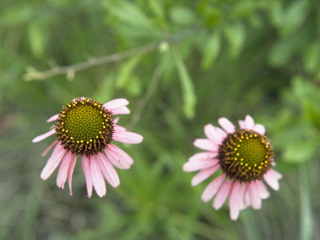
Flaigg, Lillian G.
Echinacea angustifolia
Echinacea angustifolia DC.
Black Samson, Black Samson Echinacea, Narrow-leaf Coneflower
Asteraceae (Aster Family)
Synonym(s):
USDA Symbol: ECAN2
USDA Native Status: L48 (N), CAN (N)
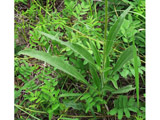
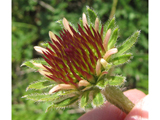
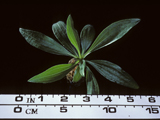
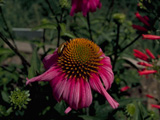
The many stout stems of this perennial are 18-24+ in. tall and rarely branched. Oblong leaves are covered with stiff hairs. The flower heads, borne singly atop the stems, have pinkish-lavender rays drooping from a dark, spiny, cone-shaped center.
Echinacea angustifolia tends to look poorly in its native habitat but often thrives in cultivation.

Plant Characteristics
Duration: PerennialHabit: Herb
Root Type: Tap
Size Notes: Up to about 28 inches tall, often shorter.
Fruit: Fruit is a cypsela (pl. cypselae). Though technically incorrect, the fruit is often referred to as an achene.
Bloom Information
Bloom Color: Pink , PurpleBloom Time: May , Jun , Jul
Distribution
USA: CO , DC , IA , KS , LA , MN , MO , MT , ND , NE , NM , OK , SD , TX , WYCanada: MB , SK
Native Distribution: W. MN to Sask. & MT, s. to TX & NM
Native Habitat: Woodlands' edge, Opening, Prairie, Plains, Meadows, Pastures, Savannas
Growing Conditions
Water Use: LowLight Requirement: Sun , Part Shade
Soil Moisture: Dry
Soil pH: Circumneutral (pH 6.8-7.2)
Soil Description: Clay Loam, Medium Loam, Sandy Loam, Clay, Sandy.
Conditions Comments: Narrow-leaf coneflower is a suitable addition to a prairie garden and attractive in flower arrangements. It tolerates well-drained clay-loam and high levels of soil alkalinity, and is more drought tolerant than E. pallida and E. purpurea. E. angustifolia tends to look poorly in its native habitat, but often thrives in cultivation.
Benefit
Use Medicinal: Vit. A, Vit. C, Vit. E, copper, iodine, iron, potassium, sulphur. Medicinal uses: Today Echinacea used to boot the immune system. It is believed to ward off colds and the flu. But at high doses, the effectiveness decreases. Recent studies show that Echinacea may have anti-inflammatory properties and be useful in a wide variety of areas. Native Americans used Echinacea to treat snakebites, burns, toothaches, colds, sore throat, headache, gonorrhea, mumps, tonsillitis, and smallpox (when mixed with puffball spores and skunk oil). Early settlers used it for almost every ailment. The juice from the plant can prevent burns. Root (chewed or in tea) used for snake bites, spider bites, cancers, toothaches, burns, hard-to-heal sores, and wounds, flu and colds. (Foster & Duke) Universal application for the bites and stings of all bugs; also snakebites, toothache, mumps; washed hands in decoction of plant in order for them to withstand heat; decoction of roots for snakebite and hydrophobia. (Weiner) Macerated root used for snakebite, stings and venomous bites, including hydrophobia. Ate root and green fruit when thirsty or perspiring and as painkiller for toothache, tonsillitus, stomachache and pain in bowels. Macerated root used as local anesthetic. Root used as cough medicine. Colds and sore throat treated by chewing piece of root and letting juice run down the throat. Tea made of leaves and root as a remedy for sore mouth and gums. Tea used for rheumatism, arthritus, mumps and measles. (Kindscher)Conspicuous Flowers: yes
Attracts: Butterflies
Nectar Source: yes
Deer Resistant: No
Value to Beneficial Insects
Special Value to Native BeesThis information was provided by the Pollinator Program at The Xerces Society for Invertebrate Conservation.
Propagation
Propagation Material: SeedsCommercially Avail: yes
Maintenance: Remove spent blossoms, Prevent complete soil dryness, Maintain mulch layer, Fertilize in spring with rose food
Find Seed or Plants
Order seed of this species from Native American Seed and help support the Wildflower Center.
Find seed sources for this species at the Native Seed Network.
View propagation protocol from Native Plants Network.
Mr. Smarty Plants says
Wildlife uses of wildflowers in Central Texas
May 01, 2006
How are wildflowers in Central Texas used by wildlife?
view the full question and answer
From the National Organizations Directory
According to the species list provided by Affiliate Organizations, this plant is on display at the following locations:Lady Bird Johnson Wildflower Center - Austin, TX
Texas Parks and Wildlife Department - Austin, TX
Native Seed Network - Corvallis, OR
NPSOT - Williamson County Chapter - Georgetown, TX
Bibliography
Bibref 1207 - Earth Medicine, Earth Food (1990) Michael A. WeinerBibref 610 - Edible wild plants of the prairie : an ethnobotanical guide (1987) Kindscher, K.
Bibref 417 - Field Guide to Medicinal Plants and Herbs of Eastern and Central North America (2000) Foster, S. & J. A. Duke
Bibref 946 - Gardening with Prairie Plants: How to Create Beautiful Native Landscapes (2002) Wasowski, Sally
Bibref 355 - Landscaping with Native Plants of Texas and the Southwest (1991) Miller, G. O.
Bibref 318 - Native Texas Plants: Landscaping Region by Region (2002) Wasowski, S. & A. Wasowski
Bibref 281 - Shinners & Mahler's Illustrated Flora of North Central Texas (1999) Diggs, G. M.; B. L. Lipscomb; B. O'Kennon; W. F...
Bibref 248 - Texas Wildflowers: A Field Guide (1984) Loughmiller, C. & L. Loughmiller
Bibref 291 - Texas Wildscapes: Gardening for Wildlife (1999) Damude, N. & K.C. Bender
Bibref 328 - Wildflowers of Texas (2003) Ajilvsgi, Geyata.
Bibref 286 - Wildflowers of the Texas Hill Country (1989) Enquist, M.
Search More Titles in Bibliography
Web Reference
Webref 38 - Flora of North America (2019) Missouri Botanical Garden, St. Louis, MO & Harvard University Herbaria, Cambridge, MA.From the Archive
Wildflower Newsletter 1985 VOL. 2, NO.2 - Guide to Black-Eyed Susan, Parkways, Wildflowers for the East, Arboretum Mall to...Wildflower Newsletter 1990 VOL. 7, NO.4 - Research Update, Wild-Collecting Endangers Natives, Director's Report, Maryland ...
Wildflower Newsletter 1993 VOL. 10, NO.3 - Miss Helen Hayes Memorial, Director's Report, Monarda Medicinal Mints of Distinc...
Additional resources
USDA: Find Echinacea angustifolia in USDA PlantsFNA: Find Echinacea angustifolia in the Flora of North America (if available)
Google: Search Google for Echinacea angustifolia
Metadata
Record Modified: 2022-12-26Research By: TWC Staff, TMH