Native Plants

Plant Database
Search for native plants by scientific name, common name or family. If you are not sure what you are looking for, try the Combination Search or our Recommended Species lists.
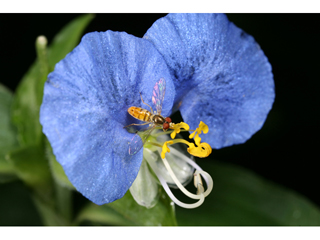
Fannon, Carolyn
Commelina erecta
Commelina erecta L.
Dayflower, Widow's Tears, White-mouth Dayflower, Whitemouth Dayflower
Commelinaceae (Spiderwort Family)
Synonym(s):
USDA Symbol: COER
USDA Native Status: L48 (N), PR (N), VI (N)
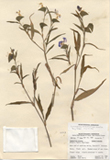
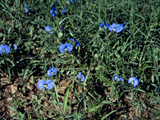
The soft, jointed stems of this perennial grow upright only if supported by other plants. Usually they lie on the ground and grow up to 3 ft. long. The ephemeral flowers, about 1 in. across, have two larger, showy, blue petals and one much smaller white petal. Flowers with 2 large, ear-like, blue petals and one smaller petal bloom in small clusters, in a bract, at the top of several erect branches. They only bloom for a day, but there are several buds on a plant that open 3-4 days apart. The principal leaves are linear to somewhat lance-shaped.
This is a highly variable species. The Spanish name means "herb of the (cooked) chicken."
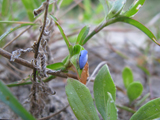
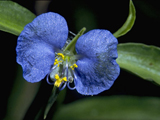
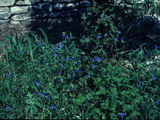
Plant Characteristics
Duration: PerennialHabit: Herb
Leaf Arrangement: Alternate
Leaf Complexity: Simple
Leaf Venation: Parallel
Leaf Margin: Entire
Fruit Type: Capsule
Size Notes: Stems weakly erect to ascending to decumbent, up to about 3 feet long.
Bloom Information
Bloom Color: BlueBloom Time: May , Jun , Jul , Aug , Sep , Oct
Distribution
USA: AL , AR , AZ , CO , DC , DE , FL , GA , IA , IL , IN , KS , KY , LA , MD , MI , MN , MO , MS , NC , NE , NJ , NM , NY , OK , PA , RI , SC , SD , TN , TX , VA , WI , WV , WYNative Distribution: FL to NM, n. to NJ, OH, IL & s. SD
Native Habitat: Open pinelands; dry scrub & woods
Growing Conditions
Light Requirement: Part ShadeSoil Moisture: Dry
Soil Description: Dry, sandy soils.
Conditions Comments: Commelina erecta can be grown from seed or transplanted tubers. Its flower is a beautiful medium blue, most frequently seen in spring or fall but occasionally occuring in July and August. It is well suited to naturalized mass plantings in meadows or by wooded areas; beware that the plant can become invasive. This is a variable species, particularly in regards to the size and shape of the leaves. This variation has led to segregation as species or varieties by some authorities.
Benefit
Conspicuous Flowers: yesAttracts: Birds
Deer Resistant: No
Propagation
Propagation Material: TubersCommercially Avail: yes
National Wetland Indicator Status
| Region: | AGCP | AK | AW | CB | EMP | GP | HI | MW | NCNE | WMVE |
| Status: | FACU | FACU | FAC | FAC | FACU | FAC | UPL | FACU |
From the National Organizations Directory
According to the species list provided by Affiliate Organizations, this plant is on display at the following locations:Fredericksburg Nature Center - Fredericksburg, TX
Lady Bird Johnson Wildflower Center - Austin, TX
Pineywoods Native Plant Center - Nacogdoches, TX
Sibley Nature Center - Midland, TX
Brackenridge Field Laboratory - Austin, TX
Patsy Glenn Refuge, c/o Wimberley Birding Society - Wimberley, TX
Stengl Biological Research Station - Smithville, TX
Herbarium Specimen(s)
NPSOT 0021 Collected July 10, 1990 in Bexar County by Judith C. BerryNPSOT 0225 Collected May 27, 1992 in Comal County by Mary Beth White
NPSOT 0020 Collected July 10, 1990 in Bexar County by Judith C. Berry
Wildflower Center Seed Bank
LBJWC-661 Collected 2008-07-02 in Travis County by Lady Bird Johnson Wildflower CenterBibliography
Bibref 318 - Native Texas Plants: Landscaping Region by Region (2002) Wasowski, S. & A. WasowskiBibref 281 - Shinners & Mahler's Illustrated Flora of North Central Texas (1999) Diggs, G. M.; B. L. Lipscomb; B. O'Kennon; W. F...
Bibref 248 - Texas Wildflowers: A Field Guide (1984) Loughmiller, C. & L. Loughmiller
Bibref 328 - Wildflowers of Texas (2003) Ajilvsgi, Geyata.
Bibref 286 - Wildflowers of the Texas Hill Country (1989) Enquist, M.
Search More Titles in Bibliography
Web Reference
Webref 38 - Flora of North America (2019) Missouri Botanical Garden, St. Louis, MO & Harvard University Herbaria, Cambridge, MA.Webref 23 - Southwest Environmental Information Network (2009) SEINet - Arizona Chapter
Additional resources
USDA: Find Commelina erecta in USDA PlantsFNA: Find Commelina erecta in the Flora of North America (if available)
Google: Search Google for Commelina erecta
Metadata
Record Modified: 2023-02-01Research By: NPC, GDB