Native Plants

Plant Database
Search for native plants by scientific name, common name or family. If you are not sure what you are looking for, try the Combination Search or our Recommended Species lists.
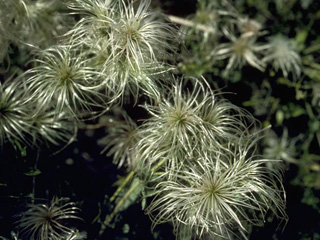
Kline, Kimberly
Clematis drummondii
Clematis drummondii Torr. & A. Gray
Old Man's Beard, Drummond's Clematis, Texas Virgin's Bower, Goat's Beard
Ranunculaceae (Buttercup Family)
Synonym(s):
USDA Symbol: CLDR
USDA Native Status: L48 (N)
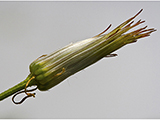
This is a climbing vine that covers fences and shrubs. Leaves are opposite and compound, with 5-7 leaflets 1/2-1 inch long, coarsely cut, sometimes toothed. The 4 petal-like sepals are light greenish-yellow, almost white, narrow and thin, with margins slightly crinkled, 1/2-1 inch long. There are no petals. The stamens are quite conspicuous. When the seeds mature, the female vine is covered with great masses of silky, feathery plumes, 2-4 inches long, which grow out from the seed cover. Male and female flowers on different plants.
The species name of this plant is named for Thomas Drummond, (ca. 1790-1835), naturalist, born in Scotland, around 1790. In 1830 he made a trip to America to collect specimens from the western and southern United States. In March, 1833, he arrived at Velasco, Texas to begin his collecting work in that area. He spent twenty-one months working the area between Galveston Island and the Edwards Plateau, especially along the Brazos, Colorado, and Guadalupe rivers. His collections were the first made in Texas that were extensively distributed among the museums and scientific institutions of the world. He collected 750 species of plants and 150 specimens of birds. Drummond had hoped to make a complete botanical survey of Texas, but he died in Havana, Cuba, in 1835, while making a collecting tour of that island.

Plant Characteristics
Duration: PerennialHabit: Vine
Leaf Retention: Deciduous
Leaf Arrangement: Opposite
Leaf Complexity: Pinnate
Breeding System: Flowers Unisexual , Dioecious
Fruit Type: Achene
Size Notes: Stems scrambling to climbing, up to about 15 feet long, sometimes longer.
Bloom Information
Bloom Color: WhiteBloom Time: Apr , May , Jun , Jul , Aug , Sep
Bloom Notes: Petals absent. Sepals petaloid.
Distribution
USA: AZ , CO , NM , OK , TXNative Distribution: Clematis drummondii grows in dry soil along roadsides and in rocky canyons. It climbs by twining over weeds, shrubs, and fences. It is found in central, south, and west Texas.
Native Habitat: Thickets, Canyons Fence rows
Growing Conditions
Water Use: LowLight Requirement: Sun , Part Shade
Soil Moisture: Dry , Moist
Cold Tolerant: yes
Heat Tolerant: yes
Soil Description: Sandy, Sandy Loam, Medium Loam, Clay Loam, Clay, Limestone-based
Conditions Comments: Clematis drummondii can be grown from seed easily, propagated by cuttings which will root from nodes with less success, or transplanted from the field in winter. The plant is hardy and drought tolerant. Notable ornamental features include delicate foliage, long blooming attractive flowers, and interesting feathery seed clusters.
Benefit
Use Ornamental: Twines on fences & other plants, Attractive, Fruits ornamentalUse Wildlife: Cover, Seeds-granivorous birds, Nesting site.
Use Medicinal: Teas useful for headaches and migraine.
Conspicuous Flowers: yes
Interesting Foliage: yes
Attracts: Butterflies
Larval Host: Fatal metalmark butterfly.
Deer Resistant: Minimal
Butterflies and Moths of North America (BAMONA)
|
Fatal Metalmark (Calephelis nemesis) 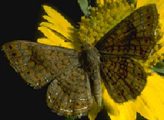 Larval Host |
From the National Organizations Directory
According to the species list provided by Affiliate Organizations, this plant is on display at the following locations:Lady Bird Johnson Wildflower Center - Austin, TX
Tohono Chul Park, Inc. - Tucson, AZ
Brackenridge Field Laboratory - Austin, TX
Nueces River Authority - Uvalde, TX
Texas Parks and Wildlife Department - Austin, TX
Texas Master Naturalists - Lost Pines Chapter - Bastrop, TX
National Butterfly Center - Mission, TX
Jacob's Well Natural Area - Wimberley, TX
NPSOT - Williamson County Chapter - Georgetown, TX
Herbarium Specimen(s)
NPSOT 0019 Collected June 30, 1990 in Bexar County by Judith C. BerryNPSOT 0475 Collected Jul 30, 1993 in Atascosa County by Louise Morrell
NPSOT 0460 Collected Jun 29, 1987 in Bexar County by Harry Cliffe
NPSOT 0461 Collected Jun 28, 1987 in Bexar County by Harry Cliffe
NPSOT 0247 Collected June 23, 1992 in Comal County by Mary Beth White
NPSOT 0155 Collected May 17, 1991 in Bexar County by Lottie Millsaps
NPSOT 0113 Collected June 1, 1991 in Bexar County by Lottie Millsaps
Wildflower Center Seed Bank
LBJWC-627 Collected 2007-11-01 in Mason County by Lady Bird Johnson Wildflower CenterBibliography
Bibref 355 - Landscaping with Native Plants of Texas and the Southwest (1991) Miller, G. O.Bibref 281 - Shinners & Mahler's Illustrated Flora of North Central Texas (1999) Diggs, G. M.; B. L. Lipscomb; B. O'Kennon; W. F...
Bibref 248 - Texas Wildflowers: A Field Guide (1984) Loughmiller, C. & L. Loughmiller
Bibref 291 - Texas Wildscapes: Gardening for Wildlife (1999) Damude, N. & K.C. Bender
Bibref 328 - Wildflowers of Texas (2003) Ajilvsgi, Geyata.
Bibref 286 - Wildflowers of the Texas Hill Country (1989) Enquist, M.
Search More Titles in Bibliography
Web Reference
Webref 38 - Flora of North America (2019) Missouri Botanical Garden, St. Louis, MO & Harvard University Herbaria, Cambridge, MA.Webref 23 - Southwest Environmental Information Network (2009) SEINet - Arizona Chapter
Additional resources
USDA: Find Clematis drummondii in USDA PlantsFNA: Find Clematis drummondii in the Flora of North America (if available)
Google: Search Google for Clematis drummondii
Metadata
Record Modified: 2022-12-06Research By: NPC