Native Plants

Plant Database
Search for native plants by scientific name, common name or family. If you are not sure what you are looking for, try the Combination Search or our Recommended Species lists.
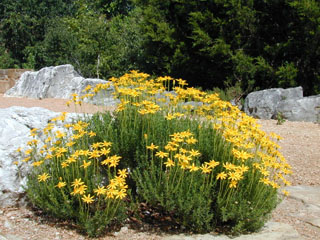
Marcus, Joseph A.
Chrysactinia mexicana
Chrysactinia mexicana A. Gray
Damianita
Asteraceae (Aster Family)
Synonym(s):
USDA Symbol: CHME3
USDA Native Status: L48 (N)
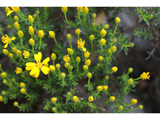
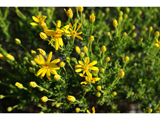
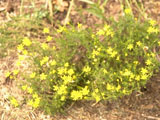
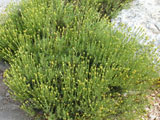
Damianita is a 1-2 ft., bushy, low-growing, aromatic, evergreen shrub with stems rising in a mounded or bouquet form from a woody base. Leaves crowded on the twigs, dark green, up to 3/8 inch long by 1/16 inch or less wide, covered with green to black glandular dots visible under a 10x hand lens. This is a very leafy plant - the narrow, fragrant foliage everywhere except on the 1-3 in. long peduncles. These extend from branch tips and bear a solitary, yellow, composite flower. The flower heads are golden yellow, 1 inch across, commonly with 8 narrow ray flowers, on slender stems at the end of the branches. Fruit very small, 1/8 inch long and with a crown of short bristles visible under a 10x hand lens.
Technically a shrub; used like a flower. Very drought-tolerant.
Plant Characteristics
Duration: PerennialHabit: Subshrub , Shrub
Leaf Retention: Evergreen
Size Notes: Up to about 2 feet tall.
Fruit: Fruit is a cypsela (pl. cypselae). Though technically incorrect, the fruit is often referred to as an achene.
Bloom Information
Bloom Color: YellowBloom Time: Apr , May , Jun , Jul , Aug , Sep
Distribution
USA: NM , TXNative Distribution: Edwards Plateau & Trans-Pecos in TX, NM & adjacent Mex.
Native Habitat: Found on caliche and limestone outcrops in the southern half of the Hill Country. Well-drained sand, loam, caliche or limestone. Limestone sites in desert plains & mountains
Growing Conditions
Water Use: LowLight Requirement: Sun
Soil Moisture: Dry
Drought Tolerance: High
Cold Tolerant: yes
Soil Description: Igneous, Limestone-based, Sandy, Sandy Loam, Medium Loam, Clay Loam, Clay, Caliche type.
Conditions Comments: Significant drought hardiness and wonderfully aromatic foliage are two features damianita has going for it. Mainly it blooms in spring, then on and off again through summer. Older plants may take on a twisted, gnarled appearance. Technically a shrub; used like a flower. Creates a vivid, yellow carpet when massed. Excellent border plant for flower bed or a ground cover for hillsides or hot exposed areas. Prune lightly after bloom periods to shape plant. Requires excellent drainage.
Benefit
Use Ornamental: Creates a vivid, yellow carpet when massed. Excellent border plant for flower bed or a ground cover for hillsides or hot exposed areas. Showy, Aromatic, AttractiveUse Wildlife: Cover, Nesting site, Nectar-insects
Conspicuous Flowers: yes
Fragrant Flowers: yes
Fragrant Foliage: yes
Deer Resistant: High
Propagation
Description: Sow seed in spring, or take softwood cuttings in summer.Seed Collection: Collect the dry flower heads after the blooming periods and store in paper bags or sealed containers in cool, dry place until spring planting.
Seed Treatment: Sow seed as early as possible, especially in fall.
Commercially Avail: yes
Maintenance: To keep damianita more compact, remove the woody stems from underneath and deadhead or "tip" the tops. Tolerates poor soil.
Mr. Smarty Plants says
Small shrub to plant in Austin Texas
March 11, 2009
Hi..
I live in Southwest Austin and I am looking for a shrub that I can plant against the back of my house, which faces the north. I want something native, fairly low maintenance and not too large,...
view the full question and answer
Deer resistant, sun tolerant plants for landscaping
April 19, 2007
I live in Driftwood and am looking for flowering, deer-resistant plants for the northern side of my house; however the house turn just enough to the west that the flowerbed receives about 3 hours of a...
view the full question and answer
From the National Organizations Directory
According to the species list provided by Affiliate Organizations, this plant is on display at the following locations:Lady Bird Johnson Wildflower Center - Austin, TX
Texas Discovery Gardens - Dallas, TX
Sibley Nature Center - Midland, TX
NPSOT - Native Plant Society of Texas - Fredericksburg, TX
NPSOT - Fredericksburg Chapter - Fredericksburg, TX
NPSOT - Austin Chapter - Austin, TX
NPSOT - Williamson County Chapter - Georgetown, TX
Wildflower Center Seed Bank
LBJWC-643 Collected 2008-05-18 in Travis County by Lady Bird Johnson Wildflower CenterBibliography
Bibref 355 - Landscaping with Native Plants of Texas and the Southwest (1991) Miller, G. O.Bibref 354 - Native & Naturalized Woody Plants of Austin & the Hill Country (1981) Lynch, D.
Bibref 995 - Native Landscaping from El Paso to L.A. (2000) Wasowski, S. and A. Wasowski
Bibref 318 - Native Texas Plants: Landscaping Region by Region (2002) Wasowski, S. & A. Wasowski
Bibref 248 - Texas Wildflowers: A Field Guide (1984) Loughmiller, C. & L. Loughmiller
Bibref 291 - Texas Wildscapes: Gardening for Wildlife (1999) Damude, N. & K.C. Bender
Bibref 286 - Wildflowers of the Texas Hill Country (1989) Enquist, M.
Search More Titles in Bibliography
Additional resources
USDA: Find Chrysactinia mexicana in USDA PlantsFNA: Find Chrysactinia mexicana in the Flora of North America (if available)
Google: Search Google for Chrysactinia mexicana
Metadata
Record Modified: 2011-03-23Research By: TWC Staff