Native Plants

Plant Database
Search for native plants by scientific name, common name or family. If you are not sure what you are looking for, try the Combination Search or our Recommended Species lists.
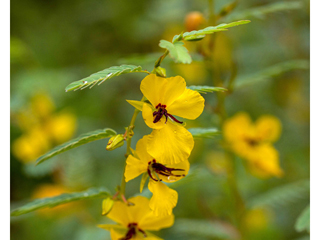
Holmes, James Garland
Chamaecrista fasciculata
Chamaecrista fasciculata (Michx.) Greene
Partridge Pea, Sleepingplant, Sensitive Plant
Fabaceae (Pea Family)
Synonym(s):
USDA Symbol: CHFA2
USDA Native Status: L48 (N)
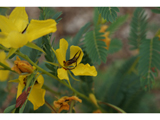
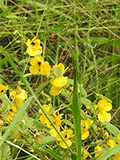
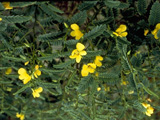
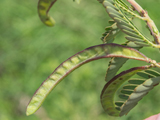
Sleepingplant or partridge-pea is a slender-stemmed, 1-3 ft. annual with pinnately-compound leaves bearing many small, yellow-green leaflets which fold together when touched. Large, showy, yellow flowers arise from leaf axils. Each flower is marked with red and is followed by a narrow pod.
This wildflower provides bright summer color, and the flowers attract bees and butterflies. Seed pods are eaten by gamebirds and songbirds, and the plant provides excellent cover for gamebirds and browse for deer. Leaves collapse when touched, giving rise to the common name Sensitive-plant. Like other members of the pea family, Partridge-pea requires the presense of microorganisms that inhabit nodules on the plant's root system and produce nitrogen compounds necessary for the plant's survival.

Plant Characteristics
Duration: AnnualHabit: Herb
Leaf Retention: Deciduous
Leaf Arrangement: Alternate
Fruit Type: Legume
Size Notes: Up to about 3 feet tall.
Leaf: Green
Flower: Flowers 1/2 inch
Bloom Information
Bloom Color: YellowBloom Time: Jun , Jul , Aug , Sep , Oct
Distribution
USA: AL , AR , CT , DC , DE , FL , GA , IA , IL , IN , KS , KY , LA , MA , MD , MI , MN , MO , MS , NC , NE , NJ , NM , NY , OH , OK , PA , RI , SC , SD , TN , TX , VA , WI , WVNative Distribution: MA to FL Panhandle, w. to MN, e. NE, OK & extreme e. TX
Native Habitat: Open woodlands, Prairie, Plains, Meadows, Pastures, Savannas
Growing Conditions
Water Use: MediumLight Requirement: Sun , Part Shade
Soil Moisture: Dry , Moist
Soil Description: Dry, deep, sandy, well-drained soils. Clay, Clay Loam, Medium Loam, Sandy Loam, Sandy, Acid-based, Calcareous
Benefit
Use Ornamental: Showy, Color, Wildflower meadow, BorderUse Wildlife: Nectar-Bees, Nectar-Butterflies, Seeds-Granivorous birds, Nectar-ants.
Conspicuous Flowers: yes
Attracts: Birds , Butterflies
Larval Host: Cloudless giant sulphur, Orange sulphur, Sleepy orange butterflies.
Nectar Source: yes
Deer Resistant: No
Value to Beneficial Insects
Special Value to Native BeesSpecial Value to Bumble Bees
Supports Conservation Biological Control
This information was provided by the Pollinator Program at The Xerces Society for Invertebrate Conservation.
Butterflies and Moths of North America (BAMONA)
|
Orange Sulphur (Colias eurytheme) 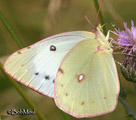 Larval Host |
Sleepy Orange (Abaeis nicippe) 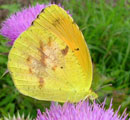 Larval Host |
Propagation
Propagation Material: SeedsDescription: Propagate by seed.
Commercially Avail: yes
Find Seed or Plants
Order seed of this species from Native American Seed and help support the Wildflower Center.
View propagation protocol from Native Plants Network.
National Wetland Indicator Status
| Region: | AGCP | AK | AW | CB | EMP | GP | HI | MW | NCNE | WMVE |
| Status: | FACU | FACU | FACU | FACU | FACU | FACU |
From the National Organizations Directory
According to the species list provided by Affiliate Organizations, this plant is on display at the following locations:Crosby Arboretum - Picayune, MS
Stengl Biological Research Station - Smithville, TX
Texas Parks and Wildlife Department - Austin, TX
Wellspring Organic Farm and Education Center - West Bend, WI
Wildflower Center Seed Bank
LBJWC-0149 Collected 2007-09-04 in County by Lady Bird Johnson Wildflower CenterBibliography
Bibref 946 - Gardening with Prairie Plants: How to Create Beautiful Native Landscapes (2002) Wasowski, SallyBibref 318 - Native Texas Plants: Landscaping Region by Region (2002) Wasowski, S. & A. Wasowski
Bibref 291 - Texas Wildscapes: Gardening for Wildlife (1999) Damude, N. & K.C. Bender
Bibref 1294 - The Midwestern Native Garden: Native Alternatives to Nonnative Flowers and Plants An Illustrated Guide (2011) Adelman, Charlotte and Schwartz, Bernard L.
Search More Titles in Bibliography
Research Literature
Reslit 482 - Population differentiation in an annual legume: Local adaptation (2000) L. F. Galloway and C. B. FensterReslit 483 - Nuclear and cytoplasmic contributions to intraspecific divergence in an annual legume (2001) L. F. Galloway and C. B. Fenster
Reslit 481 - The effect of nuclear and cytoplasmic genes on fitness and local adaptation in an annual legume, Chamaecrista fasciculata (1999) L. F. Galloway and C. B. Fenster
Reslit 473 - Establishing vegetation on migrating inland sand dunes in Texas (2006) T. E. Fulbright, J. A. Ortega-Santos, A. Lozano-Ca...
Reslit 439 - Quantifying gene flow from spatial genetic structure data in a metapopulation of Chamaecrista fasciculata (Leguminosae) (2003) C. B. Fenster, X. Vekemans and O. J. Hardy
Reslit 436 - Inbreeding and outbreeding depression in natural populations of Chamaecrista fasciculata (Fabaceae) (2000) C. B. Fenster and L. F. Galloway
Reslit 437 - Population differentiation in an annual legume: Genetic architecture (2000) C. B. Fenster and L. F. Galloway
Reslit 421 - Evolutionary potential of Chamaecrista fasciculata in relation to climate change. II. Genetic architecture of three populations reciprocally planted along an environmental gradient in the great plains (2004) J. R. Etterson
Reslit 420 - Evolutionary potential of Chamaecrista fasciculata in relation to climate change. 1. Clinal patterns of selection along an environmental gradient in the great plains (2004) J. R. Etterson
Reslit 405 - Intraspecific hybridization and the recovery of fitness in the native legume Chamaecrista fasciculata (2006) D. L. Erickson and C. B. Fenster
This information was provided by the Florida WIldflower Foundation.
Search More Titles in Research Literature
Additional resources
USDA: Find Chamaecrista fasciculata in USDA PlantsFNA: Find Chamaecrista fasciculata in the Flora of North America (if available)
Google: Search Google for Chamaecrista fasciculata
Metadata
Record Modified: 2017-11-09Research By: TWC Staff