Native Plants

Plant Database
Search for native plants by scientific name, common name or family. If you are not sure what you are looking for, try the Combination Search or our Recommended Species lists.
Loughmiller, Campbell and Lynn
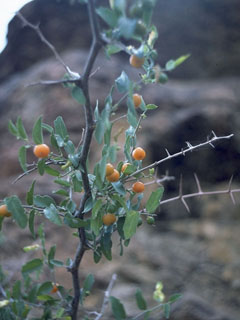
Celtis ehrenbergiana
Celtis ehrenbergiana (Klotzsch) Liebm.
Desert Hackberry, Spiny Hackberry, Shiny Hackberry, Granjeno, Huasteco
Ulmaceae (Elm Family)
Synonym(s): Celtis pallida, Celtis spinosa var. pallida, Celtis tala var. pallida, Momisia pallida
USDA Symbol: CEEH
USDA Native Status: L48 (N)
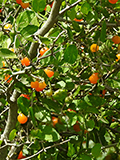
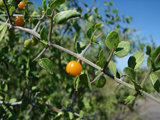
One of the few shrubs in the Celtis genus, this deciduous plant rarely reaches 10 ft. in height, but can grow taller. Its numerous spiny branches are whitish gray. The bark is smooth and gray. Leaves are small, roundish, and somewhat rough. Clusters of small, fairly inconspicuous, white flowers are followed by shiny red, orange and yellow fruit ripening in fall but persisting long after leaf-fall.
The species name "pallida" can be attributed to the paleness of the branches.


Plant Characteristics
Duration: PerennialHabit: Shrub
Leaf Retention: Deciduous , Evergreen
Leaf Complexity: Simple
Inflorescence: Axillary
Fruit Type: Drupe
Size Notes: Up to almost 20 feet tall, often much shorter.
Leaf: Green
Fruit: Orange
Bloom Information
Bloom Color: White , Yellow , GreenBloom Time: Feb , Mar , Apr , May
Distribution
USA: AZ , FL , NM , TXNative Distribution: W. TX to AZ & n. Mex.
Native Habitat: Mesas; foothills; thickets
Growing Conditions
Water Use: LowLight Requirement: Sun , Part Shade
Soil Moisture: Dry
CaCO3 Tolerance: High
Soil Description: Drier, rocky soils. Sandy, Sandy Loam Medium Loam Clay Loam, Clay.
Conditions Comments: Good erosion control.
Benefit
Use Ornamental: AttractiveUse Wildlife: Valuable bird and honey plant. The dense growth makes excellent cover for Gambel's quail and other birds. Nectar-insects, bees, butterflies, moths. Fruit-mammals, birds. Celtis ehrenbergiana is the host plant source for the occasional population explosions of American Snout Butterflies. During summer releafing at the end of extended droughts, adult American Snout populations can number in the billions in South Texas.
Attracts: Birds , Butterflies
Larval Host: American Snout butterfly
Butterflies and Moths of North America (BAMONA)
|
American Snout Butterfly (Libytheana carinenta) 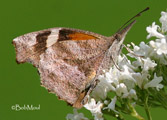 Larval Host |
Mr. Smarty Plants says
Edible plants native to Austin, TX
August 05, 2009
Hello,
I am a chef from Buenos Aires Argentina visiting Austin, Texas and would like to learn about native, edible plants in the region.
Please let me know if there are any native, edible plants...
view the full question and answer
From the National Organizations Directory
According to the species list provided by Affiliate Organizations, this plant is on display at the following locations:Texas Parks and Wildlife Department - Austin, TX
National Butterfly Center - Mission, TX
Wildflower Center Seed Bank
LBJWC-1059 Collected 2007-05-23 in Cameron County by Lady Bird Johnson Wildflower CenterBibliography
Bibref 355 - Landscaping with Native Plants of Texas and the Southwest (1991) Miller, G. O.Bibref 995 - Native Landscaping from El Paso to L.A. (2000) Wasowski, S. and A. Wasowski
Bibref 291 - Texas Wildscapes: Gardening for Wildlife (1999) Damude, N. & K.C. Bender
Bibref 297 - Trees of Central Texas (1984) Vines, Robert A.
Search More Titles in Bibliography
Web Reference
Webref 23 - Southwest Environmental Information Network (2009) SEINet - Arizona ChapterAdditional resources
USDA: Find Celtis ehrenbergiana in USDA PlantsFNA: Find Celtis ehrenbergiana in the Flora of North America (if available)
Google: Search Google for Celtis ehrenbergiana
Metadata
Record Modified: 2022-10-17Research By: TWC Staff