Native Plants

Plant Database
Search for native plants by scientific name, common name or family. If you are not sure what you are looking for, try the Combination Search or our Recommended Species lists.
Page, Lee
Bouteloua gracilis
Bouteloua gracilis (Willd. ex Kunth) Lag. ex Griffiths
Blue Grama
Poaceae (Grass Family)
Synonym(s): Bouteloua gracilis var. stricta, Bouteloua oligostachya, Chondrosum gracile, Chondrosum oligostachyum
USDA Symbol: BOGR2
USDA Native Status: L48 (N), CAN (N)
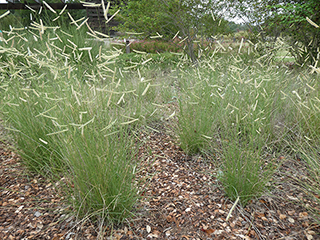
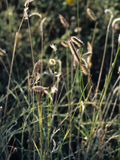
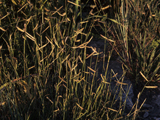
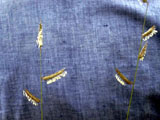
Only 12-14 in. in full flower, this is among the shortest of the native ornamental grasses. It is fine-leaved and produces blue-green seedheads which are suspended horizontally like tiny brushes from the tip of each stem. The plant turns tan when dormant. Blue grama grows in bunches in the south, and as a sod-former in the north and at high elevations. It is a perennial.
This is an important, drought-resistant, short grass in the mixed prairies and throughout the Great Plains and the Southwest. It can be confused with Hairy Grama Grass (B. hirsuta), which is distinguished by a sharp point extending beyond the florets. A somewhat similar but shorter species, Buffalograss (B. dactyloides), is usually less than 6 inches (15 cm) high and is typical of dry, short-grass plains. Blue grama is commonly planted as a turfgrass mixed with Buffalograss. Great also for planting in a wildflower meadow and grows easily from seed. One of the most important forage grasses in native ranges.


Plant Characteristics
Duration: PerennialHabit: Grass/Grass-like
Root Type: Fibrous
Leaf Retention: Deciduous
Leaf Arrangement: Alternate
Leaf Complexity: Simple
Leaf Shape: Linear
Leaf Venation: Parallel
Inflorescence: Spike
Fruit Type: Caryopsis
Size Notes: Foliage normally no more than 4 inches high, seedheads 1 to 2 feet.
Leaf: Gray-Green
Fruit: Bluish green
Bloom Information
Bloom Color: YellowBloom Time: Jul , Aug , Sep , Oct
Distribution
USA: AZ , CA , CO , CT , IA , ID , IL , KS , MA , ME , MI , MN , MO , MT , ND , NE , NM , NV , NY , OH , OK , SC , SD , TX , UT , WI , WYCanada: AB , MB , ON , SK
Native Distribution: Western North American from southern Canada to southern Mexico. Western Ontario to Alberta, south through Illinois to western Missouri, Texas, and southern California, through much of Mexico.
Native Habitat: Dry prairies; plains. A dominant grass in dry shortgrass prairies. An understory grass in moister, mixed prairies.
Growing Conditions
Water Use: Low , MediumLight Requirement: Sun
Soil Moisture: Dry
CaCO3 Tolerance: Medium
Drought Tolerance: High
Cold Tolerant: yes
Heat Tolerant: yes
Soil Description: Well-drained, low organic content, gravelly soils or sandy loams, clays. Calcareous or granitic.
Conditions Comments: The most drought-tolerant native turf grass, more so than Buffalograss. Can survive with as little as 7 inches of rain annually. The drier it is, the less likely it will be to form a solid mat by rhizomes; it will stay in separate clumps. For this reason, it is often mixed with Buffalograss and/or wildflowers for a solid cover. The taller you let it grow, the less water it will need, because its roots will be shaded.
Benefit
Use Ornamental: Shortgrass meadow, accent, perennial garden, turfUse Wildlife: Graze, Seeds-granivorous birds
Conspicuous Flowers: yes
Interesting Foliage: yes
Attracts: Birds , Butterflies
Larval Host: Skippers
Butterflies and Moths of North America (BAMONA)
|
Garita Skipperling (Oarisma garita) 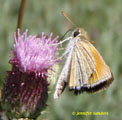 Larval Host |
Uncas Skipper (Hesperia uncas) 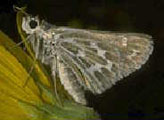 Larval Host |
Pahaska Skipper (Hesperia pahaska) 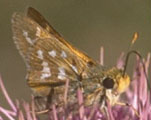 Larval Host |
Green Skipper (Hesperia viridis) 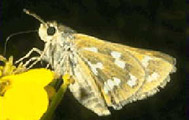 Larval Host |
|
Rhesus Skipper (Polites rhesus) 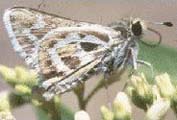 Larval Host |
Simius Roadside-Skipper (Amblyscirtes simius) 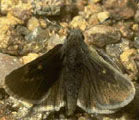 Larval Host |
Propagation
Propagation Material: SeedsDescription: Most easily propagated from seed (1/2-2 lbs. PLS per 1000 sq. ft.).
Commercially Avail: yes
Maintenance: To maintain a solid cover, water sparingly once a week to once a month, depending on region. Can be mowed, but will need less water if left tall.
Find Seed or Plants
Order seed of this species from Native American Seed and help support the Wildflower Center.
Find seed sources for this species at the Native Seed Network.
View propagation protocol from Native Plants Network.
Mr. Smarty Plants says
Native grasses for East Texas that require no mowing or watering
June 16, 2010
What native grass can I grow in deep East Texas that would require no supplemental watering and no mowing?
view the full question and answer
Native grasses for medians in Colorado Springs
June 11, 2010
Our city has stopped watering our historic landscaped medians due to severe budget shortfalls. The medians were historically tree boulevards but have had curb and gutter and blue grass added over th...
view the full question and answer
Will drought-stricken non-native St. Augustine come back in Cedar Park TX
January 30, 2010
I recently bought a new house but the grass in the yard looked completely dead (bought house in Nov) even though the neighbor's grass was still green. The previous owner stopped watering the grass (e...
view the full question and answer
Eliminating crabgrass in Middletown MO
September 28, 2009
Dear Mr. Smarty Plants,
I am having trouble with my lawn, specifically with the crabgrass in it. It now covers over 1/3 of it. I started using corn gluten meal this year, with limited tangible succ...
view the full question and answer
From the National Organizations Directory
According to the species list provided by Affiliate Organizations, this plant is on display at the following locations:Lady Bird Johnson Wildflower Center - Austin, TX
Santa Barbara Botanic Garden - Santa Barbara, CA
Texas Discovery Gardens - Dallas, TX
Sibley Nature Center - Midland, TX
NPSOT - Native Plant Society of Texas - Fredericksburg, TX
Texas Parks and Wildlife Department - Austin, TX
NPSOT - Austin Chapter - Austin, TX
Native Seed Network - Corvallis, OR
NPSOT - Williamson County Chapter - Georgetown, TX
Bibliography
Bibref 1186 - Field Guide to Moths of Eastern North America (2005) Covell, C.V., Jr.Bibref 1185 - Field Guide to Western Butterflies (Peterson Field Guides) (1999) Opler, P.A. and A.B. Wright
Bibref 946 - Gardening with Prairie Plants: How to Create Beautiful Native Landscapes (2002) Wasowski, Sally
Bibref 995 - Native Landscaping from El Paso to L.A. (2000) Wasowski, S. and A. Wasowski
Bibref 318 - Native Texas Plants: Landscaping Region by Region (2002) Wasowski, S. & A. Wasowski
Bibref 291 - Texas Wildscapes: Gardening for Wildlife (1999) Damude, N. & K.C. Bender
Bibref 1294 - The Midwestern Native Garden: Native Alternatives to Nonnative Flowers and Plants An Illustrated Guide (2011) Adelman, Charlotte and Schwartz, Bernard L.
Search More Titles in Bibliography
From the Archive
Wildflower Newsletter 1989 VOL. 6, NO.4 - Spring Climbs Rockies Slowly, Colorado Cooler, Conference of Wildflower and Nati...Additional resources
USDA: Find Bouteloua gracilis in USDA PlantsFNA: Find Bouteloua gracilis in the Flora of North America (if available)
Google: Search Google for Bouteloua gracilis
Metadata
Record Modified: 2022-07-08Research By: NPIS