Native Plants

Plant Database
Search for native plants by scientific name, common name or family. If you are not sure what you are looking for, try the Combination Search or our Recommended Species lists.
Cox, Paul
Amorpha fruticosa
Amorpha fruticosa L.
Indigo Bush, False Indigo Bush, False Indigo, Desert False Indigo
Fabaceae (Pea Family)
Synonym(s): Amorpha angustifolia, Amorpha bushii, Amorpha croceolanata, Amorpha curtissii, Amorpha dewinkeleri, Amorpha fruticosa var. angustifolia, Amorpha fruticosa var. croceolanata, Amorpha fruticosa var. emarginata, Amorpha fruticosa var. oblongifolia, Amorpha fruticosa var. occidentalis, Amorpha fruticosa var. tennesseensis, Amorpha occidentalis, Amorpha occidentalis var. arizonica, Amorpha occidentalis var. emarginata, Amorpha tennesseensis, Amorpha virgata
USDA Symbol: AMFR
USDA Native Status: L48 (N), CAN (N)
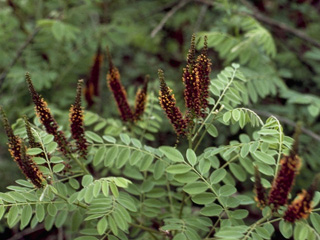
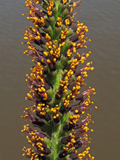
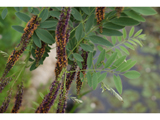
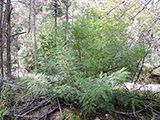
False indigo-bush is a 6-12 ft., loose, airy shrub which often forms dense thickets. Plants develop a leggy character with the majority of their pinnately compound, fine-textured foliage on the upper third of the plant. Leaflets velvety on the lower surface, margins frequently almost parallel, often abruptly rounded at both ends and with a notch at the tip. Flowers small, purple to dark blue with yellow stamens extending beyond the single petal, crowded in narrow, 3-6 in., spikelike clusters at or near the ends of the branchlets, appearing from April to June. Fruit small, up to 3/8 inch long and with blisterlike glands visible under a 10x hand lens. This is a deciduous plant.
This shrub, which often forms thickets on riverbanks and islands, can be weedy or invasive in the northeast. Another False Indigo (A. herbacea) has whitish to blue-violet flowers in fan-like masses on top of the plant and gray-downy foliage with up to 40 leaflets. The genus name, from the Greek amorphos (formless or deformed), alludes to the fact that the flower, with only a single petal (the banner or standard), is unlike the typical pea flowers of the family.
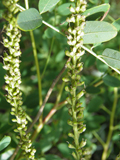
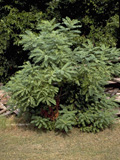
Plant Characteristics
Duration: PerennialHabit: Shrub
Leaf Retention: Deciduous
Leaf Arrangement: Alternate
Leaf Complexity: Pinnate
Leaf Pubescence: Glabrous
Leaf Margin: Entire
Leaf Apex: Mucronate
Breeding System: Flowers Bisexual
Fruit Type: Legume
Size Notes: Up to about 12 feet tall.
Leaf: Green
Autumn Foliage: yes
Bloom Information
Bloom Color: Orange , Blue , Purple , VioletBloom Time: Apr , May , Jun
Bloom Notes: Corolla deep violet-purple, anthers orange, style purplish.
Distribution
USA: AL , AR , AZ , CA , CO , CT , DC , DE , FL , GA , IA , ID , IL , IN , KS , KY , LA , MA , MD , ME , MI , MN , MO , MS , NC , ND , NE , NH , NJ , NM , NY , OH , OK , OR , PA , RI , SC , SD , TN , TX , UT , VA , VT , WA , WI , WV , WYCanada: MB , ON
Native Distribution: NJ to s.e. WI, MN, Sask. & WY, s. to FL, TX & n. Mex.,S. CA to NM & adjacent Mex.
Native Habitat: Stream & pond edges; gravel bars, open woods; roadsides, canyons.
Growing Conditions
Water Use: LowLight Requirement: Sun , Part Shade
Soil Moisture: Moist
CaCO3 Tolerance: Medium
Aquatic: yes
Cold Tolerant: yes
Soil Description: Moist soils to dry sands. pH adaptable. Sandy, Sandy Loam, Medium Loam, Clay Loam, Clay, Acid-based, Calcareous.
Benefit
Use Ornamental: Fast growing, Attractive, Blooms ornamental, Bog or pond area, Water gardenUse Wildlife: Nectar-bees, Nectar-butterflies, Nectar-insects, Browse.
Conspicuous Flowers: yes
Fragrant Flowers: yes
Fragrant Foliage: yes
Attracts: Butterflies
Larval Host: California & southern dogfaces, Silver-spotted Skipper (Epargyreus clarus), Gray hairstreak, Hoary edge skipper.
Deer Resistant: High
Value to Beneficial Insects
Special Value to Native BeesThis information was provided by the Pollinator Program at The Xerces Society for Invertebrate Conservation.
Butterflies and Moths of North America (BAMONA)
|
Silver-spotted Skipper (Epargyreus clarus) 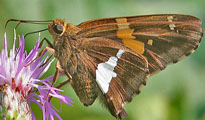 Larval Host |
Southern Dogface (Zerene cesonia) 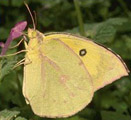 Larval Host |
California Dogface (Zerene eurydice)  Larval Host |
Gray Hairstreak (Strymon melinus) 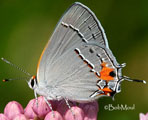 Larval Host |
|
Hoary Edge (Achalarus lyciades) 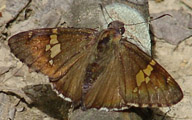 Larval Host |
Propagation
Description: Propagation is possible by scarified seed and softwood or hardwood cuttings.Seed Collection: Collect in late summer or early fall when the pod turns yellowish brown and begins to dry. Air dry and store in sealed, refrigerated containers for three to five years.
Seed Treatment: Mechanically nick the seed, soak in hot water for 10 minutes, or scarify in concentrated sulfuric acid five to eight minutes.
Commercially Avail: yes
Find Seed or Plants
Find seed sources for this species at the Native Seed Network.
View propagation protocol from Native Plants Network.
Mr. Smarty Plants says
Variety of native tall plants for a screen in shady area near Ft. Worth
June 12, 2007
Hello, we live west of Ft Worth. We are looking for tall plants to form a visual screen along a chain link fence we share with a neighbor. We have post oaks there and it is very shady and the ground ...
view the full question and answer
National Wetland Indicator Status
| Region: | AGCP | AK | AW | CB | EMP | GP | HI | MW | NCNE | WMVE |
| Status: | FACW | FACW | FACW | FACW | FACW | FACW | FACW |
From the National Organizations Directory
According to the species list provided by Affiliate Organizations, this plant is on display at the following locations:Fredericksburg Nature Center - Fredericksburg, TX
Lady Bird Johnson Wildflower Center - Austin, TX
Texas Discovery Gardens - Dallas, TX
Brackenridge Field Laboratory - Austin, TX
Crosby Arboretum - Picayune, MS
Texas Parks and Wildlife Department - Austin, TX
NPSOT - Austin Chapter - Austin, TX
Native Seed Network - Corvallis, OR
Jacob's Well Natural Area - Wimberley, TX
Wildflower Center Seed Bank
LBJWC-TS-2 Collected 2009-07-02 in Travis County by Lady Bird Johnson Wildflower CenterBibliography
Bibref 1186 - Field Guide to Moths of Eastern North America (2005) Covell, C.V., Jr.Bibref 1185 - Field Guide to Western Butterflies (Peterson Field Guides) (1999) Opler, P.A. and A.B. Wright
Bibref 946 - Gardening with Prairie Plants: How to Create Beautiful Native Landscapes (2002) Wasowski, Sally
Bibref 355 - Landscaping with Native Plants of Texas and the Southwest (1991) Miller, G. O.
Bibref 354 - Native & Naturalized Woody Plants of Austin & the Hill Country (1981) Lynch, D.
Bibref 841 - Native Alternatives to Invasive Plants (2006) Burrell, C. C.
Bibref 318 - Native Texas Plants: Landscaping Region by Region (2002) Wasowski, S. & A. Wasowski
Bibref 291 - Texas Wildscapes: Gardening for Wildlife (1999) Damude, N. & K.C. Bender
Bibref 1294 - The Midwestern Native Garden: Native Alternatives to Nonnative Flowers and Plants An Illustrated Guide (2011) Adelman, Charlotte and Schwartz, Bernard L.
Bibref 286 - Wildflowers of the Texas Hill Country (1989) Enquist, M.
Search More Titles in Bibliography
Web Reference
Webref 23 - Southwest Environmental Information Network (2009) SEINet - Arizona ChapterResearch Literature
Reslit 868 - Are rare species less shade tolerant than common species in fire-prone environments? A test with seven Amorpha (Fabaceae) species (2009) R. M. Marchin, R. K. Bhandari, W. A. Wall, M. G. H...Reslit 2725 - Amorfrutins are potent antidiabetic dietary natural products (2012) C. Weidner, J. C. De Groot, A. Prasad, A. Freiwald...
Reslit 2726 - Effects of NaCl stress on growth and physiological indexes of five greening plant seedlings and comprehensive evaluation of their salt tolerance (2011) X.-J. Wei, Y.-L. Yin, Z.-G. Lu, H.-B. Mo, J.-F. Hu...
Reslit 2727 - Dark Lance false indigo (1989) B. J. Simpson, B. W. Hipp, E. L. Mcwilliams
Reslit 2728 - The role of host seed size in mediating a latitudinal body size cline in an introduced bruchid beetle in Japan (2012) S. Sadakiyo, M. Ishihara
Reslit 2729 - Favorable fragmentation: river reservoirs can impede downstream expansion of riparian weeds (2010) S. B. Rood, J. H. Braatne, L. A. Goater
Reslit 2730 - Seeding rate affects establishment of native perennial legumes in the upper midwestern US (2006) J. A. Fischbach, N. J. Ehlke, P. R. Peterson, D. L...
Reslit 2731 - Priming and environmental influences on germination of two woody species (1993) G. L. David, D. L. Hensley, S. C. Wiest
Reslit 2732 - Shoot pruning of a hedgerow perennial legume alters the availability and temporal dynamics of root-derived nitrogen in a subtropical setting (2011) Y. Carrillo, C. F. Jordan, K. L. Jacobsen, K. G. M...
Reslit 2733 - Evaluation of diversity among North American accessions of false indigo (Amorpha fruticosa L.) for forage and biomass (2006) L. R. Dehaan, N. J. Ehlke, C. C. Sheaffer, D. L. W...
This information was provided by the Florida WIldflower Foundation.
Search More Titles in Research Literature
From the Archive
Wildflower Newsletter 1998 VOL. 15, NO.5 - Native Shrubs Providing Landscape Heritage and Habitat, Executive Director\'s Re...Additional resources
USDA: Find Amorpha fruticosa in USDA PlantsFNA: Find Amorpha fruticosa in the Flora of North America (if available)
Google: Search Google for Amorpha fruticosa
Metadata
Record Modified: 2022-10-13Research By: NPC, MWJ