Native Plants

Q. Who is Mr. Smarty Plants?
A: There are those who suspect Wildflower Center volunteers are the culpable and capable culprits. Yet, others think staff members play some, albeit small, role. You can torture us with your plant questions, but we will never reveal the Green Guru's secret identity.

Did you know you can access the Native Plant Information Network with your web-enabled smartphone?

Ask Mr. Smarty Plants
Ask Mr. Smarty Plants is a free service provided by the staff and volunteers at the Lady Bird Johnson Wildflower Center.

rate this answer

Wednesday - September 14, 2011
From: Lake Worth , FL
Region: Southeast
Topic: Non-Natives, Herbs/Forbs
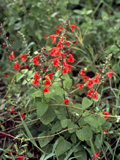
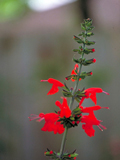
Title: Nativity of Salvia coccinea (scarlet sage)
Answered by: Nan Hampton
QUESTION:
Is Salvia coccinea native to Florida? In wikipedia they say it is native to Mexico.ANSWER:
Salvia coccinea (Scarlet sage), according to the USDA Plants Database is native to the lower 48 states of the United States, occurring in Texas, Louisiana, Alabama, Mississippi, Georgia, Florida, South Carolina and (strangely enough) Ohio, as well as Puerto Rico and the Virgin Islands. The USDA PLANTS Database says:
"In PLANTS, native means naturally occurring at the time of Columbus. Introduced plants arrived later, invariably with human assistance, from some other part of the world. Introduced plants reproduce spontaneously in the wild without human help. ... Because people have been moving plants for thousands of years, and because it is often hard to know how a plant got where it is, Native Status is frequently ambiguous and therefore difficult to assign.
We have broken the PLANTS Floristic Area (PFA) into Native Status jurisdictions to try to improve our information about where plants are native. A plant that is native to any part of a Native Status jurisdiction (e.g., L48, the lower 48 states) is considered Native, even if some populations within that area are introduced."
The Atlas of Florida Vascular Plants also lists Salvia coccinea as native.
The plant is also native to Mexico and Central and South America. What Wikipedia says is:
"At one time Brazil was considered to be where it originated, but its diploid chromosome count now points to Mexico as its place of origin."
This doesn't tell us when it originated and how it spread, but it is likely that it originated a very long time ago and could have spread up into Texas and towards Florida long before Columbus came to the New World. As the USDA PLANTS Database says: "Native status is frequently ambiguous and therefore difficult to assign."
Escaped cultivated plants likely explain the population in Ohio.
You can read more about what USDA PLANTS Database means by "native" and "introduced".
From the Image Gallery
More Herbs/Forbs Questions
Frost damage to native plants in Austin
December 19, 2011 - Hello,
We bought a number of native plants at this fall's WFC sale and planted them. The recent frost seems to have defoliated our pitcher sage, beautyberry, butterflyweed, and flame acanthus plan...
view the full question and answer
Native Perennials for Bees and Butterflies in VA
April 15, 2015 - What native perennial plants and trees can we plant to help honey bees and butterfly larvae in Harrisonburg, VA?
view the full question and answer
Propagation of Baptisia from Lancaster OH
August 24, 2012 - My Baptisia has gone to seed. When can I plant these seeds? Do they need strat? (zone 5)
view the full question and answer
Planting under Pine Trees in Pocatello ID
April 08, 2014 - Hi I was wondering if you could give me some ideas of what I could plant under and near some pine trees for my area. The trees are huge and so it is also constant shade where I want to plant. Thanks f...
view the full question and answer
Plants for under a fountain splash line in California
January 29, 2009 - What plants should we plant under our fountain's splash line in our Mediterranean style courtyard? The area will get wet from the fountain's splashing and have "full" sun. We are on a rock ridge...
view the full question and answer
| Support the Wildflower Center by Donating Online or Becoming a Member today. |