Native Plants
Q. Who is Mr. Smarty Plants?
A: There are those who suspect Wildflower Center volunteers are the culpable and capable culprits. Yet, others think staff members play some, albeit small, role. You can torture us with your plant questions, but we will never reveal the Green Guru's secret identity.
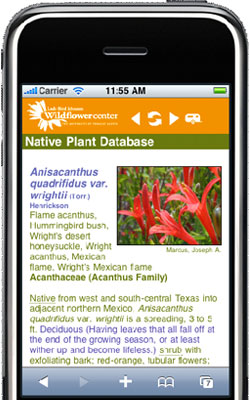
Did you know you can access the Native Plant Information Network with your web-enabled smartphone?

Ask Mr. Smarty Plants
Ask Mr. Smarty Plants is a free service provided by the staff and volunteers at the Lady Bird Johnson Wildflower Center.

rate this answer

Thursday - September 01, 2011
From: Fresno, CA
Region: California
Topic: Plant Identification
Title: Origin of thorned plant-like object falling from the sky
Answered by: Nan Hampton
QUESTION:
This morning while walking I felt a prick on my arm, like something had bitten me. I looked and saw what appeared to be a very tiny little plant with a thorn on it sticking out of my arm. I pulled it out and in a few moments felt another one. Now it is evening and the site still itches. Any idea what it might have been? I was not in any heavy brush but there were some tall trees overhead.ANSWER:
The most likely possibility I can think of is that you were struck by small leaflets with spiny stipules. Stipules are the small paired appendages at the base of the petiole (stem) of a leaf. Several species of Central American acacias have impressively large spiny stipules. Robinia pseudoacacia (Black locust) is a species native to North America with a bit more modest stipular spines. It has been reported in California in counties adjacent to Fresno County. Click "California" on the USDA Plants Database distribution map to see counties where it has been reported in California. You can also see the spiny stipule on the photograph on that page. Here is a drawing showing the leaves and the spines and here is a photo. The tree can grow from 40 to 100 feet tall and is considered invasive in many areas, including California. One acacia relative, Prosopis pubescens (Screwbean mesquite), with spiny stipules grows in Fresno County and can reach a maximum of about 30 feet. Here are photos showing the spines. An insect or small mammal feeding on the tree, could possibly chew on the newly formed leaflets at their base and cause them to fall from the tree with the stipular spines attached. One species of ant in Africa prunes new leaf shoots (presumably along with the spiny stipules) from acacia trees there. (Young, T. P., M. L. Stanton & C. E. Christian. 2003. Effects of Natural and Simulated Herbivory on Spine Lengths of Acacia drepanolobium in Kenya. Oikos Vol. 101, no. 1: 171-179).
Whatever the prickly plant-like objects are, it seems likely they fell from the tall trees you said you were walking under. Your best bet, then, is to go back and try to determine what the trees are. If you have photos of the trees and/or the prickly object, you should visit our Plant Identification page to find links to plant identification forums that accept photos for identification.
More Plant Identification Questions
Identification of tall plant with five-petaled purple flowers
June 01, 2013 - I recently moved into a house and have a plant near my fence that has purple flowers with five petals and a somewhat thick stem, about a half inch. The leaves are sparse and it grows about four to si...
view the full question and answer
Identity of shrub with brownish flowers called cinnamon bush
April 25, 2012 - When I lived in Vernon, CT, my neighbor had a small shrub/tree approximately 5 ft tall with small ovate slightly serrated leaves. In spring it produced reddish brown flowers that were of a hardened p...
view the full question and answer
Plant identification.
May 23, 2009 - Looking for the name of a green, bamboo-like plant with narrow leaves. Have no pictures.
view the full question and answer
Need an ID on a wisteria in Austin
October 12, 2010 - I bought a different type wisteria several years ago, before I started trying to grow native plants. It is the same type wisteria as the one planted at Threadgills on Barton Springs Road, Austin, TX....
view the full question and answer
Identification of a vine with purple flowers
July 06, 2011 - I'm trying to identify a vine-like plant growing in my yard to determine if it is a weed or should be kept around. It has small purple flowers with a small yellow center, looking like a mini honeysuc...
view the full question and answer
| Support the Wildflower Center by Donating Online or Becoming a Member today. |