Native Plants

Q. Who is Mr. Smarty Plants?
A: There are those who suspect Wildflower Center volunteers are the culpable and capable culprits. Yet, others think staff members play some, albeit small, role. You can torture us with your plant questions, but we will never reveal the Green Guru's secret identity.

Did you know you can access the Native Plant Information Network with your web-enabled smartphone?

Ask Mr. Smarty Plants
Ask Mr. Smarty Plants is a free service provided by the staff and volunteers at the Lady Bird Johnson Wildflower Center.

rate this answer

Monday - July 25, 2011
From: Fredericksburg, TX
Region: Southwest
Topic: Grasses or Grass-like
Title: Lindheimer's muhly, goat food in Fredericksburg TX
Answered by: Barbara Medford
QUESTION:
How can I eradicate Lindheimers muhly in my pasture and what can I plant in its place that goats will graze on?ANSWER:
From the Texas Sheep and Goat Raisers Association Learning About Goats: (read the entire link)
"Because goats will eat just about any type of vegetation, they are increasingly being used to control unwanted vegetation. Leafy spurge, an exotic species of weed poisonous to many types of animals, is taking over range land in many parts of the western United States. Tall whitetop, also known as perennial pepperweed, is another invasive plant goats are being used to help control. In Texas, landowners are using goats to control brush, particularly cedar. Cedar re-growth in fields crowds out native grasses and depletes the groundwater supply. Current research has even determined that certain goats have a genetic preference for cedar. Goats help to control this re-growth and enhance the amount of water percolating into the ground. By using goats to eat these invasive plants, landowners are helping the environment by removing the plants that are crowding out beneficial species. In addition, they do not have to use herbicides to kill the plants."
We would really hope you would not completely remove the Muhlenbergia lindheimeri (Lindheimer's muhly) (read the entire link). It is an excellent grass, endemic to the Edward's Plateau, foraged by cattle and other animals, including goats, useful as a small wildlife cover, does not need to be trimmed back in the winter, and helps to shade out invasive weeds. We don't recommend herbicides anywhere that livestock will be feeding; it can spread and kill things you didn't want killed.
If you are determined to eliminate a useful plant, pulling it out of the ground and not permitting it to set seed is about the only alternative.
From the Image Gallery
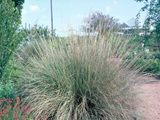
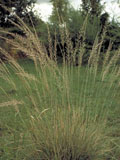
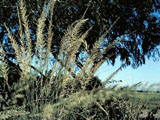
More Grasses or Grass-like Questions
Need native plants to place in chicken coop in Charolette, NC
September 20, 2014 - Hi, I live near Charlotte, NC. I'm looking for native plants that I can plant in my chicken coop that will produce food for the chickens. If they also produced some delicious food for me, I wouldn't...
view the full question and answer
Possibility of root rot in Praire flame-leaf sumac
July 08, 2004 - I bought a prairie sumac two years ago and it was fine until recently when we had a lot of rain in Austin. Now the leaves are all brown and it appears to be dying. Is there something I can do? I reall...
view the full question and answer
Native Grasses for Quebec
August 21, 2014 - I saw an article in the Martha Stewart magazine on native grasses. I live in Canada in Rimouski, in the province of Quebec. I am wondering if native grasses would grow here in the region? Our hardine...
view the full question and answer
Plants to prevent erosion on slope in Texas
June 19, 2010 - We have an erosion problem developing on the low side of a gently sloping hill. We are in clay soil at the base of the hill with oaks and pines. We have a right of way that is without trees forty fee...
view the full question and answer
Mowing frequency of native lawn from Georgetown TX
August 18, 2012 - I have a native grass and wildflower lawn. At what frequency and when should the lawn be mowed?
view the full question and answer
| Support the Wildflower Center by Donating Online or Becoming a Member today. |