Native Plants

Q. Who is Mr. Smarty Plants?
A: There are those who suspect Wildflower Center volunteers are the culpable and capable culprits. Yet, others think staff members play some, albeit small, role. You can torture us with your plant questions, but we will never reveal the Green Guru's secret identity.

Did you know you can access the Native Plant Information Network with your web-enabled smartphone?

Ask Mr. Smarty Plants
Ask Mr. Smarty Plants is a free service provided by the staff and volunteers at the Lady Bird Johnson Wildflower Center.

rate this answer

Wednesday - July 13, 2011
From: Harlingen, TX
Region: Southwest
Topic: Diseases and Disorders, Trees
Title: Treating suspected drought-stressed live oak
Answered by: Guy Thompson
QUESTION:
I have a live oak with excessive leaf drop - it was planted approx. 20 year ago surrounded by heavy pavers. very little grass - I did not plant the tree - I have noticed in the last few years the drop increases - the oaks I have in the back yard only shed during the winter, we have long hot summers. I can removed the pavers. Thank youANSWER:
There is no question that even old, well-established trees are going to need some extra help during the kind of drought we are having right now. If the pavers around your tree are set close together, water permeation may be sharply curtailed. Mr. Smarty Plants recommends that you remove as many of the pavers as possible, right out to the drip line of the tree. Replace the pavers with 2-3 inches of mulch to slow the evaporation of soil water.
Many trees have been saved in past droughts by additional watering in late summer. As the underlined article suggests, professional arborists suggest deep watering, and the amount of water applied would depend on your soil type, e.g., rocky or clay. The trees might also benefit from additional fertilization. Furthermore, trees suffering from drought stress are often more susceptible to insect and fungal attack.
This University of Illinois Extension website Dealing with the Drought affirms that watering even drought-resistant trees like the oak is essential. It points out that a 90 ft. oak tree will be a lot worse to lose than annual flowers or vegetables. We don't recommend watering at the base of the trunk, but watering farther out, with a hose or sprinklers, probably about every two weeks. An excerpt from this website will tell you why:
"Our 90-foot oak example could have roots at least 40 feet beyond the tree’s
drip-line. The same goes for most shrubs. So, apply water at the tree or
shrub’s drip-line, not at the trunk."
Those roots may be pretty deep, and part of the protection of the trees, but much of the root system is in the top 12 inches of the soil. So, putting the water out there helps to avoid fungus and rot at the base of the trunk.
From the Image Gallery
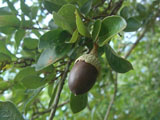
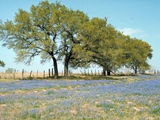
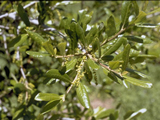
More Trees Questions
Heat tolerant arborvitae for Spring TX
September 20, 2012 - Is there an arborvitae that would be heat-tolerant to Spring, Texas (north of Houston) and amenable to neutral clay soil?
view the full question and answer
Freeze-damaged Texas Mountain Laurel in Austin, TX.
May 05, 2011 - I have a Texas Mountain Laurel (Sophora secundiflora) that is several years old. During this past winter, one of the freezes we had split one of the largest trunk right below the soil line. T...
view the full question and answer
Tree roots in sewer from Paragould AR
September 30, 2012 - I have beautiful pecan trees, an apple in the back yard, a pine on the west side of the house and pecan trees in the front yard. Two trees are interrupting my sewer systems (at least one in the back y...
view the full question and answer
Theory for live oak shoots from Austin
August 25, 2011 - More on preventing suckers from coming up around live oaks in Austin. I too have been puzzled - why some live oaks have shoots, and not others. Posting here says different varieties have suckers.
...
view the full question and answer
Native Perennials for Bees and Butterflies in VA
April 15, 2015 - What native perennial plants and trees can we plant to help honey bees and butterfly larvae in Harrisonburg, VA?
view the full question and answer
| Support the Wildflower Center by Donating Online or Becoming a Member today. |