Native Plants
Q. Who is Mr. Smarty Plants?
A: There are those who suspect Wildflower Center volunteers are the culpable and capable culprits. Yet, others think staff members play some, albeit small, role. You can torture us with your plant questions, but we will never reveal the Green Guru's secret identity.
Did you know you can access the Native Plant Information Network with your web-enabled smartphone?

Ask Mr. Smarty Plants
Ask Mr. Smarty Plants is a free service provided by the staff and volunteers at the Lady Bird Johnson Wildflower Center.

rate this answer

Saturday - May 28, 2011
From: Austin, TX
Region: Southwest
Topic: Non-Natives
Title: Milkweed and non-native goatweed in Austin
Answered by: Barbara Medford
QUESTION:
Which parks or fields can we find many milkweed and goatweed in Austin, TX? I live in Austin, TX 78757.ANSWER:
That depends. Did you want to look at them, photograph them or dig them up? Digging up native plants is pretty restricted-they may be on private land, or in a private garden, or in a park or botanical garden, like the Lady Bird Johnson Wildflower Center. Any of the custodians of those places would frown on having plants removed, and it is absolutely forbidden at the Wildflower Center.
Epimedium, goatweed, is a genus of about 60 plants endemic to China, so we are hoping you CANNOT find them in the Austin area. The Lady Bird Johnson Wildflower Center is dedicated to the growth, propagation and protection of plants native not only to North America but to the area in which those plants grow natively.
If you are interested in attracting butterflies or providing larval hosts for them, you can follow the plant links below and find out which species of Asclepias, milkweed, attract which butterflies and/or bees. For that purpose, to plant them in your own garden, we suggest you wait until Fall to purchase starter plants or seeds and follow the Propagation Instructions on the webpages for each plant.
If you were thinking of some herbal or medicinal use for the milkweeds, please read this:
Warning: All plants in the genus Asclepias are probably somewhat toxic, some fatally so, to both humans and animals. The sap of some causes skin irritation in humans. Sensitivity to a toxin varies with a person’s age, weight, physical condition, and individual susceptibility. Children are most vulnerable because of their curiosity and small size. Toxicity can vary in a plant according to season, the plant’s different parts, and its stage of growth; and plants can absorb toxic substances, such as herbicides, pesticides, and pollutants from the water, air, and soil.
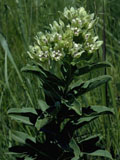
Our Native Plant Database lists 48 species of the genus Asclepias, milkweed, of which 35 are native to Texas, and 4 to the Central Texas area. These are:
Asclepias asperula (Spider milkweed)
Asclepias tuberosa (Butterflyweed)
From the Image Gallery

More Non-Natives Questions
Problems with non-native impatiens in Denton, TX
May 19, 2009 - Dear Mr. Smarty Plants,
4 weeks ago I planted a shady bed (2'x10') with impatiens for the third year in-a-row. Previously, the plants thrived & bloomed till November. Three weeks ago, something ...
view the full question and answer
Non-native, non-invasive Thunbergia alata
March 30, 2006 - I'm trying to find the proper name for Climbing Blackeyed Susan, or Blackeyed Susan Vine. We had one on a trellis and it was beautiful, but I'm told that it is an undesirable weed. Any info apprec...
view the full question and answer
Will non-native poisonous oleander grow through non-native invasive bermudagrass in Ft. Worth?
February 20, 2011 - I was wondering if you knew which flowering plants would grow through grass. I have bermuda, have tried raised beds but due to uneven yard with lots of rock it would be too expensive to do properly. ...
view the full question and answer
Ways to eliminate non-native bermuda grass from West Columbia SC
July 01, 2010 - Could you kill bermuda grass by heavy over-fertilizing it? Or black, solid plastic cloth?
Thanks
view the full question and answer
Browning of non-native Plectranthus in Dallas
November 28, 2010 - I live in Dallas and planted 'Mona Lavender' which is now brown and limp after overnight temps in the low 30's. Is it dead or will it come back? Do I need to cover these plants during the winter m...
view the full question and answer
| Support the Wildflower Center by Donating Online or Becoming a Member today. |