Native Plants

Plant Database
Search for native plants by scientific name, common name or family. If you are not sure what you are looking for, try the Combination Search or our Recommended Species lists.
Marcus, Joseph A.
Asclepias viridis
Asclepias viridis Walter
Green Milkweed, Spider Milkweed
Asclepiadaceae (Milkweed Family)
Synonym(s): Asclepiodora viridis
USDA Symbol: asvi2
USDA Native Status: L48 (N)
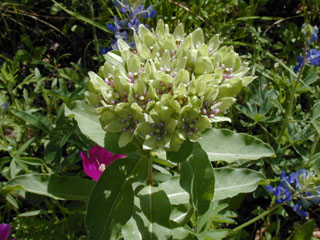
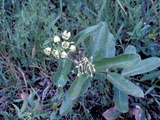
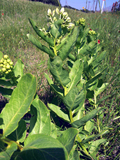
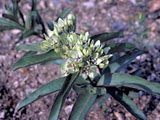
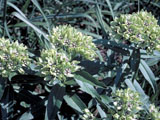
Green Milkweed is a native, perennial forb or herb with alternate, entire leaves. The leaf margins are often wavy. Flowers are white and in an umbel, mostly one per plant. Upon close inspection, some rose or purple color is evident in the center of each individual flower (gynostegium). The milky substance that is exuded when a plant part is broken is very sticky, much resembling “Elmer’s glue.” These milkweeds bloom from late spring to middle summer.
This milkweed is common in pastures from Kansas to Texas. Generally avoided by cattle and horses. It can be found along roadsides, ditches, prairies, open areas, and other areas with little vegetative competition.

Plant Characteristics
Duration: PerennialHabit: Herb
Root Type: Tap
Leaf Retention: Deciduous
Leaf Arrangement: Alternate
Leaf Complexity: Simple
Leaf Shape: Lanceolate , Ovate
Leaf Venation: Pinnate
Leaf Pubescence: Puberulent
Leaf Margin: Entire
Leaf Apex: Emarginate
Leaf Base: Truncate
Breeding System: Flowers Bisexual
Size Notes: 9 3/4 - 25 1/2 in (25-65 cm).
Leaf: Leaf arrangement is alternate to sub-opposite and attachment is petiolate with short petioles. Leaves ovate to lanceolate, 2-4 3/4 in (5-12 cm) long and 3/8- 2 1/4 in (1-5 1/2 cm) wide. Glabrous, but occasionally has fine sparse hairs.
Flower: Usually one umbel per stem but large plants may have up to 10 stems and infloresences, 3-5 in (7 3/4 -12 3/4 cm) wide with 10 +/- flowers per umbel. Color is white to yellow-green with a purple tinge. Corolla is green or cream. Hoods are purple to white. Corolla cups upward and around the outside of the hoods. Doesn't have horns.
Fruit: Pods usually erect, 2 1/2 -5 in (6-13 cm) long and 1/2 - 3/4 in (1-2 cm) wide. Slightly hairy.
Bloom Information
Bloom Color: White , Yellow , Green , PurpleBloom Time: Apr , May , Jun , Jul , Aug , Sep
Bloom Notes: Flowers details are beautiful in how they are arranged in the cluster.
Distribution
USA: AL , AR , FL , GA , IL , IN , KS , KY , LA , MO , MS , NE , OH , OK , SC , TN , TX , WVNative Habitat: Dry areas, prairies, pastures, glades, ditches, disturbed ground, limestone soils.
Growing Conditions
Water Use: LowLight Requirement: Sun
Soil Moisture: Moist
Cold Tolerant: yes
Heat Tolerant: yes
Conditions Comments: This is another member of the milkweed family that certain butterflies love. It can be found growing in rich or poor soils and blooms off and on over ther growing season through the end of summer. Has a spreading, open growth form. Requires little water and full sun.
Benefit
Warning: All plants in the genus Asclepias are probably somewhat toxic, some fatally so, to both humans and animals. The sap of some causes skin irritation in humans. Sensitivity to a toxin varies with a person’s age, weight, physical condition, and individual susceptibility. Children are most vulnerable because of their curiosity and small size. Toxicity can vary in a plant according to season, the plant’s different parts, and its stage of growth; and plants can absorb toxic substances, such as herbicides, pesticides, and pollutants from the water, air, and soil.Conspicuous Flowers: yes
Fragrant Flowers: yes
Attracts: Butterflies
Nectar Source: yes
Deer Resistant: High
Value to Beneficial Insects
Special Value to Native BeesSpecial Value to Bumble Bees
Special Value to Honey Bees
Supports Conservation Biological Control
This information was provided by the Pollinator Program at The Xerces Society for Invertebrate Conservation.
Propagation
Propagation Material: SeedsSeed Collection: June-July
Seed Treatment: Soak seed overnight in water. Cold moist stratification for 14-30 days enhances germination to greater than 60 percent.
Commercially Avail: yes
Find Seed or Plants
Order seed of this species from Native American Seed and help support the Wildflower Center.
From the National Organizations Directory
According to the species list provided by Affiliate Organizations, this plant is on display at the following locations:Lady Bird Johnson Wildflower Center - Austin, TX
Texas Discovery Gardens - Dallas, TX
Stengl Biological Research Station - Smithville, TX
NPSOT - Austin Chapter - Austin, TX
NPSOT - Williamson County Chapter - Georgetown, TX
Wildflower Center Seed Bank
LBJWC-1779 Collected 2015-09-05 in Lee County by Lady Bird Johnson Wildflower CenterLBJWC-1806 Collected 2015-09-09 in Johnson County by Lady Bird Johnson Wildflower Center
LBJWC-1723 Collected 2015-06-14 in McLennan County by Lady Bird Johnson Wildflower Center
LBJWC-1757 Collected 2015-08-10 in Burnet County by Lady Bird Johnson Wildflower Center
LBJWC-1793 Collected 2015-09-27 in Wise County by Lady Bird Johnson Wildflower Center
LBJWC-1794 Collected 2015-10-15 in McLennan County by Lady Bird Johnson Wildflower Center
LBJWC-1759 Collected 2015-07-17 in Williamson County by Lady Bird Johnson Wildflower Center
Bibliography
Bibref 328 - Wildflowers of Texas (2003) Ajilvsgi, Geyata.Bibref 286 - Wildflowers of the Texas Hill Country (1989) Enquist, M.
Search More Titles in Bibliography
Additional resources
USDA: Find Asclepias viridis in USDA PlantsFNA: Find Asclepias viridis in the Flora of North America (if available)
Google: Search Google for Asclepias viridis
Metadata
Record Modified: 2018-10-24Research By: NPC, RLU, DEW