Native Plants
Q. Who is Mr. Smarty Plants?
A: There are those who suspect Wildflower Center volunteers are the culpable and capable culprits. Yet, others think staff members play some, albeit small, role. You can torture us with your plant questions, but we will never reveal the Green Guru's secret identity.
Did you know you can access the Native Plant Information Network with your web-enabled smartphone?

Ask Mr. Smarty Plants
Ask Mr. Smarty Plants is a free service provided by the staff and volunteers at the Lady Bird Johnson Wildflower Center.

rate this answer

Tuesday - April 19, 2011
From: San Marcos, TX
Region: Southwest
Topic: Invasive Plants
Title: How to tell the difference between native and European thistles
Answered by: Nan Hampton
QUESTION:
How can I tell the difference between invasive (European) thistles and thistles that are native to Texas? And what is the best way to eradicate the invasive varieties?ANSWER:
According to the USDA Plants Database there are six different genera of plants that occur in Texas that have species with 'thistle' as part of their common name. Some of the species in those genera are native and others aren't. All of them, even those that are native, have been listed by at least one state as noxious. They are:
Centaurea melitensis (Maltese star-thistle)—non-native and noxious, appears on the Texas Invasives Database. You can see a description of two of the species below from eFloras. Occurs in Hays County.
Silybum marianum (blessed milkthistle) non-native and noxious. You can see a description of this species at eFloras. Occurs in Hays County.
Carthamus lanatus (woolly distaff thistle) non-native and noxious. You can see a description of this species at eFloras. No record in or near Hays County.
Onopordum acanthium (Scotch cottonthistle) non-native and noxious, appears in the Texas Invasives Database. You can see a description of the species in eFloras. No record in or near Hays County.
Cirsium sp. You can see the descriptions of the species below from eFloras. (Note: Arkansas and Iowa have put all Cirsium spp., native and non-native, on their Noxious Weeds lists):
- Cirsium altissimum (tall thistle)—native and noxious. No record in or near Hays County.
- Cirsium carolinianum (soft thistle)—native and noxious. No record in or near Hays County.
- Cirsium engelmannii (Engelmann's thistle)—native and noxious. No record in or near Hays County.
- Cirsium horridulum (yellow thistle)—native and noxious. Occurs in Hays County.
- Cirsium x iowense—native and noxious [cross between C. altissimum and C. discolor]
- Cirsium muticum (swamp thistle)—native and noxious. No record in or near Hays County.
- Cirsium ochrocentrum (yellowspine thistle)—native and noxious. Occurs in Hays County.
- Cirsium texanum (Texas thistle)—native and noxious. Occurs in Hays County.
- Cirsium turneri (cliff thistle)—native and noxious. No record in or near Hays County.
- Cirsium undulatum (plumed thistle)—native and noxious. Recorded in Comal County, but not Hays County.
- Cirsium vulgare (bull thistle)—non-native and noxious, appears on the Texas Invasives Database. Occurs in Hays County.
Carduus sp. You can see descriptions of the species below on eFloras. (All species appearing in Texas are non-native and considered noxious.):
- Carduus acanthoides (spiny plumeless thistle) non-native and noxious. No record in or near Hays County.
- Carduus nutans (nodding plumeless thistle) non-native and noxious, appears on the Texas Invasives Database. Reported by USDA as occurring in Blanco County, but not Hays County.
- Carduus pycnocephalus (Italian plumeless thistle) non-native and noxious. No record in our near Hays County.
- Carduus tenuiflorus (winged plumeless thistle) non-native and noxious, appears on the Texas Invasives Database. Reported by USDA as occurring in Travis County, but not Hays County.
Salsola sp. You can see descriptions of the species below on eFloras:
- Salsola collina (slender Russian thistle) non-native and noxious. No record in or near Hays County.
- Salsola kali (Russian thistle) non-native and noxious. No record in or near Hays County.
- Salsola tragus (prickly Russian thistle)—non-native and noxious, appears in the Texas Invasives Database. No record in or near Hays County.
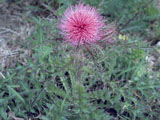
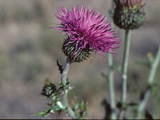
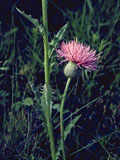
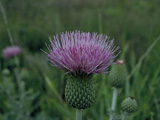
To summarize, assuming you are asking advice for the thistles that occur in Hays County, Cirsium horridulum (Yellow thistle), Cirsium ochrocentrum (Yellowspine thistle) and Cirsium texanum (Texas thistle) are native thistles that occur in Hays County and Cirsium undulatum (Plumed thistle) is a native that occurs in adjacent Comal County.
The following non-native thistles occur in Hays or adjacent counties: Centaurea melitensis (Maltese star-thistle), Silybum marianum (blessed milkthistle), Cirsium vulgare (bull thistle), Carduus nutans (nodding plumeless thistle) occurs in adjacent Blanco County and Carduus tenuiflorus (winged plumeless thistle) occurs in adjacent Travis County. The first two, Maltese star-thistle and blessed milkthistle, are relatively easy to distinguish from any of the native species in Hays County. The other three may be a bit more difficult to distinguish from the natives, but the eFloras descriptions for each should help in determining which is which. All of the invasives except Silybum marianum (blessed milkthistle) appear in the Texas Invasives Database with Management guidelines. You can find information for managing Silybum marianum from King County (Washington) Noxious Weed Control Program.


More Invasive Plants Questions
Weeds in Buffalograss from Edmond OK
September 20, 2012 - We have a patch of buffalograss surrounded by patio/flower garden/vegetable garden. We like B-grass, but are getting a lot of weeds despite preemergents, and some bermuda had appeared.
Are there h...
view the full question and answer
How to Get Rid of Spike Rush in Raised Beds in Galveston
March 16, 2011 - I have an infestation of spike rush in my raised beds and I want to know how to get rid of it, preferably without killing the insects. I have tried digging it up, but it returns. I live on Galveston B...
view the full question and answer
Pruning of non-native Senna bicapsularis from Ocean Springs MS
April 04, 2013 - I have 4 Senna plants (cassia bicapsularis) that I planted late last spring. They about 3-4 feet tall but are very gangly with leaves at or near the tips only. How should I prune them to encourage g...
view the full question and answer
Distinguishing wax myrtle from Daphne laureola in Tofino BC
September 02, 2009 - I am wondering how to distinguish California Wax Myrtle from Daphne Laurel, the latter which I would prefer to eradicate from my property. If it is wax myrtle, it gets to live..
view the full question and answer
Control of invasive sandburs in Austin
May 05, 2014 - My attempts to control / eradicate Sanbur with pre-emergent corn gluten twice yeary for the last three years have been unsuccessful. My post emergent pulling weeds for 15 years has also been unsucces...
view the full question and answer
| Support the Wildflower Center by Donating Online or Becoming a Member today. |