Native Plants

Q. Who is Mr. Smarty Plants?
A: There are those who suspect Wildflower Center volunteers are the culpable and capable culprits. Yet, others think staff members play some, albeit small, role. You can torture us with your plant questions, but we will never reveal the Green Guru's secret identity.

Did you know you can access the Native Plant Information Network with your web-enabled smartphone?

Ask Mr. Smarty Plants
Ask Mr. Smarty Plants is a free service provided by the staff and volunteers at the Lady Bird Johnson Wildflower Center.

rate this answer

Sunday - June 20, 2010
From: Philadelphia, PA
Region: Mid-Atlantic
Topic: Non-Natives, Diseases and Disorders
Title: Powdery growth in hydrangea in Philadelphia
Answered by: Barbara Medford
QUESTION:
My hydrangea plants have a weird growth on their leaves that looks like white rice. It looks like it would be powdery if brushed, but I don't want to touch it for fear that it some type of mold. Any idea what it could be?ANSWER:
There is one hydrangea native to Pennsylvania, Hydrangea arborescens (wild hydrangea), but we're betting you have a hybrid in your garden. Philadelphia, in the southeast corner of Pennsylvania, is in USDA Hardiness Zone 6b to 7. We think you probably have a form of Hydrangea macrophylla, also known as bigleaf, French, garden or florist's hydrangea. It is hardy to Zone 6, which means it can do well in your area. However, it is a native of Japan, and therefore out of our range of expertise. At the Lady Bird Johnson Wildflower Center we are committed to the growth, protection and propagation of plants native not only to North America but to the area in which that plant is being grown.
The best source we found for information on hydrangeas was The United States National Arboretum Hydrangea Questions and Answer. From that same site, you should read the part on Are hydrangeas bothered by diseases or insects?. Here is an excerpt from that portion that probably applies to your situation:
"For the bigleaf hydrangea, the major disease problem is powdery mildew (see image at right). It is most common on plants growing in shade and under high humidity conditions. Powdery mildew infested leaves are covered with a light gray powdery-looking substance. Purple splotches may also appear. Powdery mildew rarely kills plants, but is unattractive. Powdery mildew may occur on other hydrangea species, but is most severe on bigleaf hydrangea."
To us, mildew doesn't look like rice on a leaf, but it certainly isn't attractive. Another source for information on disease of hydrangeas is this one from the University of Florida Extension Service, Hydrangea macrophylla.
Native Hydrangeas from our Native Plant Image Gallery:
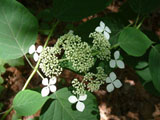
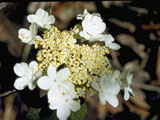
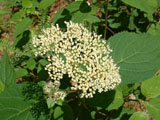
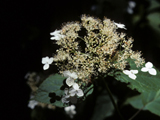
More Non-Natives Questions
Identification of a tree in Florida with bell-shaped red flowers
November 23, 2012 - A friend in Florida has asked about identification of a tree with a flower none of us have ever seen. It starts with a green pod, then flowers into, what looks to me like a Chinese lantern, or bell. I...
view the full question and answer
Identity of the mass fields of yellow flowers in North Texas
March 23, 2012 - Are the mass fields of yellow flowers we are seeing in north Texas now likely to be Indian Mustard (brassica juncea) or Charlock (brassica kaber or sinapis arvensis)?
We are teaching a wildflower ide...
view the full question and answer
Smarty Plants on Gloxinias
August 20, 2004 - How do I care for my newly acquired Gloxinias?
view the full question and answer
Flowering of pineapple guavas
November 06, 2007 - I have two pineapple guavas in their second year of planting. Both have grown extremely well, but have not flowered. I live in zone 9 near the Gulf and they receive normal irrigation. Do they take ...
view the full question and answer
Rose care for Austin
August 18, 2013 - I am a transplant from the Pacific NW and need to relearn rose care for Austin. When is the best time to cut back the roses, or do I even bother? I also need to find out how far back I can trimming a...
view the full question and answer
| Support the Wildflower Center by Donating Online or Becoming a Member today. |