Native Plants
Q. Who is Mr. Smarty Plants?
A: There are those who suspect Wildflower Center volunteers are the culpable and capable culprits. Yet, others think staff members play some, albeit small, role. You can torture us with your plant questions, but we will never reveal the Green Guru's secret identity.
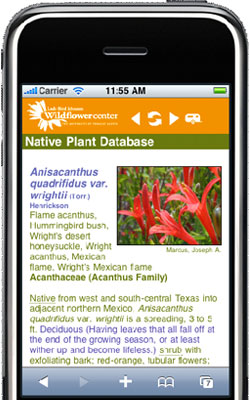
Did you know you can access the Native Plant Information Network with your web-enabled smartphone?

Ask Mr. Smarty Plants
Ask Mr. Smarty Plants is a free service provided by the staff and volunteers at the Lady Bird Johnson Wildflower Center.

rate this answer

Tuesday - November 06, 2007
From: SANTA ROSA BEACH, FL
Region: Southeast
Topic: Non-Natives
Title: Flowering of pineapple guavas
Answered by: Barbara Medford
QUESTION:
I have two pineapple guavas in their second year of planting. Both have grown extremely well, but have not flowered. I live in zone 9 near the Gulf and they receive normal irrigation. Do they take time to establish prior to bloom?ANSWER:
The Feijoa sellowiana (Pineapple guava) is undergoing a name change; apparently, it is to be termed Acca sellowiana in the future. The pineapple guava is native to Paraguay, Uruguay, northern Argentina and southern Brazil. The Lady Bird Johnson Wildflower Center is dedicated to the promotion and protection of plants native to North America. However, we are always happy to refer to websites with information on non-native plants, as well as to watch and warn about non-natives which might become invasive in North America.
This Floridata site has a very good description of the culture and uses of pineapple guava. The plants bloom in May and are covered with tiny orchid-like pink and crimson flowers. In research on the Internet, we found several mentions of guavas that had been in the ground for several years and had not bloomed yet, either. Several references were made to the need for cross pollination from another pineapple guava, but that would infer blooms, wouldn't it? Since you already have two, it looks like you're covered there. Without being able to find any definite recommendation on when a pineapple guava should be expected to show blooms, there are a couple of suggestions we would make. The first is that a plant only the second year in the ground probably is not settled enough yet to begin to bloom. It takes any woody plant a while to adjust to transplanting, and get all its systems in order. The second thought we have is that you might be over-fertilizing. Plants must bloom and fruit to satisfy their purpose in life, which is to reproduce more of themselves. However, if they are made TOO comfortable with fertilizing and coddling, they might decide they don't need to bother with reproducing, as they are not in any danger of dying. Also, over fertilizing tends to produce more leaves, causing there to be less energy available to produce blooms. So, consider a little more patience and a little less plant food, and we predict you'll be seeing blooms in a few years.
More Non-Natives Questions
Transplant time for small smoke tree from Battle Ground WA
June 01, 2014 - When do I transplant a smoke tree that is still young, about a foot high? It is too close to a fence, which I fear will be a problem as it gets big. I live in Battle Ground, WA which is zone 6.
view the full question and answer
Dying non-native red tip photinias in Lexington NC
June 27, 2009 - Large Red Tip bushes, what can I do to keep them alive? I have a few and they are dying. What can I do to save them?
view the full question and answer
Care of Rio Grande Wild Petunia
July 17, 2007 - I have bought the Rio Grande Wild Petunia, Ruellia davisiorum. How should I look after it?
view the full question and answer
Non-native Japanese maple for East Northport NY
August 20, 2013 - I live in NY and I am looking to plant a Japanese maple in front of my house. It would be in front of a window so I'm thinking should I get a dwarf? Or a semi dwarf? I know I want a red color but un...
view the full question and answer
Control of Paulownia tomentosa from Westminster MD
October 28, 2011 - I have heard that there is a type of herbicide that is to be applied to slashes made in the outer layer of invasive trees such as Paulownia. This type of application is reputed to prevent the little ...
view the full question and answer
| Support the Wildflower Center by Donating Online or Becoming a Member today. |