Native Plants

Q. Who is Mr. Smarty Plants?
A: There are those who suspect Wildflower Center volunteers are the culpable and capable culprits. Yet, others think staff members play some, albeit small, role. You can torture us with your plant questions, but we will never reveal the Green Guru's secret identity.

Did you know you can access the Native Plant Information Network with your web-enabled smartphone?

Ask Mr. Smarty Plants
Ask Mr. Smarty Plants is a free service provided by the staff and volunteers at the Lady Bird Johnson Wildflower Center.

rate this answer

Sunday - May 16, 2010
From: Pasadena, CA
Region: California
Topic: Vines
Title: Evergreen vine for wall in Pasadena CA
Answered by: Barbara Medford
QUESTION:
Hi, I am looking for an evergreen vine to cover my block wall. I saw star jasmine kept really flowing and wild and loved it but I don't like the way it will look when It blooms. I want a vine that looks a little wild and unkempt and not flat on the wall. I don't mind bigger blooms on the vine either. We will use nails and wire or whatever it takes for the vine to grow to get the look we want and will add a trellis at the top to heighten the vine when needed. Thank you for your help!!ANSWER:
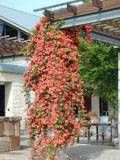
We have a dilemma here; we have found a vine that fits your requirements very well and is native to North America. Bignonia capreolata (crossvine), however, grows natively no farther west than Texas and Oklahoma. Even Las Pilitas Nursery, our standby for plants native to California, does not list it. But, it would appear it could grow very well in Southern California. This Dave's Garden forum page on Crossvine indicates that it is known to grow in 5 California cities; 4 of those cities in Central California and the other in Orange County, next door to Los Angeles County. All of these areas are in USDA Zones 9a to 9b, pretty warm, while they grow very well here in Austin, in Zone 8b.
Unfortunately, as often happens, the word "evergreen" in the specifications severely limits the number of native plants available. Very few vines are evergreen, and the sight of a deciduous vine in December is depressing, to say the least. We went to our Recommended Species section, searching for vines native to Southern California, and got the dreaded message: "Your search did not return any results." So, we went to the larger, more comprehensive Native Plant Database to search on California and vines, where we got 49 results. Of these, exactly 3 were decent-looking garden vines native to the Los Angeles County area, and not a single one was evergreen.
At the Lady Bird Johnson Wildflower Center, we are committed to the use, protection and propagation of plants native not only to North America but to the area in which they are being grown. Plants native to an area will be acclimated by millennia of experience to the rainfall, temperatures and soils in that area, requiring little or no fertilizer and less water and mainenance. We also discourage planting non-natives because of the possibility of their becoming invasive in an area where they are without competition of predators. Or, of course, they could be unable to adjust, struggle for a few years, and then die. In California, in particular, we would caution watching very closely for invasiveness in any plant. Although the Bignonia capreolata (crossvine) is not considered particularly invasive, it does sucker and in an area with such a mild climate might begin to grow out of the area where you want it, and out of control.
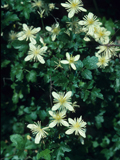
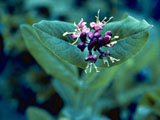
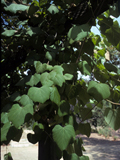
From our Native Plant Image Gallery:
More Vines Questions
Native vine for California deck
November 24, 2009 - Can you recommend a native California vine to grow on our deck to cover a trellis under a deck? There is a canopy of live coast oak above the deck so there is bright, filtered light. Thank you.
view the full question and answer
Groundcover Under Maple Tree in Ottawa That Takes Foot Traffic
April 19, 2013 - Hi, I am looking for a groundcover to put under a large maple tree that will be alright for kids to run about on and will be happy in the Ottawa climate. Your other answers to similar questions have b...
view the full question and answer
Plant identification of vine in Ohio
September 21, 2010 - I have a vine in my forest that grows up trees, that could eventually pull them over. It has roundleaves and prickers on the stem. What is this vine so I can research it?
view the full question and answer
Smarty Plants on pruning Clematis
August 26, 2005 - I would like to know about pruning clematis. The one I have is getting very large. Should I cut it back, and if so, in the Spring or Fall? I live in Michigan. Thank you.
view the full question and answer
Variation in leaves for Vitis mustangensis
May 17, 2012 - Hi, I am doing a sculpture of a mustang grape vine in limestone. In seeking a good leaf image I notice that there are both roundish shaped leaves and highly divided or "fingered" shapes on your sit...
view the full question and answer
| Support the Wildflower Center by Donating Online or Becoming a Member today. |