Native Plants

Q. Who is Mr. Smarty Plants?
A: There are those who suspect Wildflower Center volunteers are the culpable and capable culprits. Yet, others think staff members play some, albeit small, role. You can torture us with your plant questions, but we will never reveal the Green Guru's secret identity.

Did you know you can access the Native Plant Information Network with your web-enabled smartphone?

Ask Mr. Smarty Plants
Ask Mr. Smarty Plants is a free service provided by the staff and volunteers at the Lady Bird Johnson Wildflower Center.

rate this answer

Thursday - April 08, 2010
From: Plano, TX
Region: Southwest
Topic: Diseases and Disorders, Transplants
Title: Peeling bark on red oak in Plano, TX
Answered by: Barbara Medford
QUESTION:
I have a red oak that was planted 2 years ago. The trunk is approx. 5 in around. The bark around the bottom of the trunk is peeling off. At first we thought it was rabbits so we put some rabbit guard around the tree. The bark is turning a blackish color in that area and seems to be getting deeper the more the bark falls off. It sets in a lower part of the yard which will hold water when it rains a lot. Could this be water rot?ANSWER:
First, let's figure out which "red oak" we are talking about. Quercus coccinea (scarlet oak) is the only one actually called "red," but it is not native to Texas. There are six oaks listed in our Native Plant Database as being native to Texas and having "red oak" as one of their common names: Quercus buckleyi (Buckley oak), Quercus falcata (southern red oak), Quercus gravesii (Chisos red oak), Quercus shumardii (Shumard's oak), Quercus texana. (Texas red oak) and Quercus marilandica (blackjack oak). Of these, Quercus buckleyi (Buckley oak), Quercus shumardii (Shumard's oak), Quercus texana (Texas red oak) and Quercus marilandica (blackjack oak) are the four "red oaks" considered by the Texas Oak Wilt Information Partnership to be most susceptible to Oak Wilt. This is not to say we think that's your problem, we just want to narrow down the choices. A retailer can call a tree anything he wants to, so we will just pick one and use it as an example. Since this USDA Plant Profile shows it growing squarely in Plano, Collin County, we will use Quercus shumardii (Shumard's oak) as our example.
From the Dirt Doctor (Howard Garrett) we extracted this information from a site on the Shumard Oak: "Red oaks can’t stand wet feet. Poorly drained soil causes root disease, illness or death. Red oak are highly susceptible to oak wilt. Occasionally red oaks are bothered by scale, borers and other insect pests but that is always a symptom and related to a bigger problem of an environmental nature. Another cause of problems is mistakenly buying pin oaks or crossbred trees."
It looks like that is the best guess on what is causing the problems on the bottom of your tree. You planted it during a very dry period in Texas, and it is now a very wet period, especially in North Central Texas. An innocuous low spot before is now a puddle. As pointed out above, this problem in the tree's environment can make it that much more susceptible to other diseases and insect problems, most particularly fungi.
If you want to spend the time and effort, you might try transplanting the tree to a better spot. If you are going to do this, you need to do so right away, before it gets any hotter. We ordinarily recommend transplanting woody plants, shrubs and trees, in Fall or late Winter when they are more or less dormant. You can't very well wait that long. We found an excellent website from About.com: Landscaping on Transplanting Trees and Shrubs. Pay particular attention to their instructions about selecting the spot-a sunny area and, of course, not low where water will stand. Also, as recommended, get the new hole dug and ready for the tree before you dig it out of the ground or disturb it, and get it back in the ground in its new home right away.
We do not guarantee that the tree will have been worth the effort. It may die, no matter what happens. Or, it might get well and do fine if you don't do a thing, but we don't think so. We suggest that you contact the Texas A&M AgriLife Extension Office for Collin County, and see if they have any other suggestions.
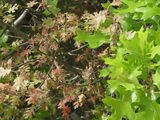
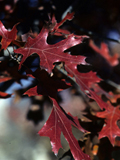
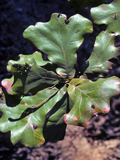
From our Native Plant Image Gallery:

More Transplants Questions
Problems with a Hackberry tree in San Antonio.
September 23, 2010 - Our old hackberry tree fell over last year. Now we have dozens of new ones popping up in the same area. We want to transplant a few to another area of the yard, but they aren't surviving. It appears ...
view the full question and answer
Transplanted crabapple tree problems in Alberta
June 18, 2009 - We transplanted a crabapple tree a couple of weeks ago. There was an abundance of clay in the soil where it was re-planted and even with all the watering, it isn't doing well. Any suggestions on how ...
view the full question and answer
Field of Dreams
June 07, 2009 - I planted a field of sunflowers in April. I transplanted some of the crowded plants to different rows in mid-May - no problems. I have tried to transplant some of the plants this first week of June ...
view the full question and answer
Transplanting live oaks in summer
July 17, 2008 - I have a need to transplant a live oak tree on a home building site. The need is now, the house is almost completely built out and the owners did not prep the site by moving trees or prepping them to ...
view the full question and answer
Failure to bud out of nuttall oak in Albany GA
April 26, 2010 - We planted a nutall oak in the fall of 09. It seemed to fare well during the winter. It is now spring and all of our other trees are budding out. The limbs are flexible. Not breaking off easily like t...
view the full question and answer
| Support the Wildflower Center by Donating Online or Becoming a Member today. |