Native Plants

Plant Database
Search for native plants by scientific name, common name or family. If you are not sure what you are looking for, try the Combination Search or our Recommended Species lists.
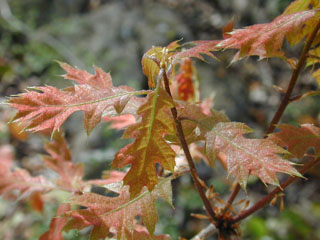
Marcus, Joseph A.
Quercus buckleyi
Quercus buckleyi Nixon & Dorr
Texas Red Oak, Buckley Oak, Texas Oak, Spanish Oak, Spotted Oak, Rock Oak
Fagaceae (Beech Family)
Synonym(s): Quercus texana
USDA Symbol: qubu2
USDA Native Status: L48 (N)
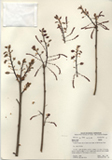
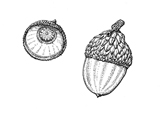
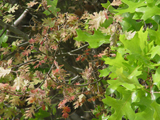
Small to medium tree to 15 m (50 ft) tall. Bark dark gray, smoothish, furrowed into ridges on lower trunk and older branches. Twigs slender, grayish or brownish, glabrous, ending in a cluster of small egg-shaped grayish or brownish buds. Leaves alternate, elliptical or obovate, 6-12 cm (2.4-4.8 in) long and 5-10 cm (2-4 in) wide,deeply divided into 5-9 (usually 7) lobes which are usually broadest toward the tip and end in several bristle-tipped teeth, shiny dark green above, pale green with tufts of hairs in vein axils below, turning brown or red in fall. Fruits are acorns maturing in the second year, egg-shaped, 12-18 mm (0.5-0.7 in) long and 8-14 mm (0.3-0.6 in) wide with a more or less shallow cup covering 1/3-1/2.
This species was named for Samuel B. Buckley, botanist and state geologist of Texas. Quercus buckleyi leaves are similar to those of Q. texana, but the two species do not overlap in their distributions. This species should be considered a conservation concern. The largest known Buckley oak grows in Travis County, Texas.


Plant Characteristics
Duration: PerennialHabit: Tree
Root Type: Tap
Leaf Retention: Deciduous
Leaf Arrangement: Alternate
Leaf Complexity: Simple
Leaf Shape: Elliptic , Obovate
Leaf Venation: Pinnate
Leaf Margin: Lobed
Leaf Apex: Acuminate , Acute
Leaf Base: Truncate
Breeding System: Flowers Unisexual , Monoecious
Inflorescence: Catkin
Fruit Type: Nut
Size Notes: Height to 75 ft. Width to 60 ft.
Leaf: Glossy green above, light green to coppery-green below
Autumn Foliage: yes
Fruit: Acorns biennial; cup scales smooth to sparsely pubescent, inner surface smooth, covers 1/3-1/2 of nut; smooth or slightly pubescent, broadly ovoid nut, 3/4 inch (19 mm) long.
Bloom Information
Bloom Color: White , Red , GreenBloom Time: Mar , Apr , May , Jun
Distribution
USA: KS , OK , TXNative Distribution: Native to an area from southcentral Texas to northcentral Oklahoma.
Native Habitat: Restricted habitat associated with limestone ridges, slopes and creek bottoms.
Growing Conditions
Water Use: LowLight Requirement: Sun , Part Shade
Soil Moisture: Dry
Soil pH: Alkaline (pH>7.2)
CaCO3 Tolerance: High
Cold Tolerant: yes
Heat Tolerant: yes
Soil Description: Medium Loam, Clay Loam, Clay, Limestone-based
Conditions Comments: Q. buckleyi is more drought tolerant than the Shumard oak, but less hardy. This tree tolerates alkaline soil as well as neutral and slightly acidic soil. It is a super shade tree if you do not mind raking leaves in the fall. Red or yellow foliage in the fall.
Benefit
Use Ornamental: Fall conspicuous, Attractive, ColorUse Wildlife: Produces large numbers of acorns, which are valuable as food for wildlife.
Use Other: Texas oak is usually too small for sawlogs.
Warning: Leaves and acorns can be toxic to animals if eaten. Humans should generally avoid ingesting plants that are toxic to animals.
Interesting Foliage: yes
Deer Resistant: No
From the National Organizations Directory
According to the species list provided by Affiliate Organizations, this plant is on display at the following locations:Lady Bird Johnson Wildflower Center - Austin, TX
Brackenridge Field Laboratory - Austin, TX
Patsy Glenn Refuge, c/o Wimberley Birding Society - Wimberley, TX
Nueces River Authority - Uvalde, TX
NPSOT - Fredericksburg Chapter - Fredericksburg, TX
Texas Master Naturalists - Lost Pines Chapter - Bastrop, TX
NPSOT - Austin Chapter - Austin, TX
Jacob's Well Natural Area - Wimberley, TX
NPSOT - Williamson County Chapter - Georgetown, TX
Bibliography
Bibref 766 - Dale Groom's Texas Gardening Guide (2002) Groom, D.Bibref 1134 - Field Guide to Native Oak Species of Eastern North America (2003) Stein, John D. and Denise Binion
Bibref 355 - Landscaping with Native Plants of Texas and the Southwest (1991) Miller, G. O.
Bibref 354 - Native & Naturalized Woody Plants of Austin & the Hill Country (1981) Lynch, D.
Bibref 318 - Native Texas Plants: Landscaping Region by Region (2002) Wasowski, S. & A. Wasowski
Search More Titles in Bibliography
Additional resources
USDA: Find Quercus buckleyi in USDA PlantsFNA: Find Quercus buckleyi in the Flora of North America (if available)
Google: Search Google for Quercus buckleyi
Metadata
Record Modified: 2017-06-24Research By: TWC Staff