Native Plants

Q. Who is Mr. Smarty Plants?
A: There are those who suspect Wildflower Center volunteers are the culpable and capable culprits. Yet, others think staff members play some, albeit small, role. You can torture us with your plant questions, but we will never reveal the Green Guru's secret identity.

Did you know you can access the Native Plant Information Network with your web-enabled smartphone?

Ask Mr. Smarty Plants
Ask Mr. Smarty Plants is a free service provided by the staff and volunteers at the Lady Bird Johnson Wildflower Center.

rate this answer

Friday - March 13, 2009
From: Austin, TX
Region: Southwest
Topic: Propagation, Pruning
Title: Controlling size of red yucca in Austin
Answered by: Jackie OKeefe
QUESTION:
I have planted red yucca in my backyard, which produces many flowering stalks for the past few years. These red yucca are becoming too large for the area that are planted in. What recommendations do you have for maintaining the size of these gorgeous plants? Can I prune or shear off some of the "ever-green foliage" of the red yucca.ANSWER:
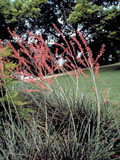
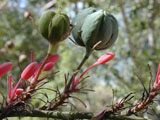
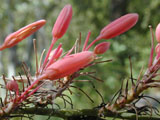
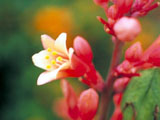
Hesperaloe parviflora (redflower false yucca) is a real workhorse plant for Austin landscapes. Its long-lasting and attractive blooms, wildlife value, easy-care nature and suitability to our climate and soils make it very desirable in our landscapes. Over time, as you have experienced, the clumps expand and become denser. Far from being a problem, this is an opportunity. These clumps are easily divided and the excess pieces can be moved to other sites, potted up, or given to your budding gardener friends. This solution is preferable to chopping away foliage, which can leave the plant with an unkempt look.
To divide-a task best done in fall or winter before new growth starts-take a close look at your plant. You should be able to see where the clump has formed new offsets as it grew. These can be dug away with a sharp spade. Each offset will produce a new plant. If more drastic size reduction is necessary, you can dig out the root clump and divide the whole thing. This site, Grow'em Plant Propagation Database, Clump Division, is a good visual of the process. It should be noted that the visuals are of a daylily, Hemerocallis, while the Red Yucca, not a yucca at all nor a daylily, is a member of the Agavaceae (Century Plant) family. Dividing an overcrowded plant gives it growing room again.
More Pruning Questions
Dead leaves on yucca in Georgetown TX
October 18, 2010 - We have 2 6ft and 3 smaller soft leaf yuccas out back in a kidney shaped area with a wax myrtle and a mountain laurel. The yuccas have done great but now two of them have a large number of dead leaves...
view the full question and answer
Lilies not blooming from Austin
May 03, 2013 - Last December 8, you published a letter in the Statesman that I had written to you regarding Rain Lilies, Oxblood Lilies, and Copper Lilies. The were sprouting in my garage in a bag. You recommended...
view the full question and answer
Pruning guidance for Carolina buckthorn from Houston
October 23, 2012 - I have a Carolina Buckthorn in my back patio that I planted in fall 2001. The summer of 2003 the roofers dropped something off the back and broke the top 10-12 inches off. I have tried to train the la...
view the full question and answer
Getting rid of yucca plants in Blanco, TX
May 12, 2009 - How does a person get rid of Yucca plants? We have four fig trees that do not bear figs, what do we need to do? We live in SE Blanco County, Texas.
view the full question and answer
Clipping of beans from newly planted Tecoma stans
April 22, 2008 - I purchased a Esperanza Plant in a pot from a nursery in April of 2008. We planted it and it is doing fine, but came with blooms and beans. Do I need to do clip or prune the beans at this stage of g...
view the full question and answer
| Support the Wildflower Center by Donating Online or Becoming a Member today. |