Native Plants

Q. Who is Mr. Smarty Plants?
A: There are those who suspect Wildflower Center volunteers are the culpable and capable culprits. Yet, others think staff members play some, albeit small, role. You can torture us with your plant questions, but we will never reveal the Green Guru's secret identity.

Did you know you can access the Native Plant Information Network with your web-enabled smartphone?

Ask Mr. Smarty Plants
Ask Mr. Smarty Plants is a free service provided by the staff and volunteers at the Lady Bird Johnson Wildflower Center.

rate this answer

Sunday - January 25, 2009
From: Dallas, TX
Region: Southwest
Topic: Invasive Plants
Title: Are Bradford pear fruits poisonous to dogs?
Answered by: Nan Hampton
QUESTION:
Are Bradford pear fruits poisonous to dogs?ANSWER:
Mr. Smarty Plants couldn't find any reference to Pyrus calleryana 'Bradford' (Bradford pear), or any Pyrus spp. for that matter, in most of our favorite poisonous plant databases:
Poisonous Plants of North Carolina
Cornell University Plants Poisonous to Livestock
Canadian Poisonous Plants Information System
Universiy of Pennsylvania Poisonous Plants
However, one database, Toxic Plants, from University of California-Davis lists the seeds of Pyrus sp. as "Major Toxicity: These plants may cause serious illness or death. If ingested, immediately call the Poison Control Center or your doctor." American Dog Trainers Network also lists pear seeds on their Poisonous Substances list. The Humane Society of the United States does not list pears or pear seeds in their list of Common Poisonous Plants, but they do list apple seeds. You can look for more reports of the toxicity of pears/pear seeds by Googling "dogs poisonous plants pears".
WrongDiagnois.com had this to say about poisoning by seeds of Pyrus communis (common pear): "Pear seeds that are chewed to a very fine consistency or crushed first may result in the release of glycosides which can be turned into cyanide by stomach acids. Large quantities are required so the risk of even mild poisoning is very minute."
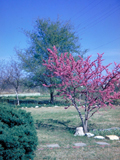
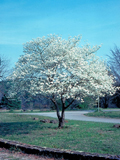
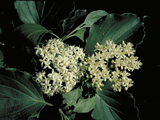
Of course, you don't want potentially poisonous substances about for your dog(s) to eat, but you probably like your pear tree as well. If this were a common pear with large fruits, you probably could get by just watching for the fruits to drop and removing them from the area. However, since these fruits are so small, I would think it would be harder to pick up all fallen fruits and easier for a dog to crush the seeds if it decided to eat the fruits. Since the Bradford pear is non-native and considered invasive in some parts of North America, perhaps you could consider replacing it with a native ornamental flowering tree such as:
Cercis canadensis var. texensis (Texas redbud),
Cornus florida (flowering dogwood),
Cornus drummondii (roughleaf dogwood)
The sap of Cornus spp. is reported by Toxic Plants UC-Davis to possibly cause skin irritation. Cornus spp. weren't on any of the general or dog-specific sites listed above for dermatitis or any other toxicity and coming in contact with the sap is not too likely to occur with dogs.
Before you pick a new tree to replace your Bradford pear, check the toxic plant databases above before you buy.
More Invasive Plants Questions
Orange trumpet creeper parasitic to oaks in New York City?
December 17, 2010 - Is the Orange Trumpet Creeper a parasite to oak trees? My concern is that a neighbor with a tall oak has a vine growing up it and I wonder if it could damage or weaken the tree?
view the full question and answer
About Salvia superba
January 09, 2006 - About 10 years ago, nurseries were offering a small salvia, called salvia superba or meadow sage. A few years later, "May Night" and "Blue Hill" appeared on the market similar to this first sal...
view the full question and answer
Will Arborvitae (Thuja occidentalis) roots cause problems in a leach field?
January 14, 2010 - A new neighbor is concerned my Arbovitae's root system will go into his leach field. His house has been there also for the same amount of time as the tree and the field. The tree is 45 years old. Do...
view the full question and answer
Non-native zoysia and bermuda grasses in Austin
July 11, 2013 - We have Bermuda grass in the front and Zoysia in the back yards. The back grass is fine but the front yard Bermuda isn't. We have watered once each week during the spring and during the past 3 weeks...
view the full question and answer
Source for seeds of Mexican primrose from Dallas
April 25, 2013 - Can I purchase Mexican Evening Primrose seeds now for planting in the fall or do I need to wait for the fresh crop of seeds that will be gathered from this spring flowering. How can I be assured the ...
view the full question and answer
| Support the Wildflower Center by Donating Online or Becoming a Member today. |