Native Plants

Q. Who is Mr. Smarty Plants?
A: There are those who suspect Wildflower Center volunteers are the culpable and capable culprits. Yet, others think staff members play some, albeit small, role. You can torture us with your plant questions, but we will never reveal the Green Guru's secret identity.

Did you know you can access the Native Plant Information Network with your web-enabled smartphone?

Ask Mr. Smarty Plants
Ask Mr. Smarty Plants is a free service provided by the staff and volunteers at the Lady Bird Johnson Wildflower Center.

rate this answer

Friday - January 18, 2008
From: Weslaco, TX
Region: Southwest
Topic: Pests, Shrubs
Title: Roses being attacked by spider mites
Answered by: Barbara Medford
QUESTION:
My roses are being eaten alive by spider mites. I read that this area of Texas has a huge problem with these devils! I've tried everything to kill them to no avail! Can you help me? Gratefully yours, JuneANSWER:
Before we do anything else, we have to look at cultural practices in your roses. Obviously, since we at the Lady Bird Johnson Wildflower Center are dedicated to the promotion and propagation of plants native to North America, we would prefer you use native roses, of which there are quite a few. Next in preference would be some of the "antique" or old roses and shrub roses, many of which have been found in old cemeteries or homesites where they have been untended or years. Those roses, and the natives, have survived so long because they are able to resist or shrug off predators. As non-native roses have been hybridized for size, color and longevity of cut flowers they have lost some of the natural traits that permitted roses to continue to live and propagate themselves uncared for. But, since you already have roses you want to preserve, we're not going to suggest you dig them up and replace them with natives, but try to help you with some non-chemical techniques that should help, at little or no cost to you or the environment.
To begin with the cultural practices: First and foremost, clean it up! Remove fallen branches and weeds, as well as leaf litter. Mites overwinter in protected areas such as untidy areas around your rose beds. That is why they keep turning up again every year. They do not overwinter on the rose, itself, so the use of dormant oil will do no good. Second, even if you have to dig some up and remove or replant some bushes, make sure there is plenty of room between your rose bushes for good air circulation. Not only will this keep active mites from moving from one bush to another, but it will help reduce fungal problems, one of the great challenges for roses.
Now, let's talk about what situations lead to heavy mite infestations. The spider mites love hot, dry, dusty weather, all prominent in Texas weather forecasts. Drought stress weakens roses, so make sure they are being regularly irrigated, preferably by drip irrigation, again to help with the mildew. However, every 7 to 10 days, you are going to spray those roses from above. Do it in the morning or early evening, so the leaves will not be wet overnight. Start at the top and work down, giving special attention to the underside of leaves, where the mites are hanging out. Use a hard spray-once the mites (and their eggs) have been washed off, they can't climb back up.
And, you ask, what about chemical intervention? Well, we don't recommend it. In the first place, the spider mite is an arachnid, and isn't much affected by pesticides. What are affected, and negatively, by chemical sprays are the beneficial insects like lady bugs and beautiful ones like butterflies. If, after trying the above cultural practices, you feel absolutely compelled to spray something, try a very weak solution of insecticidal soap. The main function of this is to make the leaves too slippy-slidey for those mites to hang on, and the flying beneficials will just fly to a dry spot. Refer to this Texas Agricultural Extension Service for a complete run-down on roses and their care.
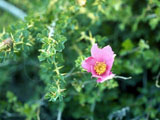
And, while we're talking about roses and have your attention, could we just mention some native roses growing in Texas. We don't want to say that the mites bite Texas roses and die, but it's always a possibility!
Rosa arkansana var. suffulta (prairie rose)





More Pests Questions
Vines free from cutter ants from Caldwell TX
November 14, 2012 - What are some climbing vines cutter ants won't eat
view the full question and answer
Black walnut herbivory
June 13, 2005 - We moved to Texas just about a year ago and have loved it here. This past January we visited the Wildflower Center and obtained some black walnut seeds. Up until last night the tree was doing well p...
view the full question and answer
Which plants are resistant to dog urine in Ashmore, IL??
May 21, 2012 - Which native plants are resistant to dogs urinating on them?
view the full question and answer
Removing yaupon hollies from yard in Austin
July 04, 2009 - We recently moved into a home w/ way too many and much too large (20-30') yaupon holly's in the back yard. I had some of them cut down, but they keep coming up from the roots of the old trees. How ...
view the full question and answer
Rabbit-proof Plants for Texas
July 03, 2014 - Do you have a list of flowers that rabbits will eat or will not eat so I know what to plant or avoid? I have a year-round rabbit population in my neighborhood and wish to co-exist with them without t...
view the full question and answer
| Support the Wildflower Center by Donating Online or Becoming a Member today. |