Native Plants

Q. Who is Mr. Smarty Plants?
A: There are those who suspect Wildflower Center volunteers are the culpable and capable culprits. Yet, others think staff members play some, albeit small, role. You can torture us with your plant questions, but we will never reveal the Green Guru's secret identity.

Did you know you can access the Native Plant Information Network with your web-enabled smartphone?

Ask Mr. Smarty Plants
Ask Mr. Smarty Plants is a free service provided by the staff and volunteers at the Lady Bird Johnson Wildflower Center.

rate this answer

Thursday - November 22, 2007
From: Kelso, WA
Region: Northwest
Topic: Invasive Plants
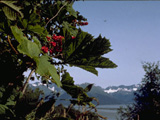
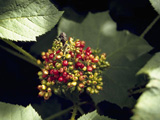
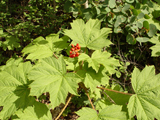
Title: How to get rid of devils club (Oplopanax horridus)
Answered by: Nan Hampton
QUESTION:
please tell me how to get rid of devils club!!!ANSWER:
You don't say how much Oplopanax horridus (devilsclub) you have and how large it is; but, no matter how much or how large, you do have a truly a thorny problem—literally. For most plants the key to getting rid of them is to pull or dig them up and dispose of them. This is not such a simple matter for devil's club because of all those thorns. So, here is Mr. Smarty Plant's recommendation:Buy yourself some heavy gloves and wear a heavy jacket and tough pants. For the small plants cut off all the thorns near the base of the plant so that you put your hand around the stem and, wearing your heavy gloves, pull up the small plant. If the plants are too large to pull up, then you need to find a set of clippers/loppers with long handles. If you can reach in to the stem of the plant with the clippers, cut it off right above the ground and then you can then dig up the roots and be rid of the plant. If the stem of the plant is too thick for your clippers, then you can remove branches at the base of the plant using the long-handled clippers. Once you have removed enough of them to safely reach the stem/trunk, you can cut it down with an axe and then dig up the roots. After you've removed the larger plants, it should be easier to control the smaller ones as they reappear (and they will). You will need to be vigilant.
After you've finished chopping them all down and you are rubbing your sore muscles, you might like to read Devil's Club (Oplopanax horridus): An Ethnobotanical Review to find how local indigenous people and modern day herbalists have used the plant to treat a large variety of ailments.
You might also like to get a "second opinion" from the Plant Answer Line of the Elisabeth C. Miller Library of the Univeristy of Washington Botanic Gardens in Seattle who have probably had a bit more hands-on (ouch!) experience with devil's club than Mr. Smarty Plants has.
More Invasive Plants Questions
Top soil dressing for bermudagrass
February 25, 2009 - Need to apply top soil dressing to bermudagrass. Can you suggest any type? This area is heavy clay soil and need to even out the lawn as well as feed the grass.
view the full question and answer
Problems with recently planted trumpet vine from Worcester MA
October 20, 2012 - Dear Mr. Smarty Plants, I have a question about my recently planted Trumpet Vines. First of all, I live in Massachusetts, zone 6. The soil is perfect for the two vines, which I bought from a local nur...
view the full question and answer
Forget-me-nots choking a spring in Bethlehem PA
June 20, 2013 - Hi Mr. Smarty Plants,
I am restoring a native plant area along a spring that feeds directly into our local creek.
Right now the spring is becoming choked with forget-me-nots, that I am trying ...
view the full question and answer
Getting rid of King Ranch bluestem
August 13, 2008 - I have recently moved to South Texas Coastal town of Portland, Texas. My St. Augestine turf grass has been invaded by - what the neighbors tell me - King Ranch Blue Stem grass. I am having a terribl...
view the full question and answer
Planting time for non-natives in Irving TX
February 07, 2012 - Have dwarf nandinas and two lorapetalums that I want to transplant. Can I do it now February 6th 2012?
view the full question and answer
| Support the Wildflower Center by Donating Online or Becoming a Member today. |