Native Plants

Plant Database
Search for native plants by scientific name, common name or family. If you are not sure what you are looking for, try the Combination Search or our Recommended Species lists.
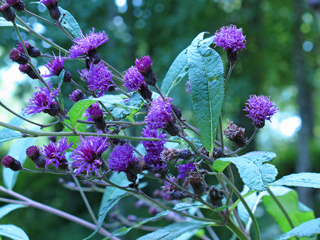
Brundage, Stephanie
Vernonia noveboracensis
Vernonia noveboracensis (L.) Michx.
New York Ironweed
Asteraceae (Aster Family)
Synonym(s): Vernonia harperi
USDA Symbol: veno
USDA Native Status: L48 (N)
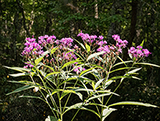
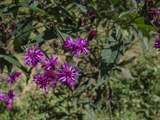
New York ironweed is a tall, clump-forming perennial, growing 5-7 ft. in height. Slightly rough stems bear lance-shaped, deep-green leaves. Small flower heads occur in large, loosely branched, flat-topped, terminal clusters. Flowers are all of the disc type and deep reddish-purple in color. Tall erect stem branches toward the summit, with each branch bearing a cluster of deep lavender to violet flower heads; together, clusters form a loose spray.
This often roughish plant is common in wet open bottomland fields. It typically has more flowers per head than Tall Ironweed (Vernonia gigantea). Reported as occurring outside of cultivation in Indiana.
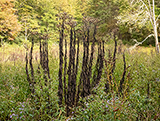
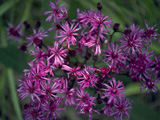
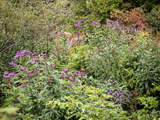
Plant Characteristics
Duration: PerennialHabit: Herb
Size Notes: Up to about 7 feet tall.
Leaf: Dark Green
Fruit: Fruit is a cypsela (pl. cypselae). Though technically incorrect, the fruit is often referred to as an achene.
Bloom Information
Bloom Color: PurpleBloom Time: Aug , Sep , Oct
Distribution
USA: AL , CT , DC , DE , FL , GA , KY , MA , MD , NC , NH , NJ , NY , OH , PA , RI , SC , TN , VA , WVCanada: ON
Native Distribution: MA to OH, s. to GA & MS; more common near the coast
Native Habitat: Moist meadows, pastures & roadsides. Flourishes on slopes in the Edwards Plateau. Well-drained caliche and limestone.
Growing Conditions
Water Use: MediumLight Requirement: Sun
Soil Moisture: Moist
Soil pH: Acidic (pH<6.8)
CaCO3 Tolerance: Medium
Drought Tolerance: Medium
Soil Description: Is found in moist soils in the wild, but will flourish in regular or dry soil. Tolerates clay and neutral to acidic conditions.
Conditions Comments: Juglone tolerant
Benefit
Use Ornamental: As a tall, narrow plant, it is suited for the back of the border or tight spaces.Use Wildlife: The flowers attract butterflies and seed heads attract birds.
Conspicuous Flowers: yes
Attracts: Birds , Butterflies
Nectar Source: yes
Value to Beneficial Insects
Special Value to Native BeesThis information was provided by the Pollinator Program at The Xerces Society for Invertebrate Conservation.
Propagation
Description: Sow seeds in fall or provide cold stratification. Germination is usually low so sow thickly. Also propagated by "softwood" cuttings taken in late spring or by division of clumps.Seed Collection: Nutlets mature 3-4 weeks after the blooming period. Store dry in sealed, refrigerated containers.
Seed Treatment: This species requires or benefits from a three month period of cold-moist stratification in the refrigerator.
Commercially Avail: yes
Find Seed or Plants
View propagation protocol from Native Plants Network.
National Wetland Indicator Status
| Region: | AGCP | AK | AW | CB | EMP | GP | HI | MW | NCNE | WMVE |
| Status: | FACW | FAC | FACW | FAC | FACW | FACW | FAC |
From the National Organizations Directory
According to the species list provided by Affiliate Organizations, this plant is on display at the following locations:Native Plant Center at Westchester Community College, The - Valhalla, NY
Delaware Nature Society - Hockessin, DE
Mt. Cuba Center - Hockessin, DE
Bibliography
Bibref 928 - 100 easy-to-grow native plants for Canadian gardens (2005) Johnson, L.; A. LeyerleSearch More Titles in Bibliography
Web Reference
Webref 38 - Flora of North America (2019) Missouri Botanical Garden, St. Louis, MO & Harvard University Herbaria, Cambridge, MA.Webref 23 - Southwest Environmental Information Network (2009) SEINet - Arizona Chapter
Additional resources
USDA: Find Vernonia noveboracensis in USDA PlantsFNA: Find Vernonia noveboracensis in the Flora of North America (if available)
Google: Search Google for Vernonia noveboracensis
Metadata
Record Modified: 2023-01-30Research By: TWC Staff