Native Plants

Plant Database
Search for native plants by scientific name, common name or family. If you are not sure what you are looking for, try the Combination Search or our Recommended Species lists.
Page, Lee
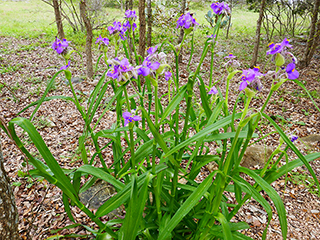
Tradescantia gigantea
Tradescantia gigantea Rose
Giant Spiderwort
Commelinaceae (Spiderwort Family)
Synonym(s):
USDA Symbol: trgi
USDA Native Status: L48 (N)
Named after John Tradescant (1608-1662) who served as gardener to Charles I of England.
Tradescantia species will hybridize in just about any combination.

Plant Characteristics
Duration: PerennialHabit: Herb
Leaf Retention: Deciduous
Leaf Arrangement: Alternate
Leaf Complexity: Simple
Leaf Shape: Lanceolate
Leaf Venation: Parallel
Leaf Margin: Entire
Fruit Type: Capsule
Size Notes: Up to about 3 feet tall.
Bloom Information
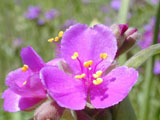
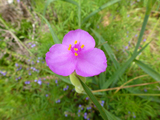
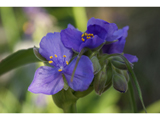
Bloom Color: White , Pink , Blue , Purple , VioletBloom Time: Mar , Apr , May
Distribution
USA: LA , TXNative Habitat: Prairie/Plains/Meadows/Pastures/Savannas, Woodlands' edge/Opening
Growing Conditions
Water Use: MediumLight Requirement: Sun , Part Shade
Soil Moisture: Moist
Soil Description: Clay, Clay Loam Medium Loam, Sandy Loam, Sandy, All soils.
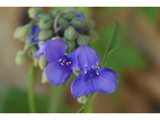
Conditions Comments: Tradescantia gigantea has a dainty, three-petal flower with slender, hairy stamens. The flower color can be an indicator of the PH of the soil. Acidic soils produce bluer flowers, while more alkaline soils create varying shades of pink and purple.
Benefit
Conspicuous Flowers: yesFragrant Flowers: yes
Interesting Foliage: yes
Nectar Source: yes
Deer Resistant: No
Value to Beneficial Insects
Special Value to Native BeesThis information was provided by the Pollinator Program at The Xerces Society for Invertebrate Conservation.
Mr. Smarty Plants says
Native plants for container gardens in Central Texas
March 11, 2008
Dear Mr. Smarty Plants: I moved to TX last year, for now living in an apartment with a good-size but shady deck; my garden in VA was full of VA native plants. What TX natives, if any, can I grow in ...
view the full question and answer
From the National Organizations Directory
According to the species list provided by Affiliate Organizations, this plant is on display at the following locations:Lady Bird Johnson Wildflower Center - Austin, TX
Brackenridge Field Laboratory - Austin, TX
NPSOT - Native Plant Society of Texas - Fredericksburg, TX
Stengl Biological Research Station - Smithville, TX
NPSOT - Austin Chapter - Austin, TX
NPSOT - Williamson County Chapter - Georgetown, TX
Bibliography
Bibref 765 - McMillen's Texas Gardening: Wildflowers (1998) Howard, D.Bibref 281 - Shinners & Mahler's Illustrated Flora of North Central Texas (1999) Diggs, G. M.; B. L. Lipscomb; B. O'Kennon; W. F...
Bibref 248 - Texas Wildflowers: A Field Guide (1984) Loughmiller, C. & L. Loughmiller
Bibref 328 - Wildflowers of Texas (2003) Ajilvsgi, Geyata.
Bibref 286 - Wildflowers of the Texas Hill Country (1989) Enquist, M.
Search More Titles in Bibliography
Web Reference
Webref 38 - Flora of North America (2019) Missouri Botanical Garden, St. Louis, MO & Harvard University Herbaria, Cambridge, MA.Webref 23 - Southwest Environmental Information Network (2009) SEINet - Arizona Chapter
Additional resources
USDA: Find Tradescantia gigantea in USDA PlantsFNA: Find Tradescantia gigantea in the Flora of North America (if available)
Google: Search Google for Tradescantia gigantea
Metadata
Record Modified: 2023-03-01Research By: GAP