Native Plants

Plant Database
Search for native plants by scientific name, common name or family. If you are not sure what you are looking for, try the Combination Search or our Recommended Species lists.
Reveal, James L.
Polygonatum biflorum
Polygonatum biflorum (Walter) Elliott
Smooth Solomon's Seal, Great Solomon's-seal, Sealwort
Liliaceae (Lily Family)
Synonym(s):
USDA Symbol: pobi2
USDA Native Status: L48 (N), CAN (N)
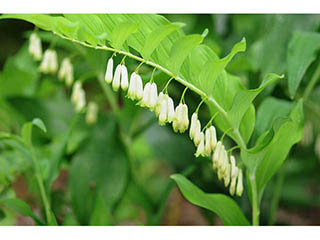
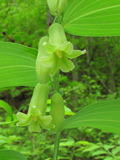
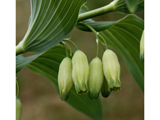
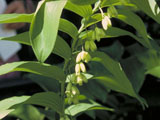
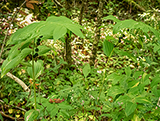
The zig-zag arching stalks are from 1-5 ft. long. Nodding, greenish-white, tubular flowers hang in pairs from the axils of the oval, conspicuously veined leaves. Hanging from the leaf axils on an arching stem are a few (often 2) greenish-white, bell-like flowers. Blue berries follow the flowers of this perennial. The root is rhizomatous but non-colonizing.
The graceful arching stems and pendulous flowers (often hidden) characterize this common plant. Another, almost identical species, Hairy Solomon's Seal (P. pubescens), is distinguished by minute hairs along veins on undersides of leaves. A much larger variety of this species, Great Solomon's Seal (P. biflorum var. commutatum), has larger flowers, 2-10 per cluster, and may be 7 feet (2.1 m) tall. The rootstalk, or rhizome, of the Solomon's Seal is jointed; the leaf stalk breaks away from it, leaving a distinctive scar said to resemble the official seal of King Solomon. Native Americans and colonists used the starchy rhizomes as food.

Plant Characteristics
Duration: PerennialHabit: Herb
Leaf Complexity: Simple
Fruit Type: Berry
Size Notes: Usually 2 feet tall, but occasionally exceeds 3 feet.
Leaf: Bright yellow-green
Flower: Flowers 3/4 inch
Fruit: Black, Blue A quarter inch to a half inch.
Bloom Information
Bloom Color: White , Yellow , Green , BrownBloom Time: Mar , Apr , May , Jun
Bloom Notes: Flowers typically pale green to white.
Distribution
USA: AL , AR , CT , DC , DE , FL , GA , IA , IL , IN , KS , KY , LA , MA , MD , ME , MI , MN , MO , MS , NC , ND , NE , NH , NJ , NM , NY , OH , OK , PA , RI , SC , SD , TN , TX , VA , VT , WI , WV , WYCanada: MB , NB , NS , ON , QC
Native Distribution: Southern Ontario, Nova Scotia, Manitoba, and Saskatchewan, south to FL and TX, up the Connecticut R. valley, s. MI, MN, & ND
Native Habitat: Rich, dry to moist woods; thickets; calcareous hammocks
Growing Conditions
Water Use: MediumLight Requirement: Part Shade , Shade
Soil Moisture: Dry , Moist
Soil pH: Acidic (pH<6.8)
Soil Description: Moist, rich, acid soils, though also occurs in calcareous areas. Prefers high humus. Sandy, Sandy Loam, Medium Loam, Clay Loam, Clay.
Conditions Comments: Does best in rich woodland soil but quite versatile and will do well at the base of trees.
Benefit
Use Ornamental: An understory plant used in eastern North America for its arching stems and attractive leaves.Use Wildlife: Roots consumed by mammals. Fruits attract birds.
Use Food: EDIBLE PARTS / PREPARATION: Young shoots can be boiled for 10 minutes and served like asparagus. Whole shoots can be cut up and put into salads. The rootstocks can be added to stew or boiled for 20 minutes and eaten like potatoes. (Poisonous Plants of N.C.)
First Nations People and colonists used the starchy rhizomes as food. (Niering)
Warning: POISONOUS PARTS: Berries. Only low toxicity if ingested. Symptoms include vomiting, diarrhea. Toxic Principle: Anthraquinone.
Conspicuous Flowers: yes
Interesting Foliage: yes
Attracts: Birds , Butterflies
Propagation
Propagation Material: Root Cuttings , SeedsDescription: Plant seeds immediately or treatment will be necessary. Rhizome cuttings will grow but may lie dormant a whole year. Divide the rhizomes in spring or fall when the plants are dormant. Set them horizontally, buds up, 18 in. apart and 1 in. deep.
Seed Collection: Collect in Sept.
Seed Treatment: Cold-moist stratify for 2 months at 40 degrees.
Commercially Avail: yes
Find Seed or Plants
View propagation protocol from Native Plants Network.
National Wetland Indicator Status
| Region: | AGCP | AK | AW | CB | EMP | GP | HI | MW | NCNE | WMVE |
| Status: | FACU | FACU | FACU | FACU | FACU | FACU | FACU |
From the National Organizations Directory
According to the species list provided by Affiliate Organizations, this plant is on display at the following locations:Pineywoods Native Plant Center - Nacogdoches, TX
Delaware Nature Society - Hockessin, DE
Mt. Cuba Center - Hockessin, DE
Bibliography
Bibref 928 - 100 easy-to-grow native plants for Canadian gardens (2005) Johnson, L.; A. LeyerleBibref 1620 - Gardening with Native Plants of the South (Reprint Edition) (2009) Wasowski, S. with A. Wasowski
Bibref 765 - McMillen's Texas Gardening: Wildflowers (1998) Howard, D.
Bibref 328 - Wildflowers of Texas (2003) Ajilvsgi, Geyata.
Search More Titles in Bibliography
From the Archive
Wildflower Newsletter 1993 VOL. 10, NO.4 - How to Hire a Garden Designer, Director's Report, Wild Collected or Propagated P...Additional resources
USDA: Find Polygonatum biflorum in USDA PlantsFNA: Find Polygonatum biflorum in the Flora of North America (if available)
Google: Search Google for Polygonatum biflorum
Metadata
Record Modified: 2019-12-06Research By: TWC Staff