Native Plants

Plant Database
Search for native plants by scientific name, common name or family. If you are not sure what you are looking for, try the Combination Search or our Recommended Species lists.
Hampton, Nan
Picea mariana
Picea mariana (Mill.) Britton, Sterns & Poggenb.
Black Spruce, Spruce Fir
Pinaceae (Pine Family)
Synonym(s): Picea mariana var. mariana
USDA Symbol: pima
USDA Native Status: L48 (N), AK (N), CAN (N), SPM (N)
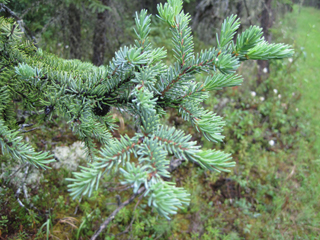
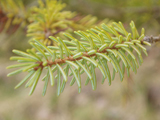
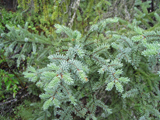
Black spruce is a very narrow, spire-like tree, growing 30-75 ft. tall with a limited spread. Descending branches, with dark, bluish-green needles, have upturned ends. Lower limbs sweep the ground. Tree with open, irregular, conical crown of short, horizontal or slightly drooping branches; a prostrate shrub at timberline.
Black Spruce is one of the most widely distributed conifers in North America. Uses are similar to those of White Spruce (Picea glauca); however, the small size limits lumber production. The lowest branches take root by layering when deep snows bend them to the ground, forming a ring of small trees around a large one. Spruce gum and spruce beer were made from this species and Red Spruce.


Plant Characteristics
Duration: PerennialHabit: Tree
Leaf Retention: Evergreen
Leaf Complexity: Simple
Breeding System: Flowers Unisexual , Monoecious
Fruit Type: Cone
Size Notes: Up to about 75 feet tall.
Leaf: Green
Fruit: Purple, Brown
Bloom Information
Bloom Color: Red , YellowBloom Time: Apr , May
Distribution
USA: AK , CT , IL , MA , ME , MI , MN , NH , NJ , NY , PA , RI , VT , WICanada: AB , BC , MB , NB , NL , NS , NT , ON , PE , QC , SK , YT
Native Distribution: Lab. & Nf. to the Yukon Valley, s. in mts. to PA, c. WI, c. MN & B.C.
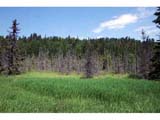
Native Habitat: Peat bogs; floodplains; swamps
Growing Conditions
Water Use: HighLight Requirement: Sun , Part Shade , Shade
Soil Moisture: Moist , Wet
CaCO3 Tolerance: Low
Soil Description: Wet to mesic, acidic soils.
Conditions Comments: An extremely slow grower. Shallow root system makes this tree susceptible to wind throw. Some disease and insect problems. A cold-climate tree, restricted in the southern part of its range to cold sphagnum bogs. The Alaska variety is less than 30 ft. tall and often shrubby.
Benefit
Use Wildlife: Twigs, leaves and seeds are important wildlife food. Very valuable as nesting sites for birds.Use Other: Long wood fibres of black spruce are most commonly used for pulpwood, especially for producing high quality papers. A thing of the past now is the gathering of spruce gum, by gummers on snowshoes, carrying long poles fitted with chisels to knock off the resinous exudations. In the old lumber camps, spruce gum was the chewing gum. (Peattie)
Fragrant Flowers: yes
Attracts: Birds , Butterflies
Larval Host: Columbia silkmoth, Bog Elfin butterfly (Callophrys lanoraieensis).
Butterflies and Moths of North America (BAMONA)
|
Bog Elfin (Callophrys lanoraieensis)  Larval Host |
Columbia silkmoth (Hyalophora columbia) 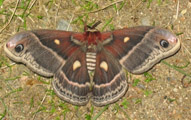 Larval Host |
Propagation
Description: Seeds of most Picea species germinate promptly without pretreatment. Cuttings root in low percentages.Seed Treatment: Pretreatment of most Picea species is not necessary, but cold stratification has been used for some of the species.
Commercially Avail: yes
Find Seed or Plants
View propagation protocol from Native Plants Network.
National Wetland Indicator Status
| Region: | AGCP | AK | AW | CB | EMP | GP | HI | MW | NCNE | WMVE |
| Status: | FACW | FACW | FACW | FACW | FACW | FACW |
Bibliography
Bibref 1186 - Field Guide to Moths of Eastern North America (2005) Covell, C.V., Jr.Bibref 1185 - Field Guide to Western Butterflies (Peterson Field Guides) (1999) Opler, P.A. and A.B. Wright
Search More Titles in Bibliography
Web Reference
Webref 3 - Flora of North America (2014) Missouri Botanical Garden, St. Louis, MO & Harvard University Herbaria, Cambridge, MA.Additional resources
USDA: Find Picea mariana in USDA PlantsFNA: Find Picea mariana in the Flora of North America (if available)
Google: Search Google for Picea mariana
Metadata
Record Modified: 2022-09-21Research By: TWC Staff