Native Plants

Plant Database
Search for native plants by scientific name, common name or family. If you are not sure what you are looking for, try the Combination Search or our Recommended Species lists.
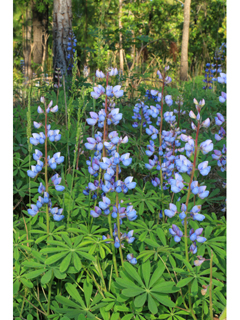
Cressler, Alan
Lupinus perennis
Lupinus perennis L.
Sundial Lupine, Wild Lupine
Fabaceae (Pea Family)
Synonym(s):
USDA Symbol: lupe3
USDA Native Status: L48 (N), CAN (I)
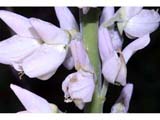
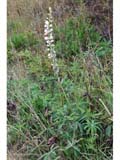
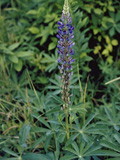
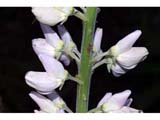
Showy, elongate clusters of purple, pea-like flowers top the 1-2 ft. stems of this perennial lupine. Blue, pea-like flowers are in an upright, elongated, terminal cluster on an erect stem with palmately compound leaves. Its leaves are palmately divided into 7-11 leaflets. Occasionally flowers range from pink to white.
The plant was once thought to deplete or "wolf" the mineral content of the soil; hence the genus name derived from the Latin lupus ("wolf"). Actually the plant and all the family enhances soil fertility by fixing atmospheric nitrogen into a useful form. In the south this flower has narrower leaflets and is often recognized as a separate species, Nuttal's Lupine (L. nuttallii). Two southern species with undivided elliptic leaves are Spreading Lupine (L. diffusus), with blue flowers and a whitish spot on the standard (upper petal), and Hairy Lupine (L. villosus), a hairy plant with lavender-blue flowers and a red-purple spot on the standard. They are found from North Carolina to Florida and west to Louisiana. A species found in Nebraska, Wyoming, and Colorado, Nebraska Lupine (L. plattensis), has blue flowers with a dark spot on the standard and paddle-shaped leaflets. L. polyphyllus is becoming extremely abundant in the Northeast, particularly Maine and adjacent Canada; it was introduced from the Northwest.

Plant Characteristics
Duration: PerennialHabit: Herb
Leaf Arrangement: Alternate
Leaf Complexity: Palmate
Breeding System: Flowers Bisexual
Fruit Type: Legume
Size Notes: Up to about 2 feet tall.
Bloom Information
Bloom Color: White , Pink , Blue , PurpleBloom Time: Apr , May , Jun , Jul
Bloom Notes: Flowers rarely pink or white.
Distribution
USA: AL , CT , DC , DE , FL , GA , IA , IL , IN , KY , LA , MA , MD , ME , MI , MN , MS , NC , NH , NJ , NY , OH , PA , RI , SC , TX , VA , VT , WI , WVCanada: NB , ON
Native Distribution: NH to s. Ont., n. IL, n. IN & e. MN, s. to FL & LA
Native Habitat: Sand hills & clearings; open woods
Growing Conditions
Light Requirement: Sun , Part ShadeSoil Moisture: Dry , Moist
Soil pH: Acidic (pH<6.8) , Circumneutral (pH 6.8-7.2)
Soil Description: Dry, sandy soils.
Conditions Comments: Requires good drainage, but is very adaptable.
Benefit
Use Wildlife: Deer browse foliage. Birds and small mammals eat the seeds.Warning: Plants in the genus Lupinus, especially the seeds, can be toxic to humans and animals if ingested. POISONOUS PARTS: Seeds. Toxic only if eaten in large quantities. Symptoms include respiratory depression and slow heartbeat, sleepiness, convulsions. Toxic Principle: Alkaloids such as lupinine, anagyrine, sparteine, and hydroxylupanine. (Poisonous Plants of N.C.)
The plant and all the family enhances soil fertility by fixing atmospheric nitrogen into a useful form. (Niering)
Conspicuous Flowers: yes
Attracts: Butterflies , Hummingbirds
Larval Host: Karner Blue butterfly (Lycaeides melissa sub. samuelis), Frosted Elfin butterfly (Callophrys irus)
Value to Beneficial Insects
Special Value to Native BeesSpecial Value to Bumble Bees
This information was provided by the Pollinator Program at The Xerces Society for Invertebrate Conservation.
Butterflies and Moths of North America (BAMONA)
|
Frosted Elfin (Callophrys irus) 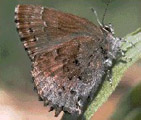 Larval Host |
Propagation
Propagation Material: SeedsDescription: Best propagated from dry, treated seed in spring. Fresh-sown seed does not need treatment. Do not plant more than 3/4 in. deep. Does not transplant well due to deep tap root
Seed Collection: Fruit is a hairy pod. Collect in late Jun. to early Jul. Seedhead explodes.
Seed Treatment: Scarification, inoculation, moist stratification for 10 days. Soil should be inoculated before swoing seed.
Commercially Avail: yes
Find Seed or Plants
Find seed sources for this species at the Native Seed Network.
Mr. Smarty Plants says
Native flowers for Door County, Wisconsin
September 02, 2009
We recently were required to put in a new septic system on our vacation property in Door County, WI. This left us with a clearing on our wooded lot where the septic field is now located. The installer...
view the full question and answer
Evergreen privacy hedge and drought-resistant garden
July 21, 2008
I am looking for a hardy evergreen hedge for privacy in Northern Michigan. I have sandy soil. Also am interested in planting a drought garden with mostly sun in same sandy soil.
view the full question and answer
Native plants to stabilize a steep bank in Pennsylvania
April 23, 2008
I would like to use native plantings to stabilize a steep bank of a septic leach field in eastern Pennsylvania. My purpose is to control erosion and to eliminate the need for mowing. What would you r...
view the full question and answer
From the National Organizations Directory
According to the species list provided by Affiliate Organizations, this plant is on display at the following locations:Delaware Nature Society - Hockessin, DE
Native Seed Network - Corvallis, OR
Mt. Cuba Center - Hockessin, DE
Bibliography
Bibref 928 - 100 easy-to-grow native plants for Canadian gardens (2005) Johnson, L.; A. LeyerleBibref 1186 - Field Guide to Moths of Eastern North America (2005) Covell, C.V., Jr.
Bibref 1185 - Field Guide to Western Butterflies (Peterson Field Guides) (1999) Opler, P.A. and A.B. Wright
Bibref 946 - Gardening with Prairie Plants: How to Create Beautiful Native Landscapes (2002) Wasowski, Sally
Bibref 318 - Native Texas Plants: Landscaping Region by Region (2002) Wasowski, S. & A. Wasowski
Bibref 1294 - The Midwestern Native Garden: Native Alternatives to Nonnative Flowers and Plants An Illustrated Guide (2011) Adelman, Charlotte and Schwartz, Bernard L.
Search More Titles in Bibliography
From the Archive
Wildflower Newsletter 1985 VOL. 2, NO.1 - A Glorious Spring, Lupines in Landscapes, Director's Report, Notable Quote, Wild...Additional resources
USDA: Find Lupinus perennis in USDA PlantsFNA: Find Lupinus perennis in the Flora of North America (if available)
Google: Search Google for Lupinus perennis
Metadata
Record Modified: 2014-09-04Research By: TWC Staff