Native Plants

Plant Database
Search for native plants by scientific name, common name or family. If you are not sure what you are looking for, try the Combination Search or our Recommended Species lists.
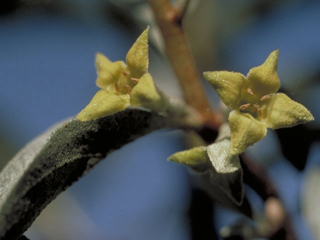
Weyand, Phyllis
Elaeagnus commutata
Elaeagnus commutata Bernh. ex Rydb.
Silverberry, American Silverberry, Wild Olive, Wolf Willow
Elaeagnaceae (Oleaster Family)
Synonym(s): Elaeagnus argentea
USDA Symbol: elco
USDA Native Status: L48 (N), AK (N), CAN (N)
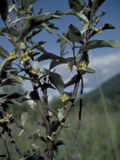
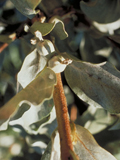
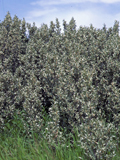
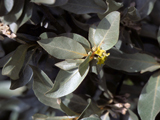
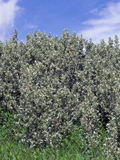
An rounded, twiggy shrub, 1-15 ft. tall, with narrow, silvery-scurfy leaves on grayish-red branches. Small clusters of inconspicuous, cone-shaped flowers are spicily perfumed with a heavy, sweet scent. The fruit is a dry, mealy, whitish berry. This suckering shrub can form patches several yards in diameter.
Fast-growing, long-lived and resistant to disease and insect problems and drought. Transplants well, due to a shallow root system. A very hardy species for cold climates, sometimes used as a windbreak. (The non-native Russian Olive, E. angustifolia, is more extensively used for windbreaks and is becoming invasive.)
Plant Characteristics
Duration: PerennialHabit: Shrub
Leaf Retention: Deciduous
Fruit Type: Drupe
Size Notes: Up to about 15 feet tall.
Leaf: White-Gray
Bloom Information
Bloom Color: YellowBloom Time: Jun , Jul
Distribution
USA: AK , CO , ID , KY , MD , MN , MT , ND , RI , SD , TX , UT , WA , WYCanada: AB , MB , NT , NU , ON , QC , SK , YT
Native Distribution: Que. to AK, s. to n.w. MN, n.c. SD, n.e. MT & in the Rockies to UT
Native Habitat: Waterways; gravel benches; prairie hillsides; dry clearings
Growing Conditions
Water Use: LowLight Requirement: Sun , Part Shade , Shade
Soil Moisture: Dry
Soil pH: Circumneutral (pH 6.8-7.2)
CaCO3 Tolerance: High
Drought Tolerance: High
Soil Description: Well-drained, poor soils.
Conditions Comments: Fast-growing, long-lived and resistant to disease and insect problems and drought. Transplants well, due to a shallow root system. A very hardy species for cold climates, sometimes used as a windbreak. (The non-native Russian olive, E. angustifolia, is more extensively used for windbreaks and is becoming invasive.)
Benefit
Use Wildlife: Browsers eat the foliage and twigs.Conspicuous Flowers: yes
Fragrant Flowers: yes
Propagation
Description: Propagation is by layering, grafting, hardwood & root cuttings and by seed. Seed usually germinate the second spring. Suckers can be separated from parent plants in spring. Stratify seed for 2 to 3 months at 40C prior to sowing. Cutting, suckers. (Williams)Seed Treatment: Seeds have a dual dormancy mechanism. A germination inhibitor is present in the seed coat, and the seeds will not germinate in the presence of light. The seed coat inhibitor can be leached by washing the seeds in warm water for 24 hours.
Commercially Avail: yes
Find Seed or Plants
View propagation protocol from Native Plants Network.
National Wetland Indicator Status
| Region: | AGCP | AK | AW | CB | EMP | GP | HI | MW | NCNE | WMVE |
| Status: | UPL | FAC | FAC | UPL | UPL | UPL | UPL | FAC |
Bibliography
Bibref 946 - Gardening with Prairie Plants: How to Create Beautiful Native Landscapes (2002) Wasowski, SallyBibref 841 - Native Alternatives to Invasive Plants (2006) Burrell, C. C.
Search More Titles in Bibliography
Web Reference
Webref 38 - Flora of North America (2019) Missouri Botanical Garden, St. Louis, MO & Harvard University Herbaria, Cambridge, MA.Webref 23 - Southwest Environmental Information Network (2009) SEINet - Arizona Chapter
Additional resources
USDA: Find Elaeagnus commutata in USDA PlantsFNA: Find Elaeagnus commutata in the Flora of North America (if available)
Google: Search Google for Elaeagnus commutata
Metadata
Record Modified: 2023-02-07Research By: TWC Staff