Native Plants

Plant Database
Search for native plants by scientific name, common name or family. If you are not sure what you are looking for, try the Combination Search or our Recommended Species lists.
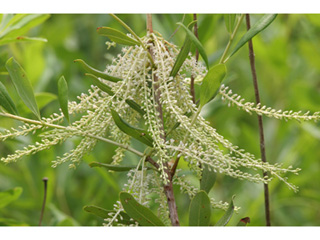
Fannon, Carolyn
Cyrilla racemiflora
Cyrilla racemiflora L.
Titi, Swamp Titi, Black Titi, White Titi, Red Titi, Leatherwood, Swamp Cyrilla, American Cyrilla, Burnwood Bark, Palo Colorado
Cyrillaceae (Cyrilla Family)
Synonym(s): Cyrilla antillana
USDA Symbol: cyra
USDA Native Status: L48 (N), PR (N)
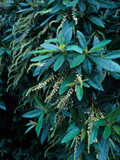
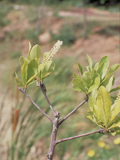
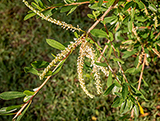
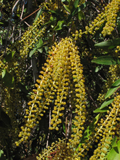
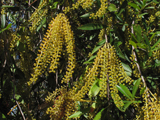
Native from southeastern North America south through Central America and the West Indies to northeastern South America, this deciduous tree stays under 30 ft., and, though it looks shrubby for several years, eventually makes a slender tree with smooth, cinnamon-colored trunks; abundant, showy, whorled clusters of airy, white blooms; and dark-green leaves. In the northern part of its range, the leaves turn rust-red in fall, dropping in spring just as the new leaves unfurl. Farther south, plants are nearly evergreen. Summer fruits are yellow-brown.
In the upper mountain forests of Puerto Rico, Leatherwood is a large dominant tree known as palo colorado ("red tree") because of its reddish-brown bark and wood. Bees produce a dark honey from the flowers.
Plant Characteristics
Duration: PerennialHabit: Tree
Leaf Retention: Deciduous , Evergreen
Leaf Arrangement: Alternate
Leaf Complexity: Simple
Leaf Shape: Oblanceolate , Oval
Leaf Venation: Reticulate
Leaf Margin: Entire
Leaf Texture: Smooth
Breeding System: Flowers Bisexual
Inflorescence: Raceme
Fruit Type: Capsule
Size Notes: Usually up to 10 feet tall, sometimes as much as 35 feet tall.
Leaf: Alternate, simple, oblanceolate to oval, rounded or pointed at the tip, narrowed to the base, thick, without teeth, smooth, sometimes nearly evergreen, reticulate-veined, up to 4 inches long, up to 1 inch wide.
Flower: Many, crowded in racemes borne on last year's twigs; racemes up to 6 inches long; flower stalks subtended by slender bracts.
Fruit: Ovoid, dry, about 1/12 inch long, with 1-5 seeds, but only 1 seed maturing.
Bloom Information
Bloom Color: WhiteBloom Time: May , Jun , Jul
Distribution
USA: AL , DE , FL , GA , LA , MS , NC , SC , TX , VANative Distribution: Coastal plain from s.e. VA to FL and TX, south through the West Indies, Mexico, and Central America to northeastern South America.
Native Habitat: Low, wet pinelands; stream banks
Growing Conditions
Water Use: MediumLight Requirement: Part Shade
Soil Moisture: Wet
Soil pH: Circumneutral (pH 6.8-7.2)
Soil Description: Moist, well-drained soils with high organic matter. Acid-based, Sandy, Sandy Loam, Medium Loam
Conditions Comments: Leatherwood does not tolerate competition from other trees or shrubs. It has no serious disease or insect problems.
Benefit
Use Ornamental: Aromatic, Showy, Blooms ornamental, Bog or pond area, Fall conspicuous, Water gardenUse Wildlife: Nectar-bees, Fruit-birds, Fruit-mammals
Conspicuous Flowers: yes
Propagation
Propagation Material: Root CuttingsDescription: Cutting root in high percentages. Root cuttings should be taken during the fall or winter, while softwood cuttings should be taken in early summer. Seeds can be direct sown.
Seed Collection: Capsules nearing maturity should be clipped from the tree before they split open.
Seed Treatment: Seeds require no special treatment.
Commercially Avail: yes
National Wetland Indicator Status
| Region: | AGCP | AK | AW | CB | EMP | GP | HI | MW | NCNE | WMVE |
| Status: | FACW | FACW | FACW | FACW |
From the National Organizations Directory
According to the species list provided by Affiliate Organizations, this plant is on display at the following locations:Crosby Arboretum - Picayune, MS
Georgia Native Plant Society - Atlanta, GA
Mt. Cuba Center - Hockessin, DE
Bibliography
Bibref 298 - Field Guide to Texas Trees (1999) Simpson, B.J.Bibref 1620 - Gardening with Native Plants of the South (Reprint Edition) (2009) Wasowski, S. with A. Wasowski
Bibref 841 - Native Alternatives to Invasive Plants (2006) Burrell, C. C.
Bibref 318 - Native Texas Plants: Landscaping Region by Region (2002) Wasowski, S. & A. Wasowski
Bibref 291 - Texas Wildscapes: Gardening for Wildlife (1999) Damude, N. & K.C. Bender
Search More Titles in Bibliography
Web Reference
Webref 17 - Southern Wetland Flora: Field Office Guide to Plant Species (0) U.S. Department of Agriculture. No date. Southern wetland flora: Field office guide to plant species. U.S.D.A. Soil Conservation Service, South Nat...Research Literature
Reslit 375 - Floral anatomy and pollination biology of Cyrilla racemiflora (Cyrillaceae) (2004) R. R. Dute, D. R. Folkerts, J. E. Watkins, M. E. S...Reslit 369 - Growth rings, phenology, hurricane disturbance and climate in Cyrilla racemiflora L., a rain forest tree of the Luquillo mountains, Puerto Rico (1998) A. P. Drew
Reslit 848 - Fruit fall in the Luquillo experimental forest, Puerto Rico (1993) A. E. Lugo and J. L. Frangi
Reslit 983 - A Lectotype for Cyrilla racemiflora L. (Cyrillaceae) (1990) C. Nelson
Reslit 1302 - A strategy for restoration of montane forest in anthropogenic fern thickets in the Dominican Republic (2006) M. G. Slocum, T. M. Aide, J. K. Zimmerman and L. N...
Reslit 1369 - Short-term disappearance of foliar litter in three species before and after a hurricane (1999) N. H. Sullivan, W. B. Bowden and W. H. McDowell
Reslit 1400 - Wood decomposition of Cyrilla racemiflora (Cyrillaceae) in Puerto Rican dry and wet forests: A 13-year case study (2005) J. A. Torres and G. Gonzalez
This information was provided by the Florida WIldflower Foundation.
Search More Titles in Research Literature
Additional resources
USDA: Find Cyrilla racemiflora in USDA PlantsFNA: Find Cyrilla racemiflora in the Flora of North America (if available)
Google: Search Google for Cyrilla racemiflora
Metadata
Record Modified: 2021-03-18Research By: TWC Staff