Native Plants

Plant Database
Search for native plants by scientific name, common name or family. If you are not sure what you are looking for, try the Combination Search or our Recommended Species lists.
Bransford, W.D. and Dolphia
Cotinus obovatus
Cotinus obovatus Raf.
American Smoke Tree, Texas Smoke Tree, Wild Smoke Tree, Smoke Tree, Smokebush, Chittamwood
Anacardiaceae (Sumac Family)
Synonym(s): Cotinus americanus
USDA Symbol: coob2
USDA Native Status: L48 (N)
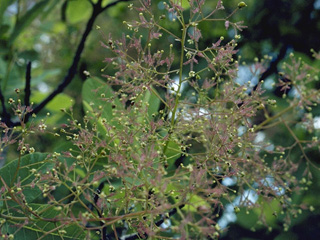
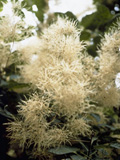
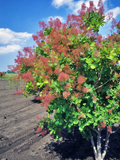
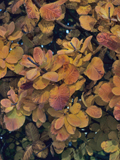
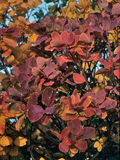
American smoketree is an upright, small tree or multi-trunked shrub, growing 15-30 ft. tall. Has a short trunk, open crown of spreading branches, resinous sap with a strong odor, and deep orange-yellow heartwood. Six to ten inch flower panicles develop long, red or purple, hairlike petioles that, in the crowded flower clusters, create a smoky appearance. (The flower itself is small and not showy.) Berries occur infrequently on pinkish stems; these also have a smoke-like look. Spring leaves are silky pink, becoming bluish to dark green. Fall leaves are magnificently colorful. A gnarled limb structure and the dark, flaking bark are other attributes. The masses of smoke-like fruit clusters with hairy stalks of sterile flowers give the species its common name.
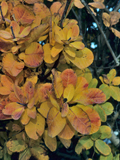
Native to rocky, usually mountain soils from Kentucky, Tennessee, and northern Alabama west to Oklahoma, with disjunct populations in a few counties of central Texas, Cotinus obovatus is an outstanding small, ornamental tree. Its bark is decorative, its leaves are soothing blue-green in spring and summer and flaming oranges and reds in fall, and its flowers form ethereal clouds of pink and purple in spring. The floral panicles wave in the breeze, giving the illusion of clouds of smoke. It is drought-tolerant, disease-resistant, well-adapted to the stony soils of its native habitat, and should not be over-watered or over-fertilized.
Plant Characteristics
Duration: PerennialHabit: Tree
Leaf Retention: Deciduous
Leaf Arrangement: Alternate
Leaf Complexity: Simple
Leaf Shape: Elliptic , Obovate , Ovate
Leaf Venation: Pinnate
Leaf Pubescence: Glabrous , Puberulent
Leaf Margin: Entire
Leaf Apex: Obtuse
Leaf Base: Cuneate , Rounded
Breeding System: Flowers Unisexual , Monoecious
Inflorescence: Panicle
Fruit Type: Drupe
Size Notes: Up to about 30 feet tall, often much shorter.
Leaf: Blue-green above, pale below.
Flower: Flowers in 12-inch panicles
Fruit: Purple to brown, 1/8 inch long.
Bloom Information
Bloom Color: Pink , Yellow , PurpleBloom Time: Apr , May
Bloom Notes: Flowers change from yellow to pink or purple as they age.
Distribution
USA: AL , AR , GA , KY , MO , OK , TN , TXNative Distribution: Ozark Mts. of AR & adjacent MO & OK; also KY & TN, s. to AL & GA; Edwards Plateau of TX
Native Habitat: Hillsides; limestone outcrops; rocky woods
Growing Conditions
Water Use: LowLight Requirement: Sun , Part Shade
Soil Moisture: Dry
Soil pH: Alkaline (pH>7.2)
Drought Tolerance: High
Cold Tolerant: yes
Heat Tolerant: yes
Soil Description: Rocky, well-drained, limestone soils, whether sand, loam, or clay.
Conditions Comments: Once it is established within its range, it thrives on tough conditions and neglect and should not be over-watered. Rich soil and too much water may create a weak plant. It likes rocky north- or east-facing slopes, or plant on protected side of Ashe Juniper (Juniperus ashei).
Benefit
Use Ornamental: A small tree valued for its trunk and branches, cloud-like spring blooms, and standout fall foliage.Use Wildlife: Browsed by wildlife.
Use Other: The wood was once used for making a yellow dye and for fence posts and tool handles
Conspicuous Flowers: yes
Interesting Foliage: yes
Deer Resistant: Moderate
Propagation
Propagation Material: Root Cuttings , Seeds , Semi-hardwood Cuttings , Softwood CuttingsDescription: Few seeds are formed. Those sown immediately after collection may take two springs to germinate. Scarification and stratification hasten germination. Smoke-trees are also propagated from root or stem cuttings or layering. Semi-hardwood or softwood cuttings should be taken in late spring after flowering.
Seed Collection: To collect seeds before wind dispersion, clip the entire fruiting panicle from the tree in late April. Collect enough to compensate for a high percentage of infertile seed. Air-dry before storing or planting. When dried, fuzzy panicle are easily detached.
Seed Treatment: Scarification in a 20-40 minute concentrated sulfuric acid treatment or with warm, moist stratification for 150 days. Follow with 60-80 days of stratification at 38-41 degrees.
Commercially Avail: yes
Maintenance: Do not over-water once it's established.
Mr. Smarty Plants says
Native alternative for Japanese Red Maple in Oklahoma
October 12, 2009
Mr. Smarty Plants, I am looking for a native alternative to a Japanese Red Maple. I would like a small tree that I can put in my front garden that will not pose a security risk my being overgrown and ...
view the full question and answer
From the National Organizations Directory
According to the species list provided by Affiliate Organizations, this plant is on display at the following locations:Lady Bird Johnson Wildflower Center - Austin, TX
Texas Discovery Gardens - Dallas, TX
NPSOT - Native Plant Society of Texas - Fredericksburg, TX
NPSOT - Austin Chapter - Austin, TX
NPSOT - Williamson County Chapter - Georgetown, TX
Mt. Cuba Center - Hockessin, DE
Bibliography
Bibref 298 - Field Guide to Texas Trees (1999) Simpson, B.J.Bibref 481 - How to Grow Native Plants of Texas and the Southwest: Revised and Updated Edition (2001) Nokes, J.
Bibref 841 - Native Alternatives to Invasive Plants (2006) Burrell, C. C.
Bibref 318 - Native Texas Plants: Landscaping Region by Region (2002) Wasowski, S. & A. Wasowski
Bibref 297 - Trees of Central Texas (1984) Vines, Robert A.
Bibref 286 - Wildflowers of the Texas Hill Country (1989) Enquist, M.
Search More Titles in Bibliography
Additional resources
USDA: Find Cotinus obovatus in USDA PlantsFNA: Find Cotinus obovatus in the Flora of North America (if available)
Google: Search Google for Cotinus obovatus
Metadata
Record Modified: 2015-11-12Research By: NPC, GDG