Native Plants

Plant Database
Search for native plants by scientific name, common name or family. If you are not sure what you are looking for, try the Combination Search or our Recommended Species lists.
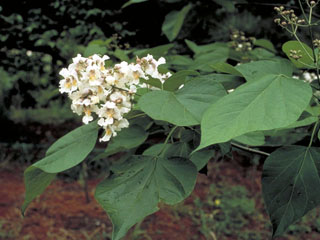
Cox, Paul
Catalpa speciosa
Catalpa speciosa (Warder) Warder ex Engelm.
Northern Catalpa, Catalpa Tree, Cigar Tree, Indian Bean
Bignoniaceae (Trumpet-Creeper Family)
Synonym(s):
USDA Symbol: casp8
USDA Native Status: L48 (N), CAN (I)
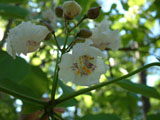
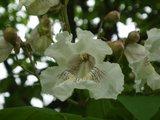
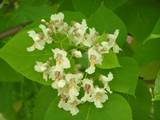
Northern catalpa is a 75-100 ft., deciduous tree with a narrow, oval crown. The rugged winter outline is striking. Grayish- to reddish-brown bark breaks into thick scales. Leaves heart shaped with a drawn out tip and usually smooth, sometimes shallowly lobed, margins, petioles up to 8 inches long and blades to 12 inches long by 8 inches wide. Large, showy, white to lavender, bell-shaped flowers with frilled rims occur in heavy, upright clusters at the outer ends of the branches. Flowers up to 2 inches long by 2 inches wide, petals white with yellow streaks and purplish spots inside, fused about half their length and flaring into 2 unequal lips, the smaller 2 lobed, the larger 3 lobed; in open clusters. Fruit a long, narrow pod up to 18 inches in length by 1/2 inch in width persisting through winter. Fall color is poor; leaves often fall before turning.
Northern Catalpa is the northernmost New World example of its tropical family and is hardier than Southern Catalpa (Catalpa bignonioides), which blooms later and has slightly smaller flowers and narrower, thinner-walled capsules. Both are called "Cigartree" and "Indian-bean" because of the distinctive fruit.


Plant Characteristics
Duration: PerennialHabit: Tree
Leaf Retention: Deciduous
Fruit Type: Capsule
Size Notes: Up to about 100 feet tall.
Leaf: Dark green.
Fruit: Long pod-like capsule.
Bloom Information
Bloom Color: WhiteBloom Time: Apr , May , Jun
Distribution
USA: AL , AR , CT , DC , GA , IA , IL , IN , KS , KY , LA , MA , MD , ME , MI , MN , MO , MS , NC , ND , NE , NH , NY , OH , OK , PA , RI , SC , SD , TN , TX , UT , VA , WI , WVNative Distribution: Originally native from w. TN & n.e. AR, to s.w. IN & e. MO; now widely naturalized in s.e. U.S.
Native Habitat: Moist, lowland woods; roadsides; waste places; uplands
Growing Conditions
Water Use: LowLight Requirement: Part Shade
Soil Moisture: Moist
CaCO3 Tolerance: Low
Soil Description: Deep, rich, moist soils.
Conditions Comments: Rapid growing and relatively short-lived, northern catalpa is adaptable to many different soils and sites, but is not particularly drought-tolerant. Catalpas are major litter producers, shedding flowers, small branches, large leaves and seedpods. Brittle branches break easily in wind storms. It is susceptible to defoliation by leaf blight and the sphinx moth caterpillar.
Benefit
Conspicuous Flowers: yesValue to Beneficial Insects
Special Value to Honey BeesThis information was provided by the Pollinator Program at The Xerces Society for Invertebrate Conservation.
Propagation
Description: Very easy to grow from seeds and transplant. Seeds require no pretreatment. Catalpa will root from semi-hardwood cuttings taken in late summer or root cuttings taken in late fall.Seed Collection: Capsules split and disperse seed in late winter or early spring. Collect fruits after capsules brown and begin to dry. Insect infestation is likely if left on the tree too long. Dry, cold storage is recommended.
Commercially Avail: yes
Find Seed or Plants
Find seed sources for this species at the Native Seed Network.
National Wetland Indicator Status
| Region: | AGCP | AK | AW | CB | EMP | GP | HI | MW | NCNE | WMVE |
| Status: | FACU | FAC | FAC | FACU | FACU | FACU | FACU |
From the National Organizations Directory
According to the species list provided by Affiliate Organizations, this plant is on display at the following locations:Native Seed Network - Corvallis, OR
Bibliography
Bibref 841 - Native Alternatives to Invasive Plants (2006) Burrell, C. C.Search More Titles in Bibliography
Additional resources
USDA: Find Catalpa speciosa in USDA PlantsFNA: Find Catalpa speciosa in the Flora of North America (if available)
Google: Search Google for Catalpa speciosa
Metadata
Record Modified: 2016-05-18Research By: TWC Staff