Native Plants

Plant Database
Search for native plants by scientific name, common name or family. If you are not sure what you are looking for, try the Combination Search or our Recommended Species lists.
Marcus, Joseph A.
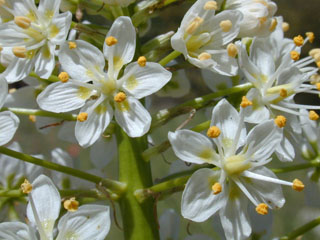
Zigadenus nuttallii
Zigadenus nuttallii (A. Gray) S. Watson
Nuttall's Death Camas, Death Camas, Poison-onion
Liliaceae (Lily Family)
Synonym(s): Toxicoscordion nuttallii
USDA Symbol: ZINU
USDA Native Status: L48 (N)
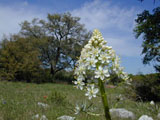
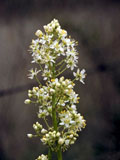
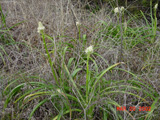
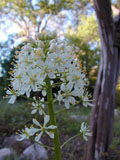
This common prairie flower grows 1-2+ feet tall and has long, narrow leaves near the bottom of the plant. The stout stems grow out of a large, black-coated bulb, which is poisonous, as are all parts of the plant, even when dry. Sheep are often poisoned by it. Flowers are cream-colored, 1/2 inch across, growing around the top of the stem in a round-topped cluster. The stamens have large yellow anthers.
This species is similar to Camas (Z. leimanthoides) but has a papery, not fibrous, coat on the bulbous base.

Plant Characteristics
Duration: PerennialHabit: Herb
Leaf Complexity: Simple
Fruit Type: Capsule
Size Notes: Up to about 2-1/2 feet tall.
Bloom Information
Bloom Color: WhiteBloom Time: Feb , Mar , Apr , May , Jun
Distribution
USA: AR , KS , LA , MO , OK , TN , TXNative Distribution: Kansas east to Missouri and Tennessee, south to Louisiana, west to Texas, and north to Oklahoma.
Native Habitat: Prairies and open woodlands.
Growing Conditions
Light Requirement: Part ShadeConditions Comments: Poisonous leaves arise from a dark bulb. Said to be rare because Indians would weed them from their Camus plots. Death Camus (Zigadenus nuttallii) vegatative and flower growth is very similar to the edible Camus (Camassia sp.); great care should be taken to become familiar with Death Camus as all parts of the plant are poisonous.
Benefit
Conspicuous Flowers: yesAttracts: Birds
Deer Resistant: High
From the National Organizations Directory
According to the species list provided by Affiliate Organizations, this plant is on display at the following locations:Lady Bird Johnson Wildflower Center - Austin, TX
Bibliography
Bibref 248 - Texas Wildflowers: A Field Guide (1984) Loughmiller, C. & L. LoughmillerBibref 328 - Wildflowers of Texas (2003) Ajilvsgi, Geyata.
Bibref 286 - Wildflowers of the Texas Hill Country (1989) Enquist, M.
Search More Titles in Bibliography
Web Reference
Webref 38 - Flora of North America (2019) Missouri Botanical Garden, St. Louis, MO & Harvard University Herbaria, Cambridge, MA.Webref 23 - Southwest Environmental Information Network (2009) SEINet - Arizona Chapter
Additional resources
USDA: Find Zigadenus nuttallii in USDA PlantsFNA: Find Zigadenus nuttallii in the Flora of North America (if available)
Google: Search Google for Zigadenus nuttallii
Metadata
Record Modified: 2023-04-12Research By: LAL