Native Plants

Plant Database
Search for native plants by scientific name, common name or family. If you are not sure what you are looking for, try the Combination Search or our Recommended Species lists.
Flaigg, Norman G.
Yucca thompsoniana
Yucca thompsoniana Trel.
Thompson's Yucca, Thompson Yucca, Beaked Yucca, Big Bend Yucca, Soyate, Palmita, Trans-Pecos Yucca
Agavaceae (Century-Plant Family)
Synonym(s): Yucca rostrata, Yucca rostrata var. linearis
USDA Symbol: YUTH
USDA Native Status: L48 (N)
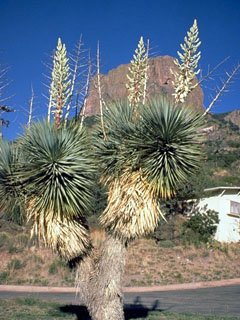
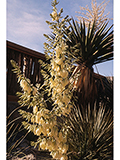
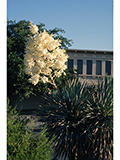
Thompson’s yucca grows 6-12 feet high, treelike, with a trunk 5-8 inches in diameter. The trunk is usually unbranched. The leaves are narrow and stiff and grow in a radiating mass near the top; they are 8-24 inches long and about 1/2 inch wide in the middle. They gradually widen from the base to the middle, then narrow to a needlelike spine at the tip. The margins are horny, pale yellow, and more or less fine-toothed. The stout, 2-3 ft. flowering stalk holds a dense panicle of white flowers slightly above the foliage.
Beaked yucca, Yucca thompsoniana (formerly Y. rostrata), gets its common name from the shape of its fruit. It. Many yuccas get unkempt, with shaggy, brown leaves hanging down; Thompson Yucca stays neat. It will adapt to any soil and reflected heat.


Plant Characteristics
Duration: PerennialHabit: Cactus/Succulent
Leaf Retention: Evergreen
Leaf Complexity: Simple
Fruit Type: Capsule
Size Notes: Up to about 12 feet tall.
Bloom Information
Bloom Color: WhiteBloom Time: Apr , May
Distribution
USA: TXNative Distribution: Trans-Pecos, TX & n. Mex.
Native Habitat: Dry, exposed, rocky slopes
Growing Conditions
Light Requirement: SunSoil Moisture: Dry
Cold Tolerant: yes
Soil Description: Rocky soils.
Conditions Comments: Many yuccas get unkempt, with shaggy, brown leaves hanging down; Thompson yucca stays better looking than that. It will adapt to any soil and reflected heat.
Benefit
Conspicuous Flowers: yesInteresting Foliage: yes
Propagation
Propagation Material: SeedsDescription: Yuccas will germinate promptly from fresh seed held over winter. Seeds germinate best in 60-70 degree temperatures. Yuccas may also be grown from rhizomes, stem cuttings, or by digging offsets from the side of established plants. Transplant into a well
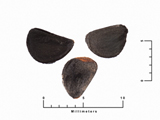
Seed Collection: Gather capsules as they begin to dry but before they split. Allow to dry, then crush to remove seeds. Overwinter, keep seeds in moist sand in the refrigerator. For longer storage periods, keep in sealed, refrigerated containers.
Commercially Avail: yes
From the National Organizations Directory
According to the species list provided by Affiliate Organizations, this plant is on display at the following locations:NPSOT - Austin Chapter - Austin, TX
NPSOT - Williamson County Chapter - Georgetown, TX
Wildflower Center Seed Bank
LBJWC-1074 Collected 2007-07-05 in Brewster County by Lady Bird Johnson Wildflower CenterBibliography
Bibref 298 - Field Guide to Texas Trees (1999) Simpson, B.J.Bibref 841 - Native Alternatives to Invasive Plants (2006) Burrell, C. C.
Bibref 995 - Native Landscaping from El Paso to L.A. (2000) Wasowski, S. and A. Wasowski
Bibref 318 - Native Texas Plants: Landscaping Region by Region (2002) Wasowski, S. & A. Wasowski
Bibref 248 - Texas Wildflowers: A Field Guide (1984) Loughmiller, C. & L. Loughmiller
Bibref 297 - Trees of Central Texas (1984) Vines, Robert A.
Search More Titles in Bibliography
Additional resources
USDA: Find Yucca thompsoniana in USDA PlantsFNA: Find Yucca thompsoniana in the Flora of North America (if available)
Google: Search Google for Yucca thompsoniana
Metadata
Record Modified: 2018-12-14Research By: TWC Staff