Native Plants

Plant Database
Search for native plants by scientific name, common name or family. If you are not sure what you are looking for, try the Combination Search or our Recommended Species lists.
Wasowski, Sally and Andy
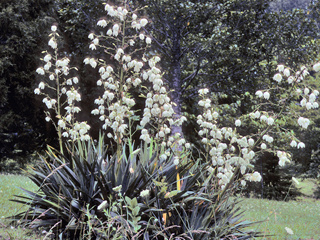
Yucca filamentosa
Yucca filamentosa L.
Adam's Needle
Agavaceae (Century-Plant Family)
Synonym(s): Yucca concava, Yucca filamentosa var. concava
USDA Symbol: YUFI
USDA Native Status: L48 (N)
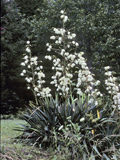
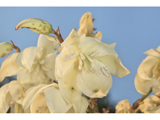
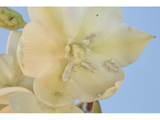
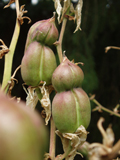
A 6 ft. flowering stalk rises above 2-3 ft. high clumps of erect, dagger-like, blue-green leaves. The flowers are cream-colored and are followed by persistent seed pods. A tall, stout stem rises from a rosette of rigid, sword-like leaves and bears a loose cluster of white, nodding, bell-shaped flowers.
Although yuccas are more typical of western deserts and grasslands, some are native in the East. This species escapes from cultivation in the northern part of its range. Soapweed (Y. glauca) is a typical species of the western Plains, found east to Iowa, Missouri, and Arkansas; its rigid, bayonet-like leaves have hairy edges, and the flowering stalk, reaching a height of 4' (1.2 m), bears a flower cluster, the base of which is reached by the leaf tips. Spanish Bayonet (Y. aloifolia), found from North Carolina south to Florida and Alabama, has toothed leaves with hairless edges. Yucca fruit can be cooked and eaten after the seeds are removed; the large petals are used in salads. Yuccas depend on the Yucca Moth as their agent of pollination, and these moths depend on yuccas for food. At flowering time the female moth gathers a mass of pollen from the anthers of the yucca and then flies to another yucca flower, where she deposits a number of eggs into the ovary among the ovules (immature seeds). Next, she places the pollen mass on the stigma of the flower, thus ensuring pollination and subsequent development of the ovules into seeds. As the seeds enlarge, they become the food source for the moth larvae. Many of the seeds remain uninjured and are eventually dispersed, potentially producing new plants. At maturity, the larvae leave the seed capsule, drop to the ground, and pupate. The adult moth emerges next season as the yuccas begin to flower.

Plant Characteristics
Duration: PerennialHabit: Cactus/Succulent
Leaf Retention: Evergreen
Leaf Complexity: Simple
Fruit Type: Capsule
Size Notes: Up to about 9 feet tall in bloom.
Bloom Information
Bloom Color: WhiteBloom Time: Apr , May , Jun , Jul , Aug
Distribution
USA: AL , AR , CT , DE , FL , GA , IL , IN , KS , KY , LA , MA , MD , MI , MO , MS , NC , NE , NJ , NY , OH , PA , RI , SC , TN , TX , VA , WI , WVNative Distribution: Long Island and PA, s. to FL and LA
Native Habitat: Dry, sandy, open woods, hills & prairies
Growing Conditions
Light Requirement: SunSoil Moisture: Dry
Soil pH: Circumneutral (pH 6.8-7.2)
Soil Description: Coarse, dry sands.
Benefit
Use Wildlife: Flowers visited by hummingbirds.Conspicuous Flowers: yes
Attracts: Hummingbirds
Butterflies and Moths of North America (BAMONA)
|
Yucca Giant-Skipper (Megathymus yuccae)  Larval Host |
Cofaqui Giant-Skipper (Megathymus cofaqui) 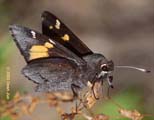 Larval Host |
Propagation
Description: Yuccas will germinate promptly from fresh seed held over winter. Seeds germinate best in 60-70 degree temperatures. Yuccas may also be grown from rhizomes, stem cuttings, or by digging offsets from the side of established plants. Transplant into a wellSeed Collection: Gather capsules as they begin to dry but before they split. Allow to dry, then crush to remove seeds. Overwinter, keep seeds in moist sand in the refrigerator. For longer storage periods, keep in sealed, refrigerated containers.
Commercially Avail: yes
From the National Organizations Directory
According to the species list provided by Affiliate Organizations, this plant is on display at the following locations:Stengl Biological Research Station - Smithville, TX
Georgia Native Plant Society - Atlanta, GA
Mt. Cuba Center - Hockessin, DE
Bibliography
Bibref 1186 - Field Guide to Moths of Eastern North America (2005) Covell, C.V., Jr.Bibref 1185 - Field Guide to Western Butterflies (Peterson Field Guides) (1999) Opler, P.A. and A.B. Wright
Bibref 1294 - The Midwestern Native Garden: Native Alternatives to Nonnative Flowers and Plants An Illustrated Guide (2011) Adelman, Charlotte and Schwartz, Bernard L.
Search More Titles in Bibliography
Research Literature
Reslit 24 - Community context of an obligate mutualism: Pollinator and florivore effects on Yucca filamentosa (2005) D. M. Althoff, K. A. Segraves and O. PellmyrReslit 25 - Characterizing the interaction between the bogus yucca moth and yuccas: do bogus yucca moths impact yucca reproductive success? (2004) D. M. Althoff, K. A. Segraves and J. P. Sparks
Reslit 662 - Non-random fruit retention in Yucca filamentosa: Consequences for an obligate mutualism (1997) C. J. Huth and O. Pellmyr
Reslit 663 - Pollen-mediated selective abortion in yuccas and its consequences for the plant-pollinator mutualism (2000) C. J. Huth and O. Pellmyr
Reslit 872 - Coexistence of mutualists and antagonists: exploring the impact of cheaters on the yucca - yucca moth mutualism (2001) D. L. Marr, M. T. Brock and O. Pellmyr
Reslit 873 - Pollen dispersal in Yucca filamentosa (Agavaceae): The paradox of self-pollination behavior by Tegeticula yuccasella (Prodoxidae) (2000) D. L. Marr, J. Leebens-Mack, L. Elms and O. Pellmy...
Reslit 874 - Effect of pollinator-inflicted ovule damage on floral abscission in the yucca-yucca moth mutualism: the role of mechanical and chemical factors (2003) D. L. Marr and O. Pellmyr
Reslit 885 - Genetic diversity and population structure of Yucca filamentosa (Agavaceae) (1998) L. K. Massey and J. L. Hamrick
Reslit 886 - Breeding structure of a Yucca filamentosa (Agavaceae) population (1999) L. K. Massey and J. L. Hamrick
Reslit 1068 - Yuccas, yucca moths, and coevolution: A review (2003) O. Pellmyr
This information was provided by the Florida WIldflower Foundation.
Search More Titles in Research Literature
Additional resources
USDA: Find Yucca filamentosa in USDA PlantsFNA: Find Yucca filamentosa in the Flora of North America (if available)
Google: Search Google for Yucca filamentosa
Metadata
Record Modified: 2012-12-09Research By: TWC Staff