Native Plants

Plant Database
Search for native plants by scientific name, common name or family. If you are not sure what you are looking for, try the Combination Search or our Recommended Species lists.
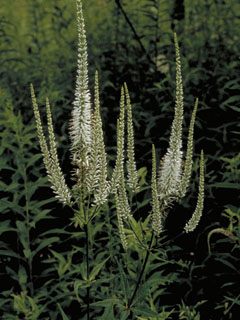
Bruso, George H.
Veronicastrum virginicum
Veronicastrum virginicum (L.) Farw.
Culver's Root
Scrophulariaceae (Figwort Family)
Synonym(s): Leptandra virginica, Veronica virginica
USDA Symbol: VEVI4
USDA Native Status: L48 (N), CAN (N)
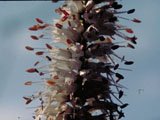
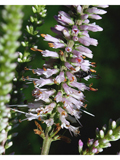
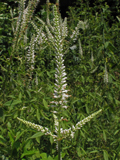
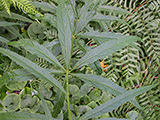
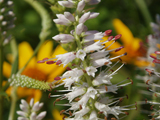
The unbranched stems of Culver’s Root grow 2-6 ft. tall and are topped by several spikes of densely-clustered, tiny, white to pinkish, tubular flowers. The total effect is candelabra-like. Narrowly oval, dark-green leaves are arranged in whorls around the stem.
The genus name, a combination of Veronica and the suffix astrum ("false"), describes this plant's resemblance to the Veronicas. It is the only species in the genus. It can be grown easily in wildflower gardens. The root contains a powerful emetic and cathartic. The common name was to honour Dr. Culver who prescribed the plant as an effective laxative.
Plant Characteristics
Duration: PerennialHabit: Herb
Fruit Type: Capsule
Size Notes: Up to about 6 feet tall.
Bloom Information
Bloom Color: White , PinkBloom Time: Jun , Jul , Aug , Sep
Bloom Notes: White or pinkish.
Distribution
USA: AL , AR , CT , DC , DE , FL , GA , IA , IL , IN , KS , KY , LA , MA , MD , ME , MI , MN , MO , MS , NC , ND , NE , NJ , NY , OH , OK , PA , SC , SD , TN , TX , VA , VT , WI , WVCanada: MB , ON
Native Distribution: VT to Ont., s. to GA, LA & OK
Native Habitat: Moist prairies; woods; stream banks
Growing Conditions
Light Requirement: Sun , Part ShadeSoil Moisture: Moist
Soil pH: Acidic (pH<6.8)
Soil Description: Moist, rich soils.
Conditions Comments: Very adaptable in the garden; try it at the woodland edge.
Benefit
Use Wildlife: Butterflies, BeesUse Medicinal: The root contains a powerful emetic and cathartic. (Niering)
Conspicuous Flowers: yes
Value to Beneficial Insects
Special Value to Native BeesSpecial Value to Honey Bees
Supports Conservation Biological Control
This information was provided by the Pollinator Program at The Xerces Society for Invertebrate Conservation.
Propagation
Description: Most easily propagated by root divisions in late fall or early spring. Each rootstock segment must have a bud. Sow seeds in fall or provide cold stratification. Also propagated by "softwood" cuttings taken in late spring.Seed Collection: Seeds can be allowed to dry out before sowing.
Seed Treatment: Seeds of this species require or benefit from a three month period of cold-moist stratification. Seeds require light to germinate.
Commercially Avail: yes
Find Seed or Plants
Find seed sources for this species at the Native Seed Network.
National Wetland Indicator Status
| Region: | AGCP | AK | AW | CB | EMP | GP | HI | MW | NCNE | WMVE |
| Status: | FACW | FACU | FAC | FAC | FAC |
From the National Organizations Directory
According to the species list provided by Affiliate Organizations, this plant is on display at the following locations:Native Plant Center at Westchester Community College, The - Valhalla, NY
Delaware Nature Society - Hockessin, DE
Longwood Gardens - Kennett Square, PA
Native Seed Network - Corvallis, OR
Mt. Cuba Center - Hockessin, DE
Bibliography
Bibref 928 - 100 easy-to-grow native plants for Canadian gardens (2005) Johnson, L.; A. LeyerleBibref 946 - Gardening with Prairie Plants: How to Create Beautiful Native Landscapes (2002) Wasowski, Sally
Bibref 841 - Native Alternatives to Invasive Plants (2006) Burrell, C. C.
Bibref 1262 - Plants of Carolinian Canada (1994) Lamb, Larry and Gail Rhynard
Bibref 1294 - The Midwestern Native Garden: Native Alternatives to Nonnative Flowers and Plants An Illustrated Guide (2011) Adelman, Charlotte and Schwartz, Bernard L.
Search More Titles in Bibliography
Web Reference
Webref 38 - Flora of North America (2019) Missouri Botanical Garden, St. Louis, MO & Harvard University Herbaria, Cambridge, MA.Webref 23 - Southwest Environmental Information Network (2009) SEINet - Arizona Chapter
From the Archive
Wildflower Newsletter 1996 VOL. 13, NO.4 - The Worth of a Native Plant, Pros and Cons of Using Rare Native Plants, Educatio...Additional resources
USDA: Find Veronicastrum virginicum in USDA PlantsFNA: Find Veronicastrum virginicum in the Flora of North America (if available)
Google: Search Google for Veronicastrum virginicum
Metadata
Record Modified: 2023-03-01Research By: TWC Staff