Native Plants

Plant Database
Search for native plants by scientific name, common name or family. If you are not sure what you are looking for, try the Combination Search or our Recommended Species lists.
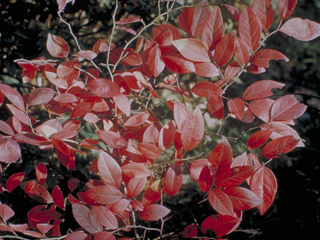
Vick, Albert F. W.
Vaccinium corymbosum
Vaccinium corymbosum L.
Highbush Blueberry
Ericaceae (Heath Family)
Synonym(s): Cyanococcus corymbosus, Cyanococcus cuthbertii, Vaccinium constablaei, Vaccinium corymbosum var. albiflorum, Vaccinium corymbosum var. glabrum
USDA Symbol: VACO
USDA Native Status: L48 (N), CAN (N)
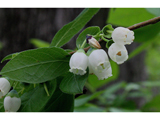
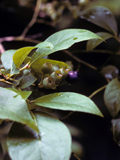
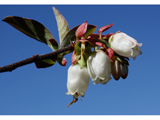
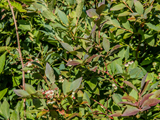
This blueberry species is usually a 6-12 ft. high and wide, deciduous shrub with numerous upright stems and twiggy branches forming a rounded, compact outline. Reddish-green spring leaves turn blue-green in summer and red, yellow, orange and purple in fall. White or pink, bell-shaped flowers in drooping clusters are followed by edible, blue fruit. A multi-stemmed shrub with green, or often red, twigs and terminal clusters of small, urn-shaped white flowers.
Our cultivated blueberries have been derived from the tall-growing shrub. It is often found in wet areas, but closely related growths occur in dry sites. These plants are very important to wildlife: their berries are relished by songbirds, game birds, bear, and small mammals; the twigs and foliage are eaten by deer and rabbits. Because of their food value and spectacular red fall foliage, these shrubs are excellent for naturalized landscaping.

Plant Characteristics
Duration: PerennialHabit: Shrub
Leaf Retention: Deciduous
Leaf Complexity: Simple
Fruit Type: Berry
Size Notes: Up to about 15 feet tall, often shorter.
Leaf: Green
Autumn Foliage: yes
Fruit: Black, Blue
Bloom Information
Bloom Color: White , PinkBloom Time: Mar , Apr , May , Jun
Distribution
USA: AL , AR , CT , DC , DE , GA , IL , IN , KY , LA , MA , MD , ME , MI , MS , NC , NH , NJ , NY , OH , OK , PA , RI , SC , TN , TX , VA , VT , WI , WVCanada: NB , NS , ON , QC
Native Distribution: N.S. to s. WI, s. to GA & AL
Native Habitat: Swamps; bogs; dry barrens; oak woods
Growing Conditions
Water Use: MediumLight Requirement: Sun , Part Shade , Shade
Soil Moisture: Dry , Moist , Wet
Soil pH: Acidic (pH<6.8)
CaCO3 Tolerance: Low
Soil Description: Wet to dry, acid, rocky soils to organic peats.
Conditions Comments: Extremely susceptible to chlorosis due to alkalinity. Benefits from mulch. Prune after fruiting.
Benefit
Use Wildlife: Berries are relished by most birds and mammals. Browsers eat foliage. Attracts 30 species of birds including: American Robin, Eastern Bluebird, Scarlet Tanager, Eastern and Spotted Towhees, Gray Catbird, Northern Mockingbird, Brown Thrasher, and Northern Cardinal (Audubon at Home).Use Food: Fruit edible.
Conspicuous Flowers: yes
Attracts: Birds
Value to Beneficial Insects
Special Value to Native BeesSpecial Value to Bumble Bees
This information was provided by the Pollinator Program at The Xerces Society for Invertebrate Conservation.
Propagation
Description: Most commonly propagated by softwood cuttings taken in spring. Vaccinium will also root from hardwood cuttings of unbranched shoots of previous season. Seeds may need to be stratified and should be sown on a slightly acid soil mix.Seed Treatment: Seeds are varyingly reported to need no special treatment or to need stratifaction for 60-90 days at 41 degrees.
Commercially Avail: yes
Find Seed or Plants
View propagation protocol from Native Plants Network.
Mr. Smarty Plants says
Edible Plants for North Georgia
January 10, 2010
We are planning a forest food garden in the hollers of the N GA Mountains.
Which edible fruit, nut, berry, herb and creepers would be best for this reddish, clay-like soil? The food garden is in...
view the full question and answer
Edible Plants for a Virginia Rain Garden
October 21, 2009
Can you recommend edible plants that would be appropriate for use in a rain garden? I'm located in Charlottesville, VA, but this can be in general as well.
view the full question and answer
National Wetland Indicator Status
| Region: | AGCP | AK | AW | CB | EMP | GP | HI | MW | NCNE | WMVE |
| Status: | FACW | FACW | FACW | FACW | FACW | FACW |
From the National Organizations Directory
According to the species list provided by Affiliate Organizations, this plant is on display at the following locations:Native Plant Center at Westchester Community College, The - Valhalla, NY
Delaware Nature Society - Hockessin, DE
Longwood Gardens - Kennett Square, PA
Mt. Cuba Center - Hockessin, DE
Bibliography
Bibref 1620 - Gardening with Native Plants of the South (Reprint Edition) (2009) Wasowski, S. with A. WasowskiBibref 841 - Native Alternatives to Invasive Plants (2006) Burrell, C. C.
Search More Titles in Bibliography
Web Reference
Webref 38 - Flora of North America (2019) Missouri Botanical Garden, St. Louis, MO & Harvard University Herbaria, Cambridge, MA.Webref 23 - Southwest Environmental Information Network (2009) SEINet - Arizona Chapter
Webref 1 - Texas Native Shrubs (2002) Texas A&M University Agriculture Program and Leslie Finical, Dallas Arboretum
Research Literature
Reslit 252 - Effects of Self-pollination and Cross-pollination of Vaccinium darrowii (Ericaceae) and Other Low-chill Blueberries (2009) D. J. Chavez and P. M. LyreneReslit 403 - Combining Ability for Seedling Root Systems Size and Shoot Vigor in Interspecific Blueberry Progenies (1994) W. A. Erb, A. D. Draper and H. J. Swartz
Reslit 2672 - The consequences of mixed pollination on seed set in Vaccinium corymbosum (1991) S. P. Vanderkloet
Reslit 2673 - Ten year study of the annual variation in berry and seed production in a population of Vaccinium corymbosum L. (1996) S. P. Vanderkloet, P. Cabilio
Reslit 2674 - A two-step pretreatment significantly enhances shoot organogenesis from leaf explants of highbush blueberry cv. Bluecrop (2002) X. L. Cao, F. A. Hammerschlag, L. Douglass
Reslit 2675 - Interactive effects of mycorrhizal inoculation and organic soil amendments on nitrogen acquisition and growth of highbush blueberry (2002) W. Q. Yang, B. L. Goulart, K. Demchak, Y. D. Li
Reslit 2676 - Inoculation with ericoid mycorrhizal fungi alters fertilizer use of highbush blueberry cultivars (2005) C. F. Scagel
Reslit 2677 - Implications of irrigation method and amount of water application on Phytophthora and Pythium infection and severity of root rot in Highbush blueberry (2007) D. R. Bryla, R. G. Linderman
Reslit 2678 - Magnitudinal asymmetries in seed production in Vaccinium corymbosum: Anomaly or not? (2010) S. P. V. Kloet, P. Cabilio
Reslit 2679 - Evaluation of irrigation methods for highbush blueberry-I. Growth and water requirements of young plants (2011) D. R. Bryla, J. L. Gartung, B. C. Strik
This information was provided by the Florida WIldflower Foundation.
Search More Titles in Research Literature
Additional resources
USDA: Find Vaccinium corymbosum in USDA PlantsFNA: Find Vaccinium corymbosum in the Flora of North America (if available)
Google: Search Google for Vaccinium corymbosum
Metadata
Record Modified: 2022-10-21Research By: TWC Staff