Native Plants

Plant Database
Search for native plants by scientific name, common name or family. If you are not sure what you are looking for, try the Combination Search or our Recommended Species lists.
Wasowski, Sally and Andy
Tsuga canadensis
Tsuga canadensis (L.) Carrière
Eastern Hemlock
Pinaceae (Pine Family)
Synonym(s):
USDA Symbol: TSCA
USDA Native Status: L48 (N), CAN (N)
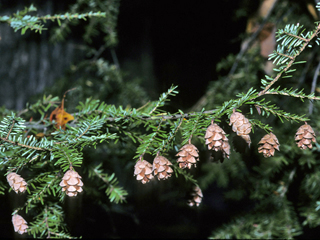
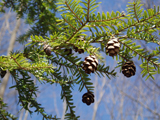
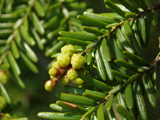
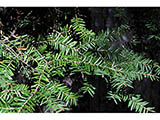
Eastern hemlock is a straight-trunked, gracefully pyramidal tree with long, pendulous limbs and short-needled, feathery branches. Evergreen needles are dark-green with silvery undersides.Evergreen tree with conical crown of long, slender, horizontal branches often drooping down to the ground, and a slender, curved, and drooping leader. Height is usually 40-70 ft., but can reach 100 ft. or more.
The bark was once a commercial source of tannin in the production of leather. Pioneers made tea from leafy twigs and brooms from the branches. A graceful shade tree and ornamental, it can also be trimmed into hedges.


Plant Characteristics
Duration: PerennialHabit: Tree
Leaf Retention: Evergreen
Leaf Complexity: Simple
Breeding System: Flowers Unisexual , Monoecious
Fruit Type: Cone
Size Notes: Up to about 100 feet tall.
Leaf: Dark Green
Fruit: Brown
Bloom Information
Bloom Color: YellowBloom Time: Apr
Distribution
USA: AL , CT , DC , DE , GA , IN , KY , MA , MD , ME , MI , MN , NC , NH , NJ , NY , OH , PA , RI , SC , TN , VA , VT , WI , WVCanada: NB , NS , ON , PE , QC
Native Distribution: N.S. to Man., s. to MD & n.e. MN; along mts. to GA & AL
Native Habitat: Rocky ridges; moist, mountain slopes
Growing Conditions
Water Use: MediumLight Requirement: Part Shade , Shade
Soil Moisture: Moist
Soil pH: Acidic (pH<6.8)
CaCO3 Tolerance: None
Soil Description: Rocky, cool, moist soils.
Conditions Comments: Eastern hemlock can be a fast-grower, but is more often slow-growing. It must be placed where there is good drainage and no strong, drying winds. Trees seem somewhat pH adaptable but prefers acidity. They can be restrained as a hedge for years with regular pruning. Sunscorch kills back branches, and drought kills the tree. A number of diseases and insects can be troublesome, but trees in good health prove reliable.
Benefit
Use Wildlife: Other Showy InsectsFragrant Foliage: yes
Attracts: Birds , Butterflies
Larval Host: Columbia silkmoth
Butterflies and Moths of North America (BAMONA)
|
Columbia silkmoth (Hyalophora columbia) 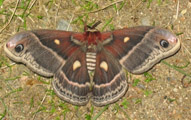 Larval Host |
Propagation
Description: Layering has proven successful, as has propagation by seed and cuttings. Cutting must be treated. Sow seeds in fall or stratify until spring. Spreading a layer of compost on bare soil beneath a mature hemlock and allowing natural seeding to produce a fSeed Collection: Cones mature in one season. Pick cones as they begin to open and leave in paper sacks until seed can be shaken free.
Seed Treatment: A 2-4 month stratification at 40 degrees hastens germination.
Commercially Avail: yes
Find Seed or Plants
View propagation protocol from Native Plants Network.
Mr. Smarty Plants says
Evergreen plants safe for horses in Louisville, Kentucky
May 16, 2010
I have a horse farm in Louisville, Ky. I want to plant evergreen plants along the walls in front of the horse barns. What types of plants are not toxic to horses can I use? Thank you so much for all y...
view the full question and answer
Evergreen privacy hedge and drought-resistant garden
July 21, 2008
I am looking for a hardy evergreen hedge for privacy in Northern Michigan. I have sandy soil. Also am interested in planting a drought garden with mostly sun in same sandy soil.
view the full question and answer
Evergreen shrubs for Michigan
June 17, 2008
I'm seeking a small-medium, ornamental, fairly compact, evergreen shrub to complement my front yard woodland wildflower garden. I want a shrub that will flank both sides of my front porch steps. I wa...
view the full question and answer
National Wetland Indicator Status
| Region: | AGCP | AK | AW | CB | EMP | GP | HI | MW | NCNE | WMVE |
| Status: | FACU | FACU | FACU | FACU |
From the National Organizations Directory
According to the species list provided by Affiliate Organizations, this plant is on display at the following locations:Georgia Native Plant Society - Atlanta, GA
Longwood Gardens - Kennett Square, PA
Mt. Cuba Center - Hockessin, DE
Bibliography
Bibref 1186 - Field Guide to Moths of Eastern North America (2005) Covell, C.V., Jr.Bibref 1185 - Field Guide to Western Butterflies (Peterson Field Guides) (1999) Opler, P.A. and A.B. Wright
Bibref 1620 - Gardening with Native Plants of the South (Reprint Edition) (2009) Wasowski, S. with A. Wasowski
Search More Titles in Bibliography
Additional resources
USDA: Find Tsuga canadensis in USDA PlantsFNA: Find Tsuga canadensis in the Flora of North America (if available)
Google: Search Google for Tsuga canadensis
Metadata
Record Modified: 2013-09-05Research By: TWC Staff