Native Plants

Plant Database
Search for native plants by scientific name, common name or family. If you are not sure what you are looking for, try the Combination Search or our Recommended Species lists.
Richardson, Charmaine
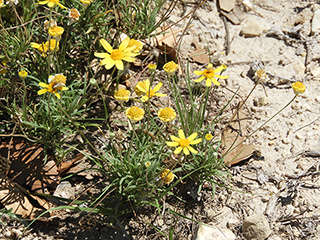
Tetraneuris scaposa
Tetraneuris scaposa (DC.) Greene
Four-nerve Daisy, Hymenoxys, Stemmy Four-nerve Daisy, Yellow Daisy, Bitterweed
Asteraceae (Aster Family)
Synonym(s):
USDA Symbol: TESC2
USDA Native Status: L48 (N)
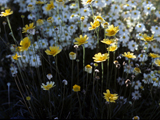
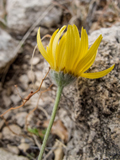
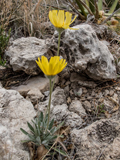
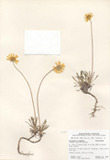
Four-nerve daisy is a low, upright, silvery perennial to 1 ft., or more, from a woody base. The solitary stem is much-branched at the base forming a clump. The solitary flower heads occur at the end of silky, leafless stalks. The tip of each yellow ray flower is three-toothed. Four dark purple veins are visible on both sides of the ray. Disc flowers are also yellow. Long, narrow, silvery-green leaves are crowded mostly toward the base.
Plant Characteristics
Duration: PerennialHabit: Herb
Size Notes: Up to about 16 inches tall.
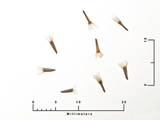
Fruit: Fruit is a cypsela (pl. cypselae). Though technically incorrect, the fruit is often referred to as an achene.
Bloom Information
Bloom Color: YellowBloom Time: Jan , Feb , Mar , Apr , May , Jun , Jul , Aug , Sep , Oct , Nov , Dec
Bloom Notes: Main bloom period is Mar-Jun. May bloom year-round under the right conditions.
Distribution
USA: CO , KS , NE , NM , OK , TXNative Distribution: Colorado and Nebraska south through Texas and New Mexico to northeastern Mexico as far south as Zacatecas
Native Habitat: Dry plains; rocky hillsides. Widespread over Texas.
Growing Conditions
Water Use: LowLight Requirement: Part Shade
Soil Moisture: Dry
Soil Description: Rocky, clay and limestone soils. Clay, Clay Loam Medium Loam, Sandy Loam Sandy, Caliche type, Limestone-based
Conditions Comments: Four-nerve daisy is heat and drought tolerant. It prefers dry, well-drained soils. The grass-like foliage works well in sunny rock gardens, container gardens and borders. Especially desirable because it blooms often throughout the winter months.
Benefit
Use Ornamental: Perennial garden, Rock gardens, Border, Rocky hillsideConspicuous Flowers: yes
Interesting Foliage: yes
Nectar Source: yes
Deer Resistant: High
Propagation
Propagation Material: SeedsSeed Collection: Collect seed when it falls off easily, year-round.
Seed Treatment: Fresh seed may germinate better. Treat with Rootshield. Transplant to 4" when second leaves appear, even though plants are tiny.
Maintenance: They grow slowly. Try not to water too much or inconsistently.
Mr. Smarty Plants says
List of native perennial Texas flowers
March 13, 2006
Good day, I am searching for a list of native Texas flowers (preferably perennials) for a flower garden.
Thank you.
view the full question and answer
From the National Organizations Directory
According to the species list provided by Affiliate Organizations, this plant is on display at the following locations:Lady Bird Johnson Wildflower Center - Austin, TX
NPSOT - Native Plant Society of Texas - Fredericksburg, TX
NPSOT - Fredericksburg Chapter - Fredericksburg, TX
NPSOT - Williamson County Chapter - Georgetown, TX
Herbarium Specimen(s)
NPSOT 0194 Collected Mar. 16, 1992 in Comal County by Mary Beth WhiteNPSOT 0202 Collected Apr 4, 1992 in Comal County by Mary Beth White
Bibliography
Bibref 318 - Native Texas Plants: Landscaping Region by Region (2002) Wasowski, S. & A. WasowskiSearch More Titles in Bibliography
Web Reference
Webref 38 - Flora of North America (2019) Missouri Botanical Garden, St. Louis, MO & Harvard University Herbaria, Cambridge, MA.Webref 23 - Southwest Environmental Information Network (2009) SEINet - Arizona Chapter
Additional resources
USDA: Find Tetraneuris scaposa in USDA PlantsFNA: Find Tetraneuris scaposa in the Flora of North America (if available)
Google: Search Google for Tetraneuris scaposa
Metadata
Record Modified: 2023-01-27Research By: LAL