Native Plants

Plant Database
Search for native plants by scientific name, common name or family. If you are not sure what you are looking for, try the Combination Search or our Recommended Species lists.
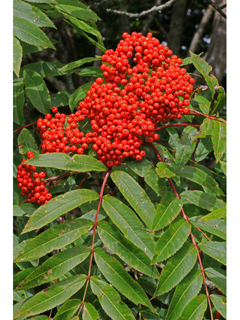
Cressler, Alan
Sorbus americana
Sorbus americana Marshall
American Mountain Ash, American Mountain-ash
Rosaceae (Rose Family)
Synonym(s): Pyrus americana, Pyrus microcarpa
USDA Symbol: SOAM3
USDA Native Status: L48 (N), CAN (N), SPM (N)
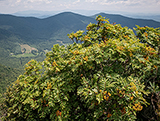
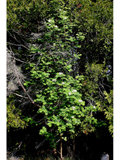
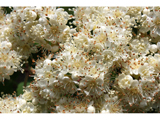
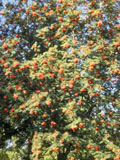
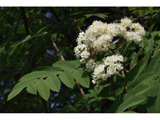
American mountain-ash is a small, ornamental tree usually 15-20 ft., but reaching 30 ft. in favorable places. The tree may be reduced to a shrub in higher elevations. The crown is narrow, open and round-topped. Pinnately-compound, deciduous leaves occur on bright-red leaf stalks and turn golden-orange in the fall. The small white, flowers are held in flat-topped clusters and are followed by broad clusters of bright, coral-red berries. Small tree with spreading crown or a shrub with many stems, and with showy white flowers, and bright red berries.
Plant Characteristics
Duration: PerennialHabit: Tree
Leaf Retention: Deciduous
Fruit Type: Pome
Size Notes: Up to about 30 feet tall, often much shorter.
Leaf: Green
Autumn Foliage: yes
Fruit: Red, orange.
Bloom Information
Bloom Color: WhiteBloom Time: Apr , May , Jun
Distribution
USA: CT , GA , IL , MA , MD , ME , MI , MN , NC , NH , NJ , NY , PA , RI , SC , TN , VA , VT , WI , WVCanada: NB , NL , NS , ON , PE , QC
Native Distribution: Nf. to Man., s. to PA & the Great Lakes region; also mts. to GA
Native Habitat: Cool, moist, open areas; granitic outcrops
Growing Conditions
Water Use: MediumLight Requirement: Sun , Part Shade , Shade
Soil Moisture: Dry , Moist
CaCO3 Tolerance: Low
Soil Description: Cool, moist, acid soils.
Conditions Comments: Mountain ash is usually short-lived due to fire blight, mildew, and borers as well as a number of other diseases and insects. In cultivation this species does best in the northern part of its range and at high altitudes. Young stems and thin bark need protection from winter browsers.
Benefit
Use Wildlife: Berries attract birds.Use Food: The fruits (fresh or dried) contain iron and vitamin C. They are also acidic and rich in tannins, however, and should be eaten in moderation. (Kershaw)
Warning: The seeds of this plant are reported to be poisonous, and those of its close relative Mescalbean (S. secundiflora) can be deadly. Sensitivity to a toxin varies with a person’s age, weight, physical condition, and individual susceptibility. Children are most vulnerable because of their curiosity and small size. Toxicity can vary in a plant according to season, the plant’s different parts, and its stage of growth; and plants can absorb toxic substances, such as herbicides, pesticides, and pollutants from the water, air, and soil.
Conspicuous Flowers: yes
Attracts: Birds
Value to Beneficial Insects
Special Value to Native BeesThis information was provided by the Pollinator Program at The Xerces Society for Invertebrate Conservation.
Propagation
Description: Plant seed in the spring. Germination is sporadic and probably will not take place until the following spring.Seed Collection: Clean as soon as collected.
Commercially Avail: yes
National Wetland Indicator Status
| Region: | AGCP | AK | AW | CB | EMP | GP | HI | MW | NCNE | WMVE |
| Status: | FACU | FACU | FAC | FAC |
From the National Organizations Directory
According to the species list provided by Affiliate Organizations, this plant is on display at the following locations:Mt. Cuba Center - Hockessin, DE
Bibliography
Bibref 841 - Native Alternatives to Invasive Plants (2006) Burrell, C. C.Search More Titles in Bibliography
Web Reference
Webref 38 - Flora of North America (2019) Missouri Botanical Garden, St. Louis, MO & Harvard University Herbaria, Cambridge, MA.Additional resources
USDA: Find Sorbus americana in USDA PlantsFNA: Find Sorbus americana in the Flora of North America (if available)
Google: Search Google for Sorbus americana
Metadata
Record Modified: 2022-10-11Research By: TWC Staff