Native Plants

Plant Database
Search for native plants by scientific name, common name or family. If you are not sure what you are looking for, try the Combination Search or our Recommended Species lists.
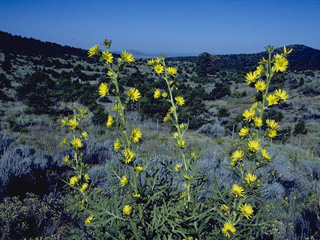
Bransford, W.D. and Dolphia
Silphium laciniatum
Silphium laciniatum L.
Compassplant, Compass Plant
Asteraceae (Aster Family)
Synonym(s):
USDA Symbol: SILA3
USDA Native Status: L48 (N), CAN (N)
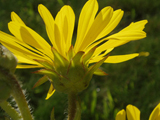
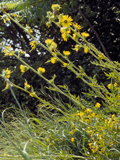
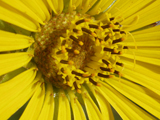
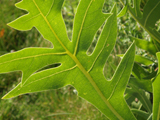
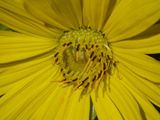
Compassplant is a tall, coarse, sunflower-like perennial, growing 3-10 ft. high. Deeply cut, hairy leaves, up to 2 ft. in length, usually orient themselves north and south to avoid the heat of the noonday sun. Scattered along the top half of the stout, sticky stem are 2-5 in. wide, yellow, radiate flowers. A tall plant bearing yellow flower heads with large, hairy-edged, green bracts; stem exudes resinous sap
Compass Plant is one of a group of tall, mostly prairie sunflowers, some with very large leaves. The common name refers to the plant's deeply incised leaves, which tend to be oriented in a north-south direction. The hardened sap of this plant can be chewed like gum. Rosinweed (S. integrifolium) has opposite, very rough, stalkless, untoothed or slightly toothed leaves and is 2-5' (60-150 cm) tall. Cup Plant (S. perfoliatum) has opposite leaves that envelop its square stem, each leaf forming a "cup" around it. Prairie Dock (S. terebinthinaceum) has large, ovate or heart-shaped, basal leaves to 2' (60 cm) long; the sparsely leaved flower stalk sometimes reaches a height of nearly 10' (3 m).
Plant Characteristics
Duration: PerennialHabit: Herb
Leaf Retention: Deciduous
Size Notes: Up to about 10 feet tall.
Fruit: Fruit is a cypsela (pl. cypselae). Though technically incorrect, the fruit is often referred to as an achene.
Bloom Information
Bloom Color: YellowBloom Time: Jul , Aug , Sep
Distribution
USA: AL , AR , CO , DC , IA , IL , IN , KS , KY , LA , MI , MN , MO , MS , ND , NE , NM , NY , OH , OK , PA , SD , TN , TX , VA , WICanada: ON
Native Distribution: OH to LA, w. to e. Great Plains
Native Habitat: Prairies
Growing Conditions
Light Requirement: SunSoil Moisture: Dry
Drought Tolerance: High
Soil Description: Various well-drained soils.
Conditions Comments: Compass plant has a large, woody taproot that may reach down 15 ft. Slow-growing, long-lived, eye-catching, sunflower-like blooms. (Ontario Native Plants 2002)
Benefit
Use Wildlife: The large seeds are favored by birds and small mammals.Conspicuous Flowers: yes
Interesting Foliage: yes
Attracts: Birds , Butterflies
Nectar Source: yes
Value to Beneficial Insects
Special Value to Native BeesSpecial Value to Bumble Bees
This information was provided by the Pollinator Program at The Xerces Society for Invertebrate Conservation.
Propagation
Description: Most easily propagated by seed. Seedlings take 2-3 years to flower. Sow unstratified seed in spring or stratified in fall. Deep roots make division difficult.Seed Collection: Collect in Sep. and Oct.
Seed Treatment: Damp stratification (2 months at 40 degrees) and scarification.
Commercially Avail: yes
Find Seed or Plants
Find seed sources for this species at the Native Seed Network.
View propagation protocol from Native Plants Network.
From the National Organizations Directory
According to the species list provided by Affiliate Organizations, this plant is on display at the following locations:Lady Bird Johnson Wildflower Center - Austin, TX
Native Seed Network - Corvallis, OR
Mt. Cuba Center - Hockessin, DE
Bibliography
Bibref 928 - 100 easy-to-grow native plants for Canadian gardens (2005) Johnson, L.; A. LeyerleBibref 946 - Gardening with Prairie Plants: How to Create Beautiful Native Landscapes (2002) Wasowski, Sally
Bibref 1294 - The Midwestern Native Garden: Native Alternatives to Nonnative Flowers and Plants An Illustrated Guide (2011) Adelman, Charlotte and Schwartz, Bernard L.
Search More Titles in Bibliography
Web Reference
Webref 38 - Flora of North America (2019) Missouri Botanical Garden, St. Louis, MO & Harvard University Herbaria, Cambridge, MA.Webref 23 - Southwest Environmental Information Network (2009) SEINet - Arizona Chapter
Additional resources
USDA: Find Silphium laciniatum in USDA PlantsFNA: Find Silphium laciniatum in the Flora of North America (if available)
Google: Search Google for Silphium laciniatum
Metadata
Record Modified: 2023-01-16Research By: TWC Staff