Native Plants

Plant Database
Search for native plants by scientific name, common name or family. If you are not sure what you are looking for, try the Combination Search or our Recommended Species lists.
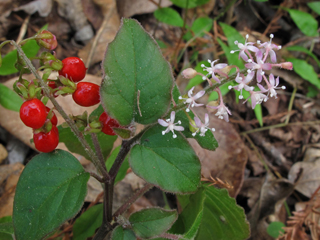
Cressler, Alan
Rivina humilis
Rivina humilis L.
Pigeonberry, Rouge Plant, Baby-peppers, Bloodberry
Phytolaccaceae (Pokeweed Family)
Synonym(s):
USDA Symbol: RIHU2
USDA Native Status: L48 (N), HI (I), PR (N), VI (N)
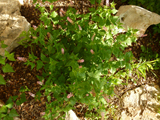
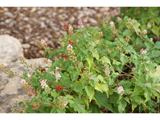
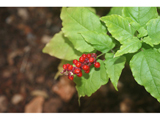
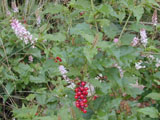
Pigeonberry is a perennial herb usually 1-3 feet tall that grows beneath trees and shrubs. The flowers are about 1/4 inch across, white to pink, growing on the last 2-3 inches of the stems. The fruits are numerous, red and almost translucent, often appearing on the lower part of the stem while the upper part is still blooming. They are a choice food for many kinds of birds. The leaves are 1-3 inches long and wavy on the edges (248).
Pigeonberry appeals to the eye when it blooms pale pink and bears scarlet fruit simultaneously.
Plant Characteristics
Duration: PerennialHabit: Herb
Leaf Retention: Deciduous
Fruit Type: Berry
Size Notes: Usually up to about 3 feet tall, may reach 6 feet.
Fruit: Red to orange, 2-3.5 mm.
Bloom Information
Bloom Color: White , PinkBloom Time: Jan , Feb , Mar , Apr , May , Jun , Jul , Aug , Sep , Oct , Nov , Dec
Distribution
USA: AL , AR , AZ , FL , HI , LA , MS , NM , OK , TXNative Distribution: Southern North America from Florida to Arizona, north to Oklahoma and Arkansas, south through Central America and the Caribbean to tropical South America
Native Habitat: In moist or alluvial soils in partial shade. Also in hilly chaparral.
Growing Conditions
Water Use: MediumLight Requirement: Part Shade
Soil Moisture: Moist
Soil Description: Moist and well-drained sand, sandy loam, loam, clay, and calcareous soils.
Conditions Comments: Prefers light shade and moist but well drained soil. Without supplemental water in summer, it may go dormant.
Benefit
Use Ornamental: Low-growing herb layer plant, decorative fruit and flowersUse Wildlife: Fruit-birds
Use Other: The red fruits have been used for cosmetics, hence the name Rouge Plant.
Warning: Caution: the fruit and leaves are toxic if ingested.
Conspicuous Flowers: yes
Attracts: Birds
Deer Resistant: Moderate
Propagation
Propagation Material: SeedsDescription: Seed and cuttings.
Seed Collection: Collect berries when plump and red. Allow to dry spread out.
Seed Treatment: Seeds germinate well and grow slowly.
Commercially Avail: yes
Maintenance: Water during summer drought.
Find Seed or Plants
Order seed of this species from Native American Seed and help support the Wildflower Center.
Mr. Smarty Plants says
Native grasses for East Texas that require no mowing or watering
June 16, 2010
What native grass can I grow in deep East Texas that would require no supplemental watering and no mowing?
view the full question and answer
National Wetland Indicator Status
| Region: | AGCP | AK | AW | CB | EMP | GP | HI | MW | NCNE | WMVE |
| Status: | UPL | FAC | UPL | UPL | FAC | UPL | FAC | FAC |
From the National Organizations Directory
According to the species list provided by Affiliate Organizations, this plant is on display at the following locations:Naval Air Station Kingsville - Kingsville, TX
Lady Bird Johnson Wildflower Center - Austin, TX
Brackenridge Field Laboratory - Austin, TX
NPSOT - Fredericksburg Chapter - Fredericksburg, TX
NPSOT - Austin Chapter - Austin, TX
National Butterfly Center - Mission, TX
NPSOT - Williamson County Chapter - Georgetown, TX
Herbarium Specimen(s)
NPSOT 0118 Collected June 7, 1991 in Bexar County by Lottie MillsapsNPSOT 0071 Collected Sept. 12, 1990 in Bexar County by Lottie Millsaps
Wildflower Center Seed Bank
LBJWC-MM-756 Collected 2010-07-25 in Hays County by Lady Bird Johnson Wildflower CenterBibliography
Bibref 318 - Native Texas Plants: Landscaping Region by Region (2002) Wasowski, S. & A. WasowskiBibref 281 - Shinners & Mahler's Illustrated Flora of North Central Texas (1999) Diggs, G. M.; B. L. Lipscomb; B. O'Kennon; W. F...
Bibref 248 - Texas Wildflowers: A Field Guide (1984) Loughmiller, C. & L. Loughmiller
Bibref 328 - Wildflowers of Texas (2003) Ajilvsgi, Geyata.
Bibref 286 - Wildflowers of the Texas Hill Country (1989) Enquist, M.
Search More Titles in Bibliography
Web Reference
Webref 38 - Flora of North America (2019) Missouri Botanical Garden, St. Louis, MO & Harvard University Herbaria, Cambridge, MA.Webref 23 - Southwest Environmental Information Network (2009) SEINet - Arizona Chapter
Research Literature
Reslit 964 - Potential allelopathic effects of Brazilian pepper (Schinus terebinthifolius Raddi, Anacardiaceae) aqueous extract on germination and growth of selected Florida native plants (2005) E. C. Morgan and W. A. OverholtReslit 1381 - Effect of ammonia fumes on total chlorophyll and carotenoid content in Rivina humilis Linn (2000) M. V. M. Teresa and C. T. Anitha
This information was provided by the Florida WIldflower Foundation.
Search More Titles in Research Literature
Additional resources
USDA: Find Rivina humilis in USDA PlantsFNA: Find Rivina humilis in the Flora of North America (if available)
Google: Search Google for Rivina humilis
Metadata
Record Modified: 2023-04-26Research By: TWC Staff