Native Plants

Plant Database
Search for native plants by scientific name, common name or family. If you are not sure what you are looking for, try the Combination Search or our Recommended Species lists.
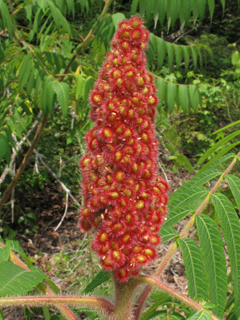
Cressler, Alan
Rhus typhina
Rhus typhina L.
Staghorn Sumac, Velvet Sumac
Anacardiaceae (Sumac Family)
Synonym(s): Datisca hirta, Rhus hirta, Rhus typhina var. laciniata
USDA Symbol: RHTY
USDA Native Status: L48 (N), CAN (N)
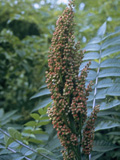
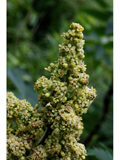
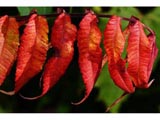
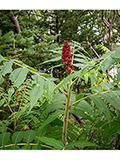
The stag-horn sumac is a 15-30 ft., colony-forming, deciduous shrub with crooked, leaning trunks, picturesque branches and velvety twigs. Large, bright-green, pinnately-compound leaves become extremely colorful in early fall. On female plants, yellow-green flowers are followed by fuzzy, bright red berries in erect, pyramidal clusters which persist throughout winter. Staghorn Sumac reaches tree size more often than related species and commonly forms thickets. In winter, the bare, widely forking, stout, hairy twigs resemble deer antlers "in velvet," hence the alternate common name.

Plant Characteristics
Duration: PerennialHabit: Shrub , Tree
Leaf Retention: Deciduous
Leaf Arrangement: Alternate
Leaf Complexity: Pinnate
Leaf Shape: Lanceolate
Leaf Venation: Pinnate
Leaf Margin: Serrate
Breeding System: Flowers Unisexual , Dioecious
Fruit Type: Drupe
Size Notes: Height to 25 feet.
Leaf: Green above, pale below.
Autumn Foliage: yes
Fruit: Red and fuzzy. 1/8 inch diameter.
Bloom Information
Bloom Color: Red , Yellow , GreenBloom Time: Jun , Jul
Distribution
USA: AL , CT , DC , DE , GA , IA , IL , IN , KS , KY , MA , MD , ME , MI , MN , MO , MS , NC , NH , NJ , NY , OH , PA , RI , SC , SD , TN , UT , VA , VT , WI , WVCanada: NB , NS , ON , PE , QC
Native Distribution: E. Que. to MN, s. to n. SC, AL, IL & IA
Native Habitat: Dry uplands; old fields; hardwood forest edges
Growing Conditions
Water Use: LowLight Requirement: Sun , Part Shade , Shade
Soil Moisture: Dry
Soil pH: Circumneutral (pH 6.8-7.2)
CaCO3 Tolerance: High
Drought Tolerance: High
Soil Description: Dry, rocky or gravelly soils.
Conditions Comments: Staghorn sumac is most effective when drifts or colonies, typical of natural settings, are allowed to establish. Colonies can be rejuvenated every few years by cutting them to the ground in mid-winter. Sumacs grow in dry waste areas, such as impossible slopes where even juniper struggle. They are fast growing, generally pest and disease-free, and drought-tolerant. Thin bark makes sumac especially sensitive to lawn mowers and string trimmers. Wounding, however, triggers development of replacement sprouts. Colonies are often single-sexed, formed from a single, suckering parent. Only female plants produce berries. The berries are winter food for many upland gamebirds, songbirds, and large and small mammals.
Benefit
Use Ornamental: Grown as an ornamental, especially a variety with dissected leaves, for the autumn foliage and showy fruit.Use Wildlife: Berries are a preferred food source for ruffed grouse, ring-necked pheasant, eastern phoebe, common crow, northern mockingbird, gray catbird, American robin, wood thrush, hermit thrush, eastern bluebird and European starling. It is also used by over 30 other species, and since the fruit hangs on throughout the winter, is another excellent emergency source of food. Honeybees are attracted to the flowers in spring.
Use Food: Indians made a lemonade-like drink from the crushed fruit of this and related species.
Use Other: The tannin-rich fruit, bark and leaves were used to tan hides. The leaves and fruits were boiled to make black ink, and the dried leaves were an ingredient in smoking mixtures.
Conspicuous Flowers: yes
Interesting Foliage: yes
Attracts: Birds
Value to Beneficial Insects
Special Value to Native BeesSpecial Value to Honey Bees
Provides Nesting Materials/Structure for Native Bees
Supports Conservation Biological Control
This information was provided by the Pollinator Program at The Xerces Society for Invertebrate Conservation.
Propagation
Description: Easily propagated from early winter root divisions. Place root cuttings in flats of moist sand. Plant scarified and stratified seed 1/3-3/4 in. deep.Seed Treatment: Acid scarify one to three hours, then stratify immediately for 30 days at 41 degrees.
Commercially Avail: yes
Mr. Smarty Plants says
Flowering and evergreen shrubs for landscape in Indiana
May 29, 2010
I live in Southern Indiana and we are getting ready to redesign our front landscape. Currently, we have some yews and other shrubs that are unruly and require a lot of pruning and care. My husband hat...
view the full question and answer
Plant identfication
October 21, 2009
Hi...Can you please identfy the tall, evergreen shrub with purple plum-colored foliage that I have noticed in winter locally?...Hope so, need he color! THX
view the full question and answer
From the National Organizations Directory
According to the species list provided by Affiliate Organizations, this plant is on display at the following locations:Delaware Nature Society - Hockessin, DE
Mt. Cuba Center - Hockessin, DE
Bibliography
Bibref 1620 - Gardening with Native Plants of the South (Reprint Edition) (2009) Wasowski, S. with A. WasowskiBibref 946 - Gardening with Prairie Plants: How to Create Beautiful Native Landscapes (2002) Wasowski, Sally
Bibref 841 - Native Alternatives to Invasive Plants (2006) Burrell, C. C.
Search More Titles in Bibliography
Additional resources
USDA: Find Rhus typhina in USDA PlantsFNA: Find Rhus typhina in the Flora of North America (if available)
Google: Search Google for Rhus typhina
Metadata
Record Modified: 2015-06-18Research By: TWC Staff