Native Plants

Plant Database
Search for native plants by scientific name, common name or family. If you are not sure what you are looking for, try the Combination Search or our Recommended Species lists.
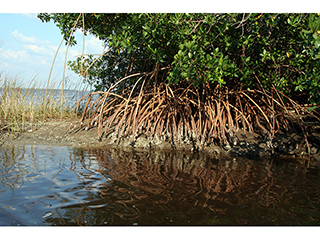
Cressler, Alan
Rhizophora mangle
Rhizophora mangle L.
Red Mangrove
Rhizophoraceae (Red Mangrove Family)
Synonym(s):
USDA Symbol: RHMA2
USDA Native Status: L48 (N), HI (I), PR (N), VI (N)
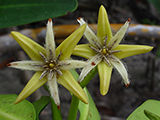
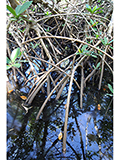
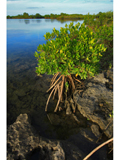
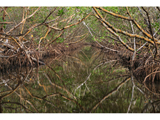
At maturity, this evergreen plant becomes a tangled mass of prop roots, aerial roots, branches and leaves. The brown, cylindrical fruits of these evergreen shrubs or trees are preceded by small, clustered, yellow-green, star-like flowers, with four leathery petals. The conspicuous prop roots growing down from the branches are usually the distinguishing characteristic of this mangrove which can grow to 30 feet, or more, in height.
Mangroves do not propagate using ordinary means of dispersal. Rather, young plants begin to grow while still attached to the parent tree, developing into propagules that drop into the water and float along until an appropriate substrate is encountered. The germinating fruits of the Red Mangrove are quite spectacular: pendulous, torpedo-like seedlings dangling from the branches. The lima-bean–like pods of the Black Mangrove split almost immediately when the fruit falls. And though they are not as visible, the spongy-coated, ribbed fruits of the White Mangrove often sprout as soon as they are stranded in soil. Propagules of all three mangroves take root mainly in sheltered areas or on shorelines with relatively low wave energy, which can be found throughout much of the southwestern and southern parts of Florida.
Plant Characteristics
Duration: PerennialHabit: Shrub
Leaf Retention: Evergreen
Fruit Type: Berry
Size Notes: Up to about 75 feet tall by 40 feet wide, usually much smaller.
Bloom Information
Bloom Color: Yellow , GreenBloom Time: Jan , Feb , Mar , Apr , May , Jun , Jul , Aug , Sep , Oct , Nov , Dec
Distribution
USA: FL , NC , SCNative Habitat: Shallow marine coastlines.
Growing Conditions
Light Requirement: Part ShadeSoil Moisture: Wet
Soil Description: Wet, brackish soils.
Conditions Comments: Rhizophora mangle often forms impenetrable thickets on salt or brackish shores. Its flowers and fruit occur most abundantly in late summer. The berry germinates on the tree, producing a 10-12 in. seedling that falls to the water and floats until it reaches water of suitable depth to establish its roots in the mud. With their tangle of vegetation, red mangroves are effective barriers to erosion.
Butterflies and Moths of North America (BAMONA)
|
Mangrove Skipper (Phocides pigmalion) 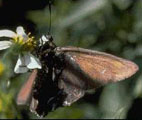 Larval Host |
Propagation
Commercially Avail: yesNational Wetland Indicator Status
| Region: | AGCP | AK | AW | CB | EMP | GP | HI | MW | NCNE | WMVE |
| Status: | OBL | OBL | OBL | OBL |
Bibliography
Bibref 1186 - Field Guide to Moths of Eastern North America (2005) Covell, C.V., Jr.Bibref 1185 - Field Guide to Western Butterflies (Peterson Field Guides) (1999) Opler, P.A. and A.B. Wright
Search More Titles in Bibliography
Web Reference
Webref 57 - Atlas of Florida Plants (2020) Institute for Systematic BotanyWebref 38 - Flora of North America (2019) Missouri Botanical Garden, St. Louis, MO & Harvard University Herbaria, Cambridge, MA.
Webref 23 - Southwest Environmental Information Network (2009) SEINet - Arizona Chapter
Additional resources
USDA: Find Rhizophora mangle in USDA PlantsFNA: Find Rhizophora mangle in the Flora of North America (if available)
Google: Search Google for Rhizophora mangle
Metadata
Record Modified: 2023-05-08Research By: TWC Staff