Native Plants

Plant Database
Search for native plants by scientific name, common name or family. If you are not sure what you are looking for, try the Combination Search or our Recommended Species lists.
Wasowski, Sally and Andy
Quercus michauxii
Quercus michauxii Nutt.
Swamp Chestnut Oak, Basket Oak, Cow Oak, Swamp Oak
Fagaceae (Beech Family)
Synonym(s): Quercus houstoniana, Quercus prinus
USDA Symbol: QUMI
USDA Native Status: L48 (N)
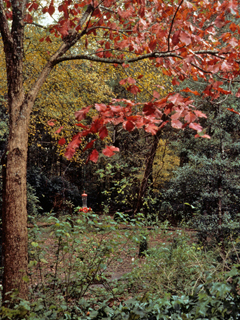
A 60-100 ft. oak with a tight, narrow crown very high on the massive trunk. Bark is light gray. The shiny, oval, unlobed leaves have large, rounded teeth and turn yellow to vibrant red in the fall. Large tree with compact, rounded crown and chestnutlike foliage.
GROWTH FORM: large tree growing to 48 - 100 feet (15 - 30.5 m), occasionally to 155 feet (47.2 m), with a compact rounded crown and chestnut like foliage, often with a limbless trunk to 40 feet (12.2 m). BARK: light gray, rough, flaky ridges. TWIGS and BUDS: juvenile growth is green, progressing to brown during the first winter and turning gray during second year; ovoid, reddish-brown bud, apex may be blunt or pointed, sparsely pubescent scales. LEAVES: short petiole 1⁄4 - 3⁄4 inch (6 - 19 mm) long; obovate leaves widest beyond the middle, 2 3⁄4 - 11 inches (70 - 279 mm) long, 2 - 7 inches (51 - 178 mm) wide, wavy margin with 9 - 14 pair of rounded teeth, base acuminate, apex broadly rounded with an abruptly pointed tip; shiny dark green above, grayish-green with dense pubescence (felty to the touch) below.
Named for French botanist, Frances A. Michaux, who wrote a three volume treatise on the trees of eastern North America. Called "Basket Oak" because baskets were woven from fibers and splints obtained by splitting the wood. These strong containers were used to carry cotton from the fields. The sweetish acorns can be eaten raw, without boiling. Cows consume the acorns, hence the name "Cow Oak." Swamp chestnut oak is considered an early succession species with mature trees retarding growth of understory vegetation due to an allelopathic effect.
From the Image Gallery
Plant Characteristics
Duration: PerennialHabit: Tree
Leaf Retention: Deciduous
Leaf Arrangement: Alternate
Leaf Complexity: Simple
Leaf Shape: Obovate
Leaf Venation: Pinnate
Leaf Margin: Dentate
Breeding System: Flowers Unisexual , Monoecious
Inflorescence: Catkin
Fruit Type: Nut
Size Notes: Large tree growing to 48 - 100 feet (15 - 30.5 m), occasionally to 155 feet (47.2 m) tall.
Leaf: Leaves shiny dark green above, grayish-green with dense pubescence (felty to the touch) below.
Autumn Foliage: yes
Fruit: Acorns annual; 1 - 3 on peduncle 1⁄2 - 1 1⁄4 inches (13 - 32 mm) long; deep, bowl-shaped cup with brown pubescent scales, enclosing 1⁄2 of nut; light to dark brown, ovoid nut, 1 - 1 3⁄8 inches (25 - 35 mm) long.
Bloom Information
Bloom Color: YellowBloom Time: Mar , Apr , May
Distribution
USA: AL , AR , DE , FL , GA , IL , IN , KY , LA , MD , MO , MS , NC , NJ , OK , SC , TN , TX , VANative Distribution: Illinois east to New Jersey, south to Florida, west to Texas, and north to Missouri.
Native Habitat: Occurs on a variety of moist soils and well- drained alluvial floodplains in the central and southern forest regions. Bottomland forests; stream banks; calcareous swamps
Growing Conditions
Water Use: MediumLight Requirement: Part Shade
Soil Moisture: Moist
CaCO3 Tolerance: None
Soil Description: Deep, rich soils. Sandy, Sandy Loam, Medium Loam, Clay Loam, Clay, Acid-based.
Conditions Comments: Tolerates compaction better than most oaks. Long-lived and slow-growing. Adaptable. One of the best oaks for fall color. Drought tolerant.
Benefit
Use Ornamental: Shade tree, Attractive, Fall conspicuousUse Wildlife: Fruit-birds, Cover, Nesting site, Substrate-insectivorous birds.
Use Food: The acorns are food for humans, cattle, deer, and small mammals. The nuts are sweet enough to eat raw without boiling.
Interesting Foliage: yes
Attracts: Birds , Butterflies
Larval Host: Horace's Duskywing, Northern hairstreak, White M hairstreak.
Butterflies and Moths of North America (BAMONA)
|
White M Hairstreak (Parrhasius m-album) 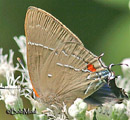 Larval Host |
Propagation
Description: Oaks are most often propagated from seed. No pretreatment is necessary. Plant immediately – outdoors or in deep containers to accomodate long initial taproot. The acorns sprout without a dormancy period and begin to germinate as soon as they fall fromSeed Collection: Best quality acorns are picked or shaken from the tree. Collect when color has changed to brown. Best if sown immediately as acorns lose viability quickly in storage. Short-term storage in moist, shaded saw dust or sand. Acorns to be sown immediately can be soaked in hot water for 15 min. to prevent weevil infestation. Stored seed should be fumigated with methyl bromide.
Commercially Avail: yes
Maintenance: Prevent complete soil dryness, Prune to maintain shape, May be pruned 12 mo. out of the year, Fertilize 3 times a year with lawn fertilizer 3:1:2 ratio
Find Seed or Plants
View propagation protocol from Native Plants Network.
National Wetland Indicator Status
| Region: | AGCP | AK | AW | CB | EMP | GP | HI | MW | NCNE | WMVE |
| Status: | FACW | FACW | FACW | FACW | FACW |
From the National Organizations Directory
According to the species list provided by Affiliate Organizations, this plant is on display at the following locations:Pineywoods Native Plant Center - Nacogdoches, TX
Crosby Arboretum - Picayune, MS
Mt. Cuba Center - Hockessin, DE
Bibliography
Bibref 766 - Dale Groom's Texas Gardening Guide (2002) Groom, D.Bibref 1134 - Field Guide to Native Oak Species of Eastern North America (2003) Stein, John D. and Denise Binion
Bibref 298 - Field Guide to Texas Trees (1999) Simpson, B.J.
Bibref 1620 - Gardening with Native Plants of the South (Reprint Edition) (2009) Wasowski, S. with A. Wasowski
Bibref 318 - Native Texas Plants: Landscaping Region by Region (2002) Wasowski, S. & A. Wasowski
Bibref 291 - Texas Wildscapes: Gardening for Wildlife (1999) Damude, N. & K.C. Bender
Search More Titles in Bibliography
Additional resources
USDA: Find Quercus michauxii in USDA PlantsFNA: Find Quercus michauxii in the Flora of North America (if available)
Google: Search Google for Quercus michauxii
Metadata
Record Modified: 2023-06-22Research By: TWC Staff