Native Plants

Plant Database
Search for native plants by scientific name, common name or family. If you are not sure what you are looking for, try the Combination Search or our Recommended Species lists.
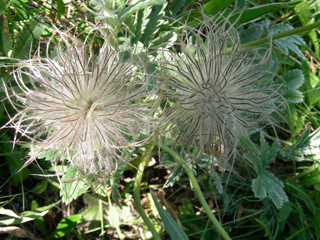
Beckers, Eric
Pulsatilla patens ssp. multifida
Pulsatilla patens (L.) Mill. ssp. multifida (Pritz.) Zamels
Cutleaf Anemone, Pasqueflower, Wild Crocus
Ranunculaceae (Buttercup Family)
Synonym(s): Anemone ludoviciana, Anemone multifida, Anemone nuttalliana, Anemone patens var. multifida, Anemone patens var. nuttalliana, Anemone patens var. wolfgangiana, Pulsatilla hirsutissima, Pulsatilla ludoviciana, Pulsatilla nuttalliana, Pulsatilla patens ssp. hirsutissima
USDA Symbol: PUPAM
USDA Native Status: L48 (N), AK (N), CAN (N)
This is a low perennial, leaves rarely exceeding 6 in. in height. Its furry leaf clusters appear soon after winter snows disappear, and the large, showy, lavender flowers open soon thereafter. Long, silky hairs cover the finely divided, deeply lobed leaves and give the plant a silvery sheen. These leaves continue to expand after the flowers open. Long plumes of seed-like fruits follow the flowers.
This plant's bloom period greatly affected by altitude.
From the Image Gallery
Plant Characteristics
Duration: PerennialHabit: Herb
Fruit Type: Achene
Size Notes: Up to about 2 feet tall when flowering.
Bloom Information
Bloom Color: White , Blue , PurpleBloom Time: Apr , Jul , Aug
Distribution
USA: AK , CO , IA , ID , IL , KS , MI , MN , MT , ND , NE , NM , SD , TX , UT , WA , WI , WYCanada: AB , BC , MB , SK
Native Distribution: WI to AK, s. to IL, MO, TX, NM mts., n.e. UT & WA
Native Habitat: Prairies; sandy hillsides; high alt., ponderosa pine communities
Growing Conditions
Light Requirement: Sun , Part ShadeSoil Moisture: Dry
Soil pH: Circumneutral (pH 6.8-7.2)
Soil Description: Dry, sandy loams.
Conditions Comments: This plant does not like competition from grasses or other shade-producing vegetation. Seed production is improved if the plant is protected from high winds. Its bloom period greatly affected by altitude.
Benefit
Warning: POISONOUS PARTS: All parts when fresh. Toxic only if eaten in large quantities. Symptoms include inflammation and blistering upon contact with fresh sap and irritation of the mouth, vomiting and diarrhea following ingestion. (Poisonous Plants of N.C.)Conspicuous Flowers: yes
Propagation
Description: Best propagated by seed which benefits from a short period of stratification. Treatment, however, is not necessary. Seedlings are difficult to establish unless raised in a nursery bed and transplanted after a year. Two to three years to flowering. ProSeed Collection: Collect from May to early June.
Seed Treatment: Cold-moist stratification.
Commercially Avail: yes
Bibliography
Bibref 946 - Gardening with Prairie Plants: How to Create Beautiful Native Landscapes (2002) Wasowski, SallySearch More Titles in Bibliography
Web Reference
Webref 38 - Flora of North America (2019) Missouri Botanical Garden, St. Louis, MO & Harvard University Herbaria, Cambridge, MA.Webref 74 - Southwest Colorado Wildflowers (2020) Rocky Mountain Biological Laboratory
Webref 23 - Southwest Environmental Information Network (2009) SEINet - Arizona Chapter
Additional resources
USDA: Find Pulsatilla patens ssp. multifida in USDA PlantsFNA: Find Pulsatilla patens ssp. multifida in the Flora of North America (if available)
Google: Search Google for Pulsatilla patens ssp. multifida
Metadata
Record Modified: 2022-11-18Research By: TWC Staff