Native Plants

Plant Database
Search for native plants by scientific name, common name or family. If you are not sure what you are looking for, try the Combination Search or our Recommended Species lists.
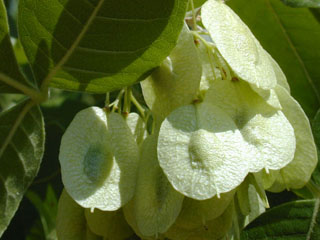
Marcus, Joseph A.
Ptelea trifoliata
Ptelea trifoliata L.
Wafer Ash, Common Hoptree, Hop Tree
Rutaceae (Rue Family)
Synonym(s):
USDA Symbol: PTTR
USDA Native Status: L48 (N), CAN (N)
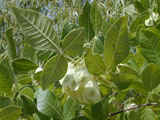
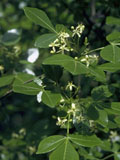
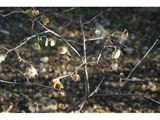
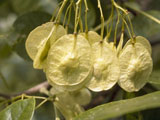
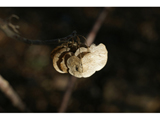
Aromatic shrub or small tree with a rounded crown. The trunk is slender and crooked, bearing interwoven, ascending branches. Bark, crushed foliage, and twigs have a slightly lemonlike, unpleasant musky odor. Trifoliate, deciduous leaves with leaflets on a petiole up to 2 inches long, the terminal leaflet up to 2 1/2 inches long, obovate, tapering more gradually to the base than to the tip, midrib of lateral leaflets off center. Leaves are dark-green in summer, turning yellow in fall. Flowers small, greenish white, in clusters among the leaves, appearing in April. Fruit distinctive, waferlike samara with broad wings, approximately 7/8 inch long by 3/4 inch wide.
This widespread species includes many varieties with leaflets of differing sizes and shapes. The common name refers to a reported use in earlier days of the bitter fruit as a substitute for hops in brewing beer. The bitter bark of the root, like other aromatic barks, has been used for home remedies. The northernmost New World representative of the Rue (Citrus) family.
Plant Characteristics
Duration: PerennialHabit: Tree
Leaf Retention: Deciduous
Leaf Arrangement: Alternate
Leaf Complexity: Trifoliate
Fruit Type: Samara
Size Notes: Up to about 25 feet tall, usually shorter.
Leaf: Green
Autumn Foliage: yes
Fruit: Green
Bloom Information
Bloom Color: White , Green , BrownBloom Time: Mar , Apr , May , Jun , Jul
Distribution
USA: AL , AR , AZ , CO , CT , DC , DE , FL , GA , IA , IL , IN , KS , KY , LA , MA , MD , ME , MI , MN , MO , MS , NC , NE , NH , NJ , NM , NY , OH , OK , PA , RI , SC , TN , TX , UT , VA , VT , WI , WVCanada: ON , QC
Native Distribution: W. NY to c. MI, s.e. IA & s.e. KS, s. to FL & TX; introduced in n. Midwest states & New England
Native Habitat: Alluvial thickets; rocky slopes; gravelly places
Growing Conditions
Water Use: Low , Medium , HighLight Requirement: Sun , Part Shade , Shade
Soil Moisture: Dry , Moist , Wet
Soil pH: Circumneutral (pH 6.8-7.2)
CaCO3 Tolerance: Medium
Soil Description: Moist to dry, well-drained loams. Sandy, Medium Loam Sandy Loam, Clay Loam Clay, Limestone-based, Acid-based, Calcareous.
Conditions Comments: It is an attractive, tall shrub or small understory tree, for both moist conditions and dry rocky sites. If grown in full sun and cut back, wafer ash will be quite bushy. Sweet nectar of this plant attracts many species of butterflies. All parts are aromatic. Prefers moist soil such as a watered garden or seep area.
Benefit
Use Ornamental: Fruits ornamental, Blooms ornamental, Accent tree or shrub, AromaticUse Wildlife: Provides food and shelter for birds and mammals. Nectar-butterflies
Use Other: The fruits have been used in beer as a substitute for hops, hence the name hop-tree."" (Kershaw)
Conspicuous Flowers: yes
Fragrant Flowers: yes
Fragrant Foliage: yes
Attracts: Birds , Butterflies
Larval Host: Eastern Tiger Swallowtail, Giant Swallowtail
Nectar Source: yes
Deer Resistant: High
Butterflies and Moths of North America (BAMONA)
|
Eastern Tiger Swallowtail (Papilio glaucus) 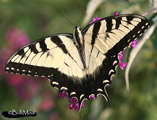 Larval Host |
Giant Swallowtail (Papilio cresphontes) 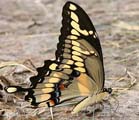 Larval Host |
Propagation
Propagation Material: SeedsDescription: Sow seeds directly outdoors after collection or store and stratify seeds. Softwood and semi-hardwood cuttings taken in mid-summer to late fall will root.
Seed Collection: Harvest samaras in late summer and early fall as soon and they turn light yellow-brown. Store in sealed, refrigerated containers. (Wings may be left on.)
Seed Treatment: Stratify 3 months at 41 degrees.
Commercially Avail: yes
Mr. Smarty Plants says
Non-toxic shade trees for horses in Florida
April 01, 2009
Looking for non poisonous shade trees for pasture with horses. Would prefer flowering or something that changes color. Thank you.
view the full question and answer
Variety of native tall plants for a screen in shady area near Ft. Worth
June 12, 2007
Hello, we live west of Ft Worth. We are looking for tall plants to form a visual screen along a chain link fence we share with a neighbor. We have post oaks there and it is very shady and the ground ...
view the full question and answer
National Wetland Indicator Status
| Region: | AGCP | AK | AW | CB | EMP | GP | HI | MW | NCNE | WMVE |
| Status: | FACU | UPL | FAC | FAC | FACU | FACU | UPL |
From the National Organizations Directory
According to the species list provided by Affiliate Organizations, this plant is on display at the following locations:Fredericksburg Nature Center - Fredericksburg, TX
Lady Bird Johnson Wildflower Center - Austin, TX
Texas Discovery Gardens - Dallas, TX
Brackenridge Field Laboratory - Austin, TX
Nueces River Authority - Uvalde, TX
NPSOT - Austin Chapter - Austin, TX
Jacob's Well Natural Area - Wimberley, TX
NPSOT - Williamson County Chapter - Georgetown, TX
Mt. Cuba Center - Hockessin, DE
Herbarium Specimen(s)
NPSOT 1134 Collected May 13, 1991 in Bexar County by Elizabeth W. HughesNPSOT 0648 Collected Jun 6, 1992 in Medina County by Harry Cliffe
NPSOT 0093 Collected April 9, 1987 in Bexar County by Harry Cliffe
Bibliography
Bibref 1186 - Field Guide to Moths of Eastern North America (2005) Covell, C.V., Jr.Bibref 1185 - Field Guide to Western Butterflies (Peterson Field Guides) (1999) Opler, P.A. and A.B. Wright
Bibref 946 - Gardening with Prairie Plants: How to Create Beautiful Native Landscapes (2002) Wasowski, Sally
Bibref 354 - Native & Naturalized Woody Plants of Austin & the Hill Country (1981) Lynch, D.
Bibref 841 - Native Alternatives to Invasive Plants (2006) Burrell, C. C.
Bibref 318 - Native Texas Plants: Landscaping Region by Region (2002) Wasowski, S. & A. Wasowski
Bibref 297 - Trees of Central Texas (1984) Vines, Robert A.
Bibref 286 - Wildflowers of the Texas Hill Country (1989) Enquist, M.
Search More Titles in Bibliography
Web Reference
Webref 57 - Atlas of Florida Plants (2020) Institute for Systematic BotanyWebref 23 - Southwest Environmental Information Network (2009) SEINet - Arizona Chapter
Additional resources
USDA: Find Ptelea trifoliata in USDA PlantsFNA: Find Ptelea trifoliata in the Flora of North America (if available)
Google: Search Google for Ptelea trifoliata
Metadata
Record Modified: 2023-05-16Research By: NPC