Native Plants

Plant Database
Search for native plants by scientific name, common name or family. If you are not sure what you are looking for, try the Combination Search or our Recommended Species lists.
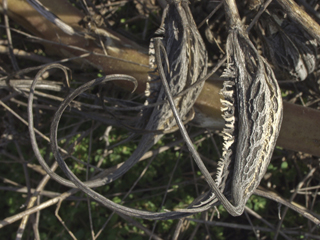
Schwartzman, Steven
Proboscidea louisianica
Proboscidea louisianica (Mill.) Thell.
Louisiana Devil's-claw, Devil's claw, Ram's-horn, Unicorn Plant, Proboscis Flower
Pedaliaceae (Sesame Family)
Synonym(s): Proboscidea louisiana
USDA Symbol: PRLO
USDA Native Status: L48 (N), CAN (I)
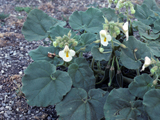
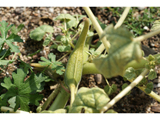
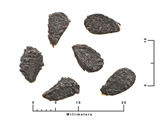
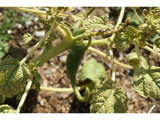
Ram’s-horn or devil’s claw is a low, spreading, bushy plant, 1-2 ft. tall, with large, long-stemmed, palmately lobed leaves. Leaves, 5-inches across and up to 1 foot long, covered with glandular nectar which often collects sand particles. Its creamy-yellow, tubular, five-lobed flowers are spotted with purple and appear in few-flowered, axillary clusters after summer rains. The fruit is a fleshy, curved pod that splits into two "claws" when it dries.
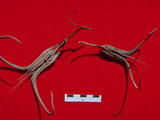
The name "unicorn plant" refers to the remarkable fruits. These are at first fleshy, the flesh later falling away, leaving an inner woody shell tipped by a long, curved beak (the horn of the unicorn). The beak splits lengthwise, and the shell opens between the two parts of the split beak. These fruits are easily caught on the legs of deer, rabbits, and cattle or hooked in the wool of sheep by their spreading claws (thus the name "devil's claw"). The fruits are collected and used in nature crafts.
Plant Characteristics
Duration: AnnualHabit: Herb
Leaf Retention: Deciduous
Fruit Type: Capsule
Size Notes: Up to about 2 feet tall.
Bloom Information
Bloom Color: White , Pink , Yellow , PurpleBloom Time: May , Jun , Jul , Aug , Sep
Distribution
USA: AL , AR , CA , CO , CT , DC , DE , FL , GA , IA , ID , IL , IN , KS , KY , LA , MA , MD , ME , MI , MN , MO , MS , NC , NE , NH , NJ , NM , NV , NY , OH , OK , OR , PA , RI , SC , SD , TN , TX , VA , VT , WA , WV , WYNative Distribution: Native to TX, Mex. & possibly LA; naturalized in the s.e. and as far n. as ME & MN
Native Habitat: River banks; meadows; waste areas
Growing Conditions
Water Use: LowLight Requirement: Sun
Soil Moisture: Dry
Soil pH: Acidic (pH<6.8)
Soil Description: Moist, sandy soils. Sandy, Sandy Loam
Benefit
Use Ornamental: The fruits are collected and used in nature crafts.Use Food: This plant is often cultivated for the fruit, which is pickled and eaten like okra.
Fragrant Flowers: yes
Interesting Foliage: yes
Nectar Source: yes
Propagation
Propagation Material: SeedsDescription: Propagate by seed.
Commercially Avail: yes
Find Seed or Plants
Order seed of this species from Native American Seed and help support the Wildflower Center.
National Wetland Indicator Status
| Region: | AGCP | AK | AW | CB | EMP | GP | HI | MW | NCNE | WMVE |
| Status: | FACU | FACU | FACU | FACU | FAC | FAC | FACU |
From the National Organizations Directory
According to the species list provided by Affiliate Organizations, this plant is on display at the following locations:Fredericksburg Nature Center - Fredericksburg, TX
Lady Bird Johnson Wildflower Center - Austin, TX
Texas Discovery Gardens - Dallas, TX
Wildflower Center Seed Bank
LBJWC-1175 Collected 2008-07-03 in Hays County by Lady Bird Johnson Wildflower CenterBibliography
Bibref 765 - McMillen's Texas Gardening: Wildflowers (1998) Howard, D.Bibref 248 - Texas Wildflowers: A Field Guide (1984) Loughmiller, C. & L. Loughmiller
Bibref 328 - Wildflowers of Texas (2003) Ajilvsgi, Geyata.
Bibref 286 - Wildflowers of the Texas Hill Country (1989) Enquist, M.
Search More Titles in Bibliography
Web Reference
Webref 23 - Southwest Environmental Information Network (2009) SEINet - Arizona ChapterAdditional resources
USDA: Find Proboscidea louisianica in USDA PlantsFNA: Find Proboscidea louisianica in the Flora of North America (if available)
Google: Search Google for Proboscidea louisianica
Metadata
Record Modified: 2022-12-07Research By: NPIS, ADA