Native Plants

Plant Database
Search for native plants by scientific name, common name or family. If you are not sure what you are looking for, try the Combination Search or our Recommended Species lists.
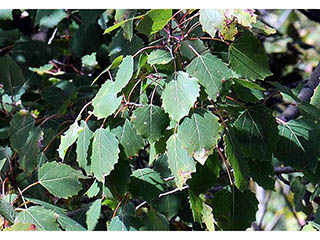
Reveal, James L.
Populus grandidentata
Populus grandidentata Michx.
Bigtooth Aspen, Big-tooth Aspen, Long-toothed Aspen
Salicaceae (Willow Family)
Synonym(s): Populus grandidentata var. angustata, Populus grandidentata var. meridionalis, Populus grandidentata var. subcordata
USDA Symbol: POGR4
USDA Native Status: L48 (N), CAN (N)
Big-tooth Aspen is a columnar tree, usually 50-75 ft. tall. Toothed leaves are cottony-white on the lower surface, especially when the tree is young. The slender trunk’s whitish bark, becomes furrowed at base and darker gray with age. Silvery catkins appear before leaves. Deciduous foliage becomes golden-yellow in fall.
Easily distinguishable from Quaking Aspen (Populus tremuloides) by the large curved teeth of leaf edges, mentioned in both common and scientific names. Like that species, Bigtooth Aspen is a pioneer tree after fires and logging and on abandoned fields, short-lived and replaced by conifers. The foliage, twig buds, and bark are consumed by wildlife.

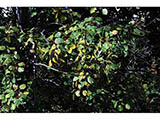
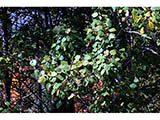

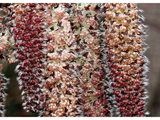
Plant Characteristics
Duration: PerennialHabit: Tree
Leaf Retention: Deciduous
Leaf Arrangement: Alternate
Leaf Complexity: Simple
Fruit Type: Capsule
Size Notes: Can be up to about 110 feet tall. Often much shorter.
Leaf: Green
Autumn Foliage: yes
Fruit: Green
Bloom Information
Bloom Color: Yellow , Green , BrownBloom Time: Mar , Apr , May
Distribution
USA: CT , DC , DE , IA , IL , IN , KY , MA , MD , ME , MI , MN , MO , NC , ND , NH , NJ , NY , OH , PA , RI , TN , VA , VT , WI , WVCanada: BC , MB , NB , NS , ON , PE , QC
Native Distribution: N.S. to s.w. Ont. & s.e. Man., s. to w. NC, TN & extreme n.e. MO
Native Habitat: Mesic, mixed woods
Growing Conditions
Water Use: HighLight Requirement: Sun
Soil Moisture: Moist
Soil pH: Acidic (pH<6.8)
CaCO3 Tolerance: Medium
Soil Description: Mesic, rich soils.
Conditions Comments: This fast-growing tree is very intolerant of shade and flooding. It invades cleared areas and reproduces rapidly from seed and root suckers. It is short-lived and plagued by disease and insect problems, but is practically indifferent to soil conditions. In any soil, weeding around the tree can boost its growth surprisingly. Aspen can be grown in a clump by periodically removing the older, damaged stems, allowing new sprouts to fill in.
Benefit
Use Wildlife: Aspens are host to a wide array of birds, mammals, and butterflies.Use Other: Large-toothed aspen is important for revegetating recently cut or burned land, holding soil in place and protecting other slower-growing species of plants. (Kershaw)
Attracts: Butterflies
Larval Host: Eastern Tiger Swallowtail, Viceroy
Butterflies and Moths of North America (BAMONA)
|
Eastern Tiger Swallowtail (Papilio glaucus)  Larval Host |
Viceroy (Limenitis archippus)  Larval Host |
Propagation
Description: Fresh seed germinates readily when placed on a saturated seed bed. Aspens, however, are best established from root cuttings set directly into their permanent locations. Trees can also be started from small sprouts lifted in the dormant season from distuCommercially Avail: yes
Find Seed or Plants
View propagation protocol from Native Plants Network.
National Wetland Indicator Status
| Region: | AGCP | AK | AW | CB | EMP | GP | HI | MW | NCNE | WMVE |
| Status: | FACU | FACU | FACU | FACU | FACU |
Bibliography
Bibref 1186 - Field Guide to Moths of Eastern North America (2005) Covell, C.V., Jr.Bibref 1185 - Field Guide to Western Butterflies (Peterson Field Guides) (1999) Opler, P.A. and A.B. Wright
Bibref 841 - Native Alternatives to Invasive Plants (2006) Burrell, C. C.
Search More Titles in Bibliography
Web Reference
Webref 3 - Flora of North America (2014) Missouri Botanical Garden, St. Louis, MO & Harvard University Herbaria, Cambridge, MA.Webref 23 - Southwest Environmental Information Network (2009) SEINet - Arizona Chapter
Additional resources
USDA: Find Populus grandidentata in USDA PlantsFNA: Find Populus grandidentata in the Flora of North America (if available)
Google: Search Google for Populus grandidentata
Metadata
Record Modified: 2023-05-16Research By: TWC Staff